
Flag football is played without tackling and without blocking: no helmet, no shoulder pads, and a kit list that fits in six lines. The international IFAF rulebook, the one used for the 5-on-5 format chosen for the Los Angeles 2028 Olympic Games, is still very precise about the jersey, the shorts and the belt. Here is what to bring to your first session, and what would keep you off the field.
Contents · 10 parts
The 2-minute summary
- Two specific items: a flag belt and a ball in the right size; everything else is ordinary sportswear.
- The jersey is tucked into the shorts: it carries a number at least 15 cm high on the back, and the shorts have no pockets, press studs or clips.
- The flags: two per player, one on each hip, in a colour that contrasts with the shorts, never greased or glued.
- The ball: regular size for men's and mixed games, youth for women's games and under-16s, junior for under-13s.
- The mouthguard: strongly recommended by IFAF, in a visible colour other than white.
- Banned: helmets, shoulder pads, headwear, jewellery, towels and studs longer than 1.25 cm.
The starter list
Flag football needs very little kit, which is part of why it has spread so fast. At a club, the belts and the balls usually belong to the team: each player turns up with their own clothing, shoes and mouthguard. For a kickabout, one belt per player and a single ball are enough to get two teams going, as our flag football gear pages show.
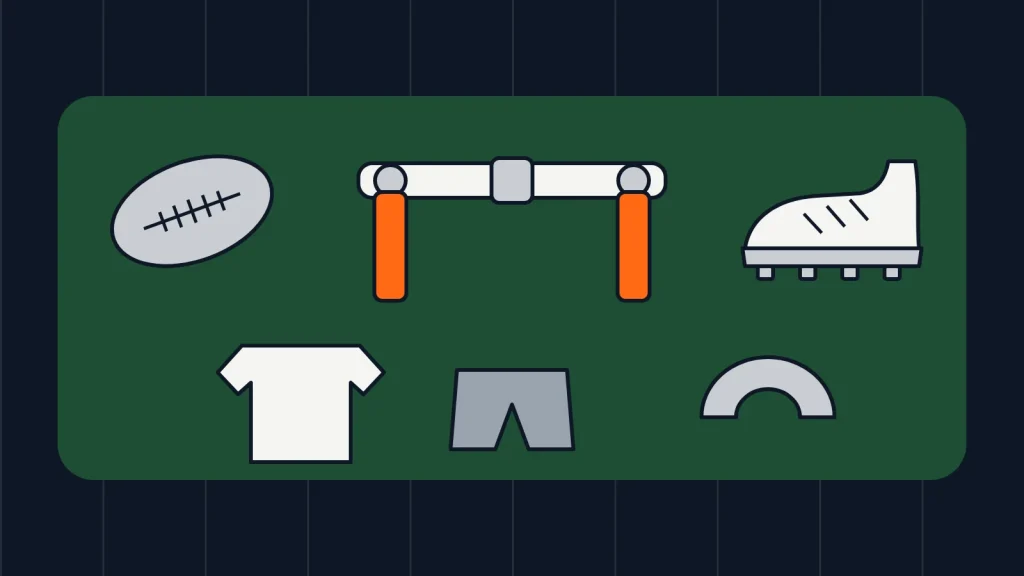
One player's full list comes down to six items:
- a flag belt fitted with two identical flags;
- a ball in the size set for the category;
- a jersey long enough to be tucked into the shorts, numbered on the back;
- shorts or trousers without pockets;
- shoes suited to the surface;
- a mouthguard, strongly recommended.
The flag belt, the only truly specific item
This is the piece that replaces the tackle: a defender pulls one of the two flags off the ball carrier to end the play. IFAF requires a tightly fixed belt with pop sockets carrying two identical flags, one on each side of the waist, the sockets facing outwards and downwards. The flags must be clearly visible, hang down freely, and all their colours must contrast with the colour of the shorts. Neither flags nor sockets may be greased, glued or altered in any way: a player who deliberately manipulates their flags is disqualified.
The rulebook even sets the dimensions: a flag is 38.1 to 40.6 cm long measured from the socket, 4.6 to 5.1 cm wide, weighs at least 11 g and withstands a pull of at least 300 newtons. The socket itself comes off under no more than 100 newtons in senior games and no more than 50 newtons in every other category. Velcro fixings are still allowed, provided the flags meet the same specifications and the fixing releases under 50 newtons. The Wilson NFL Flag Belts 12-Pack, for instance, holds twelve pop-socket belts, six red and six yellow, which covers two full teams. Barnett's Flag Kit 10 Drapeaux et Ceintures avec 6 Cônes bundles 10 nylon D-ring belts (5 red, 5 blue) with 6 cones and a carry bag, and its Flag Pop Deluxe, Drapeaux et Ceintures par 10 offers 10 adjustable belts with pop-release flags in 4 colours.
Jersey and shorts: the two rules beginners miss
The jersey has to be long enough to be tucked into the shorts, and it must never cover the flags. That is the rule newcomers discover on tournament day in a loose t-shirt: a flag hidden under the hem can no longer be pulled, and the officials penalise it. The jersey carries a whole number from 0 to 99 on the back, at least 15 cm high and in a contrasting colour, different for every player in the team; it may not be taped or tied.
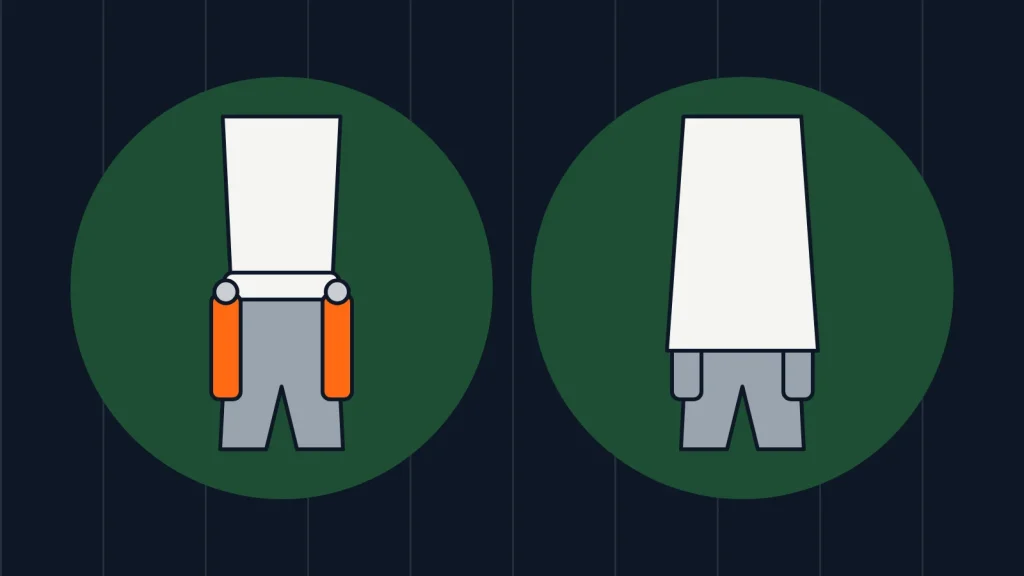
The shorts are a single colour, without pockets, press studs or clips, and of the same cut across the team; only branding, a logo or a number of 10 × 10 cm at most is allowed on the front of each leg. Skirts are illegal, and taping shorts to meet the regulations is not permitted either. Running shorts with zipped pockets are therefore out: look at our football apparel pages instead.
The ball: the right size for the category
IFAF sets three ball sizes and assigns them by category. A match ball is made of four panels of pebble-grained leather in natural tan, with eight equally spaced lacings, inflated to between 0.85 and 0.95 bar. Each team may use its own ball.
| Game | Size | Length | Weight |
|---|---|---|---|
| Men's or mixed | Regular | 27.9 to 29.2 cm | 400 to 425 g |
| Women's | Youth | 26.7 to 27.9 cm | 340 to 370 g |
| Under-16 | Youth, leather not required | 26.7 to 27.9 cm | 340 to 370 g |
| Under-13 | Junior, leather not required | 26.0 to 27.3 cm | 310 to 340 g |
In practice a senior squad needs an official leather ball such as the Wilson The Duke, while youth teams need a Youth or Junior ball such as the Wilson GST Youth. The Wilson NFL Flag Football, in composite leather and Youth size, fits the categories where leather is not required. Every measurement is set out in our ball size guide, and the full range in our American footballs pages.
Shoes: moulded and short
The rulebook only deals with shoes through what it bans: studs longer than 1.25 cm, sharpened or pointed in any way, or made of any metallic material are illegal. A pair of moulded cleats with short studs therefore qualifies, as do turf or indoor shoes depending on the surface. Measure your studs before a tournament: this is the most common reason players are turned away.
Detachable-stud football cleats are to be left at home for flag; our cleat guide covers collar heights position by position.
Mouthguard and gloves: advised, not required
IFAF does not make the mouthguard mandatory but "strongly recommends" it, and many national federations do require one, so check the rules of your competition. If worn, it must be a visible colour other than white and must not extend more than 1.25 cm out of the mouth. A boil-and-bite model such as the Shock Doctor Gel Max or the Makura Tephra Max Convertible does the job; the rest of the range sits in our mouthguards pages and in our mouthguard guide.
Gloves are not mentioned by the rulebook at all, so they are allowed, and plenty of receivers wear them in cold or wet weather. There is one limit: no adhesive, paint, grease or slippery substance may be applied to equipment or to a player. The models in our football gloves pages suit flag, and our glove guide explains how to measure your hand.
What to leave in the changing room
The list of illegal equipment is short and absolute:
- football helmets, football shoulder pads and any head wear (caps, hoods, bandannas, headbands);
- protectors that endanger opponents, such as a sharp-edged knee brace;
- glasses and frames made of breakable material, certified synthetic sport glasses excepted;
- towels or hand warmers attached to the uniform;
- electronic devices used to communicate with a coach;
- jewellery, which must be removed or completely covered up.
Before kick-off, each team hands a roster to the referee and certifies that all its players have the mandatory equipment and have been told what counts as illegal. The game itself is covered in our guide to the flag football rules, and each player's role in our guide to flag football positions.
FAQ
Do you need a helmet to play flag football?
No, it is actually banned, along with shoulder pads and head wear: the game is non-contact.
Is a mouthguard mandatory?
Not under IFAF rules, which strongly recommend one, but national federations may require it. If worn, it must be a visible colour other than white and must not stick out more than 1.25 cm from the mouth.
Can I play in running shorts?
Only if they have no pockets, press studs or clips, and match the rest of the team in a single colour. Taping or tying shorts to meet the regulations is not allowed.
How many players do you have to kit out?
A team puts 5 players on the field and may list 15 in all, 5 starters and 10 substitutes, each with a belt and two flags.
Sources
- IFAF, International Flag Football Rules 2023, rule 1, sections 1 to 3: https://www.americanfootball.sport/wp-content/uploads/2023/05/FlagRules2023.pdf
- Wilson, official NFL Flag Belts 12-Pack product page: https://nz.wilson.com/products/nfl-flag-belts-12-pack
- Wilson, official NFL Flag Football product page: https://nz.wilson.com/products/nfl-flag-football