Gloves are the piece of kit most players replace most often, and the one with the widest gap between marketing and fact. Three things actually decide the purchase: what the rulebook allows, what the palm is made of, and whether your hand matches the maker's size chart. Everything below comes from rulebooks and manufacturer pages, with the sources listed at the end.
Contents · 11 parts
- The 2-minute summary
- Gloves in the rulebook: optional, not unregulated
- The SFIA seal: what it actually certifies
- Receiver gloves: the palm does the work
- Lineman gloves: padding before tack
- Hybrid gloves, for the middle of the field
- Getting the size right
- Keeping the grip alive
- The six pairs compared
- FAQ
- Sources
The 2-minute summary
- Optional, but regulated: the IFAF rulebook files gloves under optional equipment and asks for a securely attached SFIA or NOCSAE label.
- Sticky sprays are illegal: adhesive material, grease or any other slippery substance on equipment or on a player is listed as illegal equipment.
- Receivers want a tacky palm, a thin back of hand and a snug wrist: Cutters Rev Pro 7.0, Nike Vapor Jet 9.0, Grip Boost Stealth 6.0.
- Linemen want padding on the back of the hand and a reinforced palm patch: Cutters Force 6.0.
- Sizing is driven by hand length, measured from the base of the palm to the tip of the middle finger, at both Cutters and Nike.
- Care differs: Cutters list their Rev Pro 7.0 as machine washable, while Nike ask for spot cleaning only.
AFG has not run any field test on these gloves. What follows is the published data, compared.
 Play the video: Football Gloves Explained: Fit, Grip and the Rules
Gloves in the rulebook: optional, not unregulated
Under IFAF rules, football gloves are not part of the mandatory kit. Rule 1-4-3 lists only the helmet, hip pads, jersey, knee pads, mouthpiece, pants, shoulder pads, socks and thigh guards, which is why football helmets and football shoulder pads come before gloves in an equipment budget.
Gloves then appear in Rule 1-4-6, among optional equipment, with a definition worth reading before you buy anything unusual: "A glove is a fitted covering for a hand having separate sections for each finger and thumb, without any additional material that connects any of the fingers and/or thumb." Colour is free.
The same article adds the labelling clause: "Gloves should have a securely attached label or stamp ('NF/NCAA Specifications') indicating voluntary compliance with appropriate test specifications on file with either the Sports and Fitness Industry Association (SFIA) or the National Operating Committee on Standards for Athletic Equipment (NOCSAE), unless made of unaltered plain cloth." Note the wording: should, and voluntary compliance. It is not drafted as an absolute ban, and plain cloth gloves are explicitly exempt.
One rule is far stricter, and it is the one that catches players out. Rule 1-4-7 lists as illegal equipment any "adhesive material, paint, grease or any other slippery substance applied to equipment or on a player's person, clothing or attachment", with eye shade as the only exception. Grip sprays and tacky gels belong in the bin bag, not in the kit bag. What the rulebook does allow, in the same optional-equipment article, is a small towel to dry your hands and hand warmers in bad weather.
The SFIA seal: what it actually certifies
The SFIA football glove specification programme exists so that a glove does not hand a player an unfair advantage in controlling the ball. SFIA states that its programme meets the requirements of the NFHS, the NCAA and Pop Warner, that certified products carry the full certification mark on the glove itself and on the packaging, and that testing is carried out independently by Exponent, an ISO 9001 certified firm. A separate arm-covering standard takes effect for the 2027/28 season, with brands able to submit products from 1 August 2025.
In our catalogue, the picture is uneven. Cutters state that the Rev Pro 7.0 "meets SFIA specification for NFHS/NCAA play". Grip Boost claim compliance with SFIA standards and with NFHS, NOCSAE and NCAA requirements for the Stealth 6.0 and the Raptor 2.0. Nike make no such claim on the Vapor Jet 9.0 page, and Cutters do not mention it on the Force 6.0 page either. If your league checks seals, check the wrist of the glove in front of you rather than the brand's reputation.
Receiver gloves: the palm does the work
Receiver gloves are built around a one-piece tacky palm, a thin back of hand and a wrist closure tight enough to stop the glove rolling on the catch.
The Cutters Rev Pro 7.0 uses a perforated Air C-TACK palm, so the grip surface breathes, with reinforced fingertips against twisting, slimmed-down fingers and a neoprene wrist strap. The Nike Vapor Jet 9.0 takes a different route: a Magnigrip+ palm whose material breakdown Nike publish in full, 75% polyester, 20% silicone and 5% elastane, plus silicone reinforcements that keep the fingers aligned and a repositioned pull tab for wrist mobility. The Grip Boost Stealth 6.0 runs a silicone palm whose tack comes from a chitosan formula, a biopolymer taken from crab shells, with a compression-fit back and a Pinky Grip Wrap on the little finger. The Barnett FRG-03 rounds out the list with a B-TACK grip palm (50% polyurethane, 50% nylon), which Barnett markets for receivers, defensive backs and running backs, in 5 adult sizes from S to 2XL. The Battle Doom Storm adds padded back-of-hand protection on top of its SuperStick™ palm, in adult and youth sizes, for players who want more protection than a traditional receiver glove. The Barnett FRG-03 Junior scales down the same profile for young receivers, with a palm of the same make-up (50% polyurethane, 50% nylon) and a leather and spandex back, in 3 sizes from S to L. The Under Armour Blur Receiver pairs a UA GlueGrip silicone palm with a TurfGear back of hand, in five sizes from S to 2XL. The Battle Gauntlet Pro Receiver combines two palm technologies, OctoGrip™ and SuperStick, with rubber ScaleGuard tips for impact absorption, in six adult sizes from S to 3XL. The Battle Doom Speed Receiver runs a SuperStick palm alone with a PrecisionFit back of hand, which Battle Sports markets as the most tacky material in the industry; the brand also targets it at running backs, tight ends, linebackers and defensive backs, in six sizes from S to 3XL. The Battle Doom 1.0 Receiver is the base version of the same line, with a single Ultra-Stick palm and a PerfectFit back of hand, in five adult sizes from S to 2XL and four youth sizes from S to XL.
Lineman gloves: padding before tack
Linemen need their hands protected on contact and their palm to hold a jersey, not a ball. Lineman gloves are therefore padded on the back of the hand and reinforced on the palm.
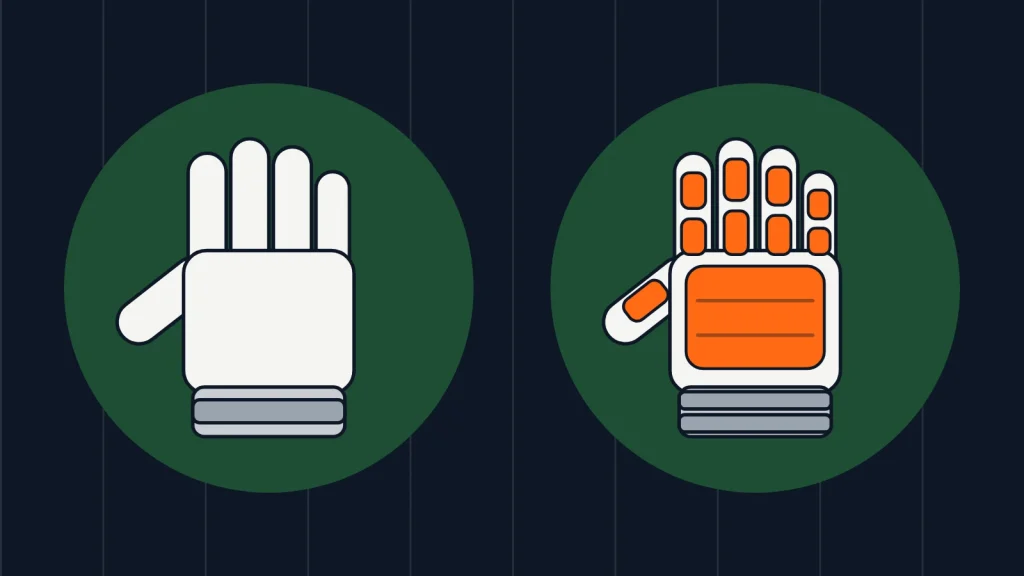
The Cutters Force 6.0 is one of the pairs in our catalogue built this way: padded C-TACK palm patch on a synthetic fabric palm, padded back of hand with flex points so the fingers still close, and a double neoprene wrist strap wrapping the joint. It starts at size M rather than S, which tells you who it is aimed at. Cutters describe their lineman range as suitable for 7v7, youth, high school and collegiate play.
The Barnett FLG-03 follows the same approach: a cabretta leather and pittards palm, a padded spandex-and-nylon backhand, in 5 sizes from S (18 cm) to 2XL (21 cm), aimed at the offensive and defensive line. The Battle Menace adds an ArmorFlex padding system over the knuckles and a GripTack™ palm, in six adult sizes from S to 3XL, with no youth version. The adidas Adizero Chaos Lineman rounds out the list with a seamless GripTack palm and TPU zones that protect without reducing dexterity, in six sizes from S to 3XL, for the offensive and defensive line. The Grip Boost Big Skill 2.0 goes for real leather instead: a leather palm stitched with Kevlar thread, thermoformed EVA foam across the back of the hand and a one-piece cuff with built-in wrist padding, worn with or without a strap, in seven sizes from S to 4XL. It is also the only lineman glove in our catalogue whose maker claims both the SFIA specification and the NFHS, NOCSAE and NCAA requirements. For the rest of the lineman's kit, see our guide to lineman football gear.
Hybrid gloves, for the middle of the field
Between the two sits the padded all-rounder. The Grip Boost Raptor 2.0 pairs the brand's Boost+ palm with impact padding on the back of the hand, and Grip Boost name running backs, tight ends, linebackers and defensive linemen as the intended wearers. It is the obvious answer when the same player catches the ball on one series and takes on blocks the next. The Barnett FKG-03 targets the same all-rounder profile, with a cabretta and Pittards leather palm and a spandex and nylon back, for linebacker, running back and tight end, in 5 sizes from S to 2XL.
Getting the size right
Both Cutters and Nike size by hand length, measured from the base of the palm to the tip of the middle finger. Nike also publish a hand circumference at the knuckles, which is useful when your measurements fall between two sizes.

| Size | Cutters hand length | Nike hand circumference |
|---|---|---|
| S | 17.8 to 18.4 cm | 19.7 to 21 cm |
| M | 18.4 to 19 cm | 21 to 21.6 cm |
| L | 19 to 19.7 cm | 21.6 to 22.2 cm |
| XL | 19.7 to 20.3 cm | 22.2 to 22.9 cm |
| 2XL | 20.3 to 21 cm | 22.9 to 24.1 cm |
| 3XL | 21 to 21.6 cm | 24.1 to 24.8 cm |
Two gaps are worth knowing about. Grip Boost publish their size chart as an image only, so the figures cannot be read reliably and merchant tables are your fallback. And none of the four makers publish a weight for these gloves, so any "lightest glove" claim you read elsewhere is not coming from the manufacturer. Our dedicated guide on football glove sizing walks through the measuring method step by step, with the Nike charts converted to centimetres.
Keeping the grip alive
Tack is a consumable. Cutters build their palms around a self-restoring grip: wipe the Rev Pro 7.0 with a damp cloth and the surface comes back, and the same REV-TACK Recharge principle applies to the Force 6.0. The Rev Pro 7.0 is also listed as machine washable and dryable, which is rare enough to note. Nike take the opposite line and ask for spot cleaning only on the Vapor Jet 9.0. Grip Boost sell a gel for their palms: a dime-sized drop spread over the palms, left to dry for 15 to 20 seconds. For the rest of the kit bag, our guide on how to clean football gear covers jerseys, pads and helmets too.
The six pairs compared
| Model | Type | Sizes | Compliance stated by the maker | From |
|---|---|---|---|---|
| Cutters Rev Pro 7.0 | Receiver | S to 3XL | SFIA, for NFHS/NCAA play | 69.95 € |
| Nike Vapor Jet 9.0 | Receiver | S to 3XL | Not mentioned | 65.90 € |
| Grip Boost Stealth 6.0 | Receiver | S to 3XL | SFIA, NFHS, NOCSAE, NCAA | 54.95 € |
| Grip Boost Raptor 2.0 | Padded hybrid | S to 3XL | SFIA, NFHS, NOCSAE, NCAA | 59.95 € |
| Cutters Force 6.0 | Lineman | M to 3XL | Not mentioned | 79.90 € |
| Barnett FLG-03 | Lineman | S to 2XL | Not mentioned | 35.00 € |
Prices recorded at European merchants on 27 September 2026, lowest figure seen, in or out of stock.
FAQ
Are football gloves compulsory?
No. The IFAF rulebook lists them under optional equipment, alongside towels and hand warmers. The helmet, mouthpiece, shoulder pads, hip pads, knee pads and thigh guards are the mandatory items.
Can I use grip spray on my gloves?
Not during a game played under IFAF rules. Adhesive material, grease and other slippery substances applied to equipment or to the player are listed as illegal equipment, with eye shade as the only exception.
What does the seal on the wrist mean?
It is the glove maker's declaration that the model complies with the SFIA specification or the NOCSAE test standard. SFIA has products tested independently by Exponent and requires the mark on both the glove and the packaging.
Should a receiver pick a padded glove?
Only if the role calls for it. Padding sits on the back of the hand and adds bulk; a pure receiver pattern keeps that back thin. A player who blocks as often as they catch is the target for a hybrid such as the Raptor 2.0.
Sources
- IFAF, Football Rules and Interpretations 2025, Rule 1-4-3, 1-4-6 and 1-4-7: https://amerikanskeidretter.no/wp-content/uploads/2025/02/IFAF-Rules-and-Interpretations-2025.2.1.pdf
- SFIA, Football Glove Specification Program: https://sfia.org/committees/football-glove-specification-program/
- Cutters, Rev Pro 7.0 Solid Receiver Gloves: https://cutterssports.com/products/rev-pro-7-solid-receiver-gloves-black
- Cutters, Force 6.0 Lineman Gloves: https://cutterssports.com/products/force-6-lineman-gloves-black
- Nike, Vapor Jet 9.0 Football Gloves: https://www.nike.com/t/vapor-jet-9-football-gloves-1-pair-NjwHvI9H
- Nike, American football gloves size and fit guide: https://www.nike.com/size-fit/american-football-gloves
- Grip Boost, Stealth 6.0 Boost Plus Football Gloves: https://www.gripboost.com/products/grip-boost-solid-black-stealth-6-0-boost-plus-football-gloves
- Grip Boost, Raptor 2.0 Padded Football Gloves: https://www.gripboost.com/products/grip-boost-raptor-2-0-black-padded-mens-football-gloves-with-boost-plus-grip-technology
- Grip Boost, Big Skill 2.0 Lineman Football Gloves: https://www.gripboost.com/products/big-skill-2-0-lineman-football-gloves-black