
Five players a side, no linemen and no kicking game: the jobs on a flag pitch look nothing like the eleven of the tackle game. The IFAF rulebook barely uses the word position, and the handful of roles it does define come with precise limits on who may carry, throw or chase the ball.
Contents · 9 parts
The 2-minute summary
- Six designations, not eleven positions: the offence is snapper, runner and receiver, the defence blitzer, rusher and defender.
- The quarterback is a definition: whoever first gets possession after the snap, who is also the first runner and has 7 seconds to pass or hand off.
- No running past the line: the quarterback may not carry the ball beyond the scrimmage line unless another player has had sole possession of it first.
- Seven yards to blitz: only a defender set up more than 7 yards back, hand raised, may charge the passer, and two per play at most.
- Everybody can catch: no minimum number of players on the line and no ineligible receiver, though the snapper may not take a forward hand-off.
- Five on, ten off: an international roster is 15 players, and substitutes come on whenever the ball is dead.
What the rulebook actually calls a position
The International Flag Football Rules 2023 contain no depth chart. Rule 2, Section 2, Article 1 states it flatly: "A player of the offensive team is either a snapper, a runner or a receiver. A player of the defensive team is either a blitzer, rusher or defender." That is the whole list for flag football at 5 on 5, and the labels move from down to down with the ball. The quarterback is "the offensive player who first gets possession of the ball after the snap", who is "also the first runner"; a passer is "a runner who throws a legal pass".
The offence: snapper, runners and receivers
The snapper puts the ball in play, backwards, in one quick and continuous motion of the hand or hands — but it "need not be between the snapper's legs" (R 7-1-2). There is also "no minimum number of players on the scrimmage line at the snap" (R 7-1-3), so the five of you may line up as you please.

Once the ball is live, the restrictions bite on the quarterback. They have 7 seconds to pass or hand off (R 7-1-3 g); exceed it and the ball is dead at the line, loss of down. They may not run beyond that line unless the ball has been solely possessed by another player and returned to them, or touched in flight by a defender (R 7-1-3 e). Behind the line it may change hands as often as you like, as long as both players stay behind it and possession has not changed (R 7-1-5) — the one exception being that no snapper may take a forward hand-off. Only one forward pass per down is allowed, thrown from behind the line (R 7-3-1).
Catching, on the other hand, is open to all. No rule makes a player ineligible by where they line up, and on a pass in the air "eligible players of either team have equal rights to the ball" (R 7-3-3). Only the passer is barred, until a defender has touched it (R 7-2-5 a).
The defence: blitzers, rushers and defenders
The 7-yard figure everybody quotes comes from the defensive roles. A blitzer (R 2-2-6) is a defender who at the snap has every part of their body more than 7 yards from the scrimmage line, and who announces themselves "by raising one hand clearly above the head at least during the last second prior to the snap". That signal buys right of way over the offence, provided the rush starts immediately and runs "quick and straight towards the point where the quarterback receives the snap". Drift or dawdle and the player keeps playing, but loses the privilege. Two blitzers per down is the maximum (R 7-1-4 d).
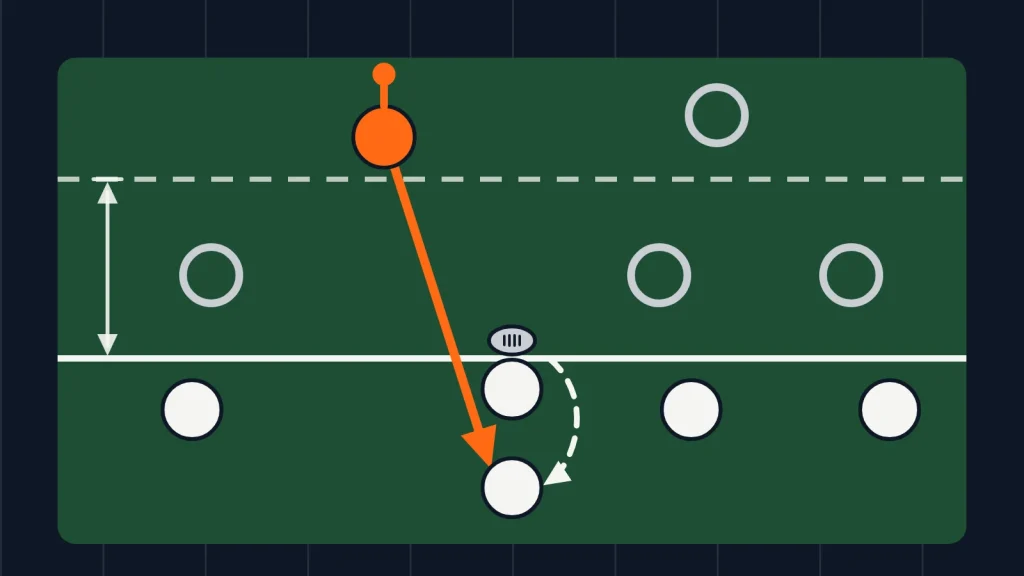
A rusher is the quiet version: "a defender who does not give a signal and legally crosses the scrimmage line". Anyone set up beyond 7 yards may cross as often as they like until the ball is dead (R 7-1-4 e). The remaining defenders must stay behind their line until the quarterback has handed off, faked a hand-off or passed (R 7-1-4 f).
Their shared job is the flag pull, and "the defender has the right to move towards the runner and attack the flags" (R 2-12-1). Pulling the flag of anyone other than the runner, a player simulating being the runner, or a player who has touched the ball in flight costs 5 yards (R 9-2-2 d). A flag pulled from the quarterback behind the line is a sack (R 2-10-4).
Nobody owns a position all game
Rule 1 fixes the numbers: two teams of no more than five, from an international roster of at most 15. Playing short is allowed, missing more than one player forfeits the game, and a sixth player on the field costs 5 yards (R 9-2-2 f). Substitutes come on freely once the ball is dead, the offence until the snapper touches the ball and the defence until the snap (R 9-3-1) — so whoever snaps on first down can be the deep receiver on second.
Where the rulebooks disagree
| IFAF 5 on 5 | NFL FLAG (US youth) | AFVD (Germany) | |
|---|---|---|---|
| Names used | snapper, runner, receiver / blitzer, rusher, defender | center, quarterback, wide receiver, running back / rusher, safety, defensive back | identical to IFAF, in German |
| Quarterback carrying the ball | not beyond the scrimmage line | "aren't allowed to run with the ball after the snap" | identical to IFAF |
| Rushing | more than 7 yards, hand raised, 2 at most | 7-yard rush line, hand raised until the snap, 2 at most | identical to IFAF |
The AFVD rulebook of 2026 calls itself "essentially a translation of the IFAF Flag Football Rules", so the roles cross over unchanged. Two German details count: a mouthguard is compulsory there, and the 15-player roster and single-gender squad are written as rules for international games.
NFL FLAG keeps the tackle vocabulary and bars the quarterback from running at all. Its pages disagree on the rush distance — the positions page says seven feet, the main rules page a 7-yard rush line — so we quote only the figure that matches IFAF. Formats shift the numbers too: Flag 7 on 7 fields seven from rosters of twenty, Beach Flag 4 on 4 allows five seconds to throw and cuts the blitz distance to 5 yards.
What this means for your kit
No rule gives one role different equipment from another. Everyone wears a tightly fixed belt with pop-sockets and two contrasting flags, one on each hip (R 1-3-1 c) — hence the dozen-packs clubs buy, like the Wilson NFL Flag Belts or the Barnett flag kit. Football helmets, head wear and football shoulder pads are illegal, and cleats may not exceed 1.25 cm (R 1-3-3), which makes moulded cleats the sensible buy; our guide to flag football cleats has the detail.
Ball size changes by category, not by role: regular for men's and mixed games, youth size for women's games and under-16s, junior below that (R 1-2-2), the family the Wilson NFL Flag ball belongs to. Since everyone is a receiver at some point, receiver gloves such as the Nike Vapor Jet 9 suit every role, and a mouthguard like the Shock Doctor Gel Max is strongly recommended by IFAF, required in Germany. See also our flag football rules guide and what you need to play flag football.
FAQ
Can the quarterback run in flag football?
Under IFAF rules they may move with the ball behind the scrimmage line but not carry it beyond, unless another player has had sole possession and given it back, or a defender has touched it in flight. NFL FLAG bars the run entirely after the snap.
How far back does a rusher have to start?
More than 7 yards from the scrimmage line, with every part of the body, at the snap. One hand raised clearly above the head in the last second before the snap establishes a blitzer with right of way; two players at most per down.
Can the centre catch a pass?
The IFAF rulebook has no ineligible receiver and no minimum number of players on the line; its only restriction on the snapper is the forward hand-off. NFL FLAG says it outright: the center snaps the ball, then can run for a pass as a receiver.
How many players does a flag football team have?
Five on the field, from a roster of up to 15 in international play. Flag 7 on 7 fields seven from twenty, Beach Flag 4 on 4 fields four from ten.
Sources
- IFAF, International Flag Football Rules 2023, 5 on 5 / non-contact: https://www.americanfootball.sport/wp-content/uploads/2023/05/FlagRules2023.pdf
- AFVD, AFVD Flag Football Regeln 2026: https://afvd.de/wp-content/uploads/2026/01/AFVD_Flag_Football_Regeln_2026.pdf
- NFL FLAG, Flag Football Positions: https://nflflag.com/coaches/default/flag-football-rules/football-positions
- NFL FLAG, Flag Football Rules: https://nflflag.com/coaches/default/flag-football-rules