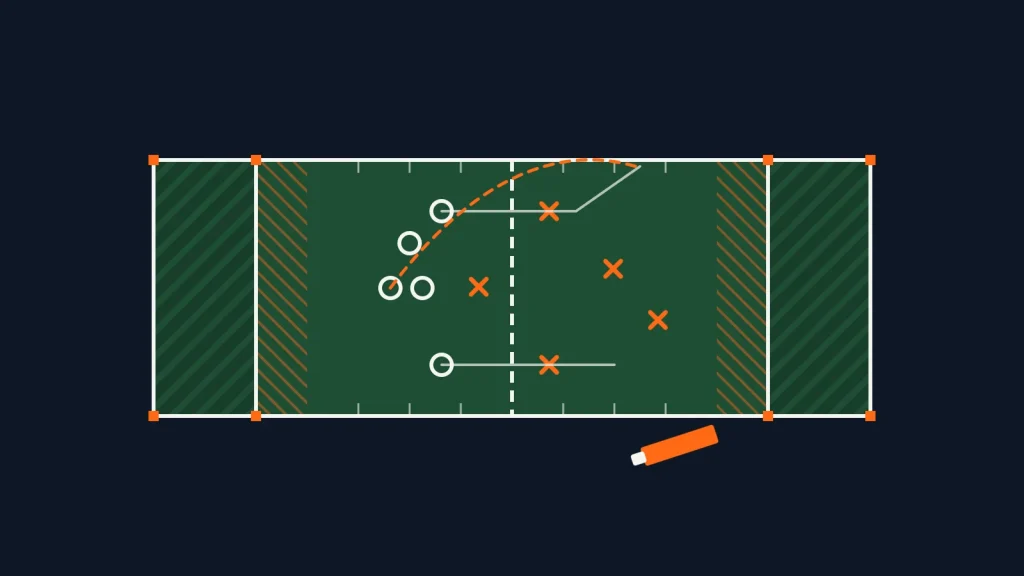
Flag football is American football without tackles, blocks or kicks: a defender stops the ball carrier by pulling one of the flags from their belt. This guide summarises the official IFAF rules for the 5-on-5 format, the one played at international championships and chosen for the Los Angeles 2028 Olympic Games. Every figure below comes from the IFAF International Flag Football Rules 2023, in force since 1 May 2023 and the latest edition published by IFAF.
Contents · 13 parts
The 2-minute summary
- The principle: 5 against 5, with no tackling, no blocking and no kicking; you stop the ball carrier by pulling one of the two flags off their belt.
- Field and time (IFAF 2023 rules): 50 × 25 yards with 10-yard end zones, two 20-minute halves.
- Downs: the offence starts on its own 5-yard line and has 4 downs to cross midfield, then 4 more to score; inside the 5 yards before each goal line, only passing plays are allowed.
- The quarterback: 7 seconds to throw or hand off, and only one forward pass per down.
- Scoring: a touchdown is worth 6 points, followed by a 1- or 2-point conversion.
- Gear: the flag belt is compulsory, a mouthguard is strongly recommended and cleats are limited to 1.25 cm. The sport makes its Olympic debut in Los Angeles in 2028.
 Play the video: Flag football rules for beginners: field, downs, scoring & kit
The 5-on-5 format
Two teams of 5 players face each other, with rosters capped at 15 players (5 on the field, 10 substitutes). Teams are single-gender, although national federations may allow mixed teams. The game is non-contact: blocking, tackling and kicking are not allowed. There is no kicking game (no kick-off, punt or field goal), and no football helmets or football shoulder pads.
The rulebook also covers Flag 7 on 7 (30-yard-wide field) and Beach Flag 4 on 4.
The field
| Element | Official dimension |
|---|---|
| Field of play | 50 yd × 25 yd (45.75 m × 22.90 m) |
| End zones | 10 yd (9.15 m) at each end |
| No-running zones | 5 yd in front of each goal line |
| Safety area | 3 yd (2.75 m) around the field |
| Total space required | 76 yd × 31 yd (69.55 m × 28.40 m) |
A middle line splits the field in two: it is the line to gain for a first down. Organisers may enlarge or shrink each half by up to 5 yards to suit the venue or the players' age (from 40 × 20 yd to 60 × 30 yd), but the safety area cannot be reduced.
Game time
- 40 minutes of play: two 20-minute halves with a 2-minute break.
- The clock only stops for timeouts, injuries or at the referee's discretion, except in the last 2 minutes of each half, when it also stops for incomplete passes, a runner out of bounds, scores, first downs and penalties.
- Each team has 2 timeouts per half, of 60 seconds maximum.
- The offence has 25 seconds to snap once the ball is ready for play.
Downs and the no-running zones
There is no kick-off: after a coin toss, the team with the ball snaps from its own 5-yard line. It then has 4 downs to cross the middle line. Once past it, it gets a new series of 4 downs to score a touchdown. If it fails, the defence takes over on its own 5-yard line.

No-running zones are the 5 yards in front of each goal line. When the ball is snapped on or inside the 5-yard line going towards the opponent's end zone, the offence must throw a forward pass: a running play there costs 5 yards and a loss of down.
Passing, running and rushing the quarterback
- The player who receives the snap is the quarterback. They have 7 seconds to pass or hand off; after that, the ball is dead at the line of scrimmage and the down is lost.
- The quarterback cannot run beyond the line of scrimmage unless the ball has first been held by a teammate and handed back.
- Hand-offs are allowed as often as you like, as long as both players stay behind the line of scrimmage.
- One forward pass per down, thrown from behind the line of scrimmage. Backward passes are allowed until the ball crosses the line.
- Defenders lined up more than 7 yards from the line of scrimmage at the snap may rush the quarterback. Up to 2 of them can declare themselves "blitzers" by raising a hand before the snap, which gives them right of way. Defenders closer than 7 yards must wait for the hand-off, fake hand-off or pass.
The rulebook names only six roles in total, a far cry from the eleven positions of the contact game: our guide to flag football positions sets out what each one can do.
Flag pulling and forbidden contact
The play ends as soon as the ball carrier has fewer than 2 flags: pulling a flag replaces the tackle. The ball is also dead if any part of the runner's body other than a hand or foot touches the ground.

The ball carrier is not allowed to protect their flags. Flag guarding (covering a flag with a hand, arm or the ball, or stretching an arm towards the defender), jumping and diving are fouls. Dipping (bending the knees) is legal, and so is spinning as long as the flags are not raised.
Any intentional contact is a foul. The ball carrier has no right of way and must avoid defenders; stationary players have the "right of place". Holding, pushing or deliberately running into an opponent (aiming) are penalised by 10 yards.
Scoring
| Action | Points |
|---|---|
| Touchdown | 6 |
| Try from the 5-yard line | 1 |
| Try from the 10-yard line | 2 |
| Defensive touchdown on a try | 2 |
| Safety | 2 (to the opponent) |
| Safety on a try | 1 (to the opponent) |
After a touchdown, the scoring team chooses a 1-point or 2-point try before the ball is ready for play.
Main penalties
As a rule of thumb, the rulebook applies 10 yards for contact and unsportsmanlike fouls, and 5 yards for non-contact fouls.
- 10 yards + loss of down (offence) or automatic first down (defence): illegal contact, pass interference.
- 10 yards: unsportsmanlike acts, including not returning a pulled flag.
- 5 yards + loss of down, from the spot of the foul: flag guarding, jumping, diving, illegal run, illegal forward pass.
- 5 yards: false start, offside, delay of game, shielding (blocking an opponent's path without contact), illegal flag pull.
No penalty can move the ball more than half the distance to the offending team's goal line. Flagrant fouls lead to disqualification.
Required and banned equipment
Mandatory: team jerseys tucked into the shorts, with numbers at least 15 cm high on the back (0 to 99), shorts or trousers of the same colour without pockets (see football apparel), and a flag belt with pop sockets and two identical flags, one on each hip, in a colour that contrasts with the shorts. Flags must be 38.1 to 40.6 cm long and must not be altered in any way. Wilson sells these belts by the dozen, six red and six yellow, as the Wilson NFL Flag Belts 12-Pack.
Mouthguard: not compulsory under IFAF rules, but "strongly recommended"; national federations may make it mandatory. If worn, it must be a visible, non-white colour. See the Shock Doctor Gel Max and the Makura Tephra Max Convertible.
Banned: studs longer than 1.25 cm (0.5 inch), sharpened or metal; helmets, shoulder pads and any headwear (caps, bandanas, headbands); protectors that could injure others; breakable glasses; jewellery; towels; any sticky or slippery substance; communication devices. Metal studs are ruled out whatever their length; if you play in football cleats, check the stud length before a tournament. Football gloves are not mentioned in the rulebook.
Ball: pebble-grained leather, 8 laces, inflated to 12.5–13.5 psi. Regular size for men's and mixed games, such as the Wilson The Duke; youth size for women's and under-16 games; junior size for under-13s (non-leather balls allowed for youth), see our guide to football sizes by age. Wilson offers the GST Youth in Youth and Junior versions, and the Wilson NFL Flag Football in composite leather, in Youth size only. More in our American footballs and flag football gear pages.
For the full player-by-player kit list, see our guide to what you need to play flag football.
Flag football at LA 2028
Flag football makes its Olympic debut at the Los Angeles 2028 Games, with a 6-team men's tournament and a 6-team women's tournament at Exposition Park Stadium, in the 5-on-5 format described above.
FAQ
How many players are on a flag football team?
Five on the field in the IFAF format, with up to 15 players on the roster. The 7 on 7 variant uses a wider field, and Beach Flag is played 4 on 4.
Can the quarterback run in flag football?
Not directly: under IFAF rules, the quarterback cannot cross the line of scrimmage with the ball unless it has been held by a teammate first. They have 7 seconds to pass or hand off.
Are mouthguards mandatory in flag football?
IFAF strongly recommends them without making them compulsory, but national federations may require them. If worn, the mouthguard must be a visible, non-white colour.
Can you wear cleats in flag football?
Yes, if the studs are no longer than 1.25 cm, not sharpened and not made of metal. Shoes are banned in Beach Flag.
Sources
- IFAF, International Flag Football Rules 2023: https://www.americanfootball.sport/wp-content/uploads/2023/05/FlagRules2023.pdf
- LA28, Flag Football: https://la28.org/en/games-plan/olympics/flag-football.html