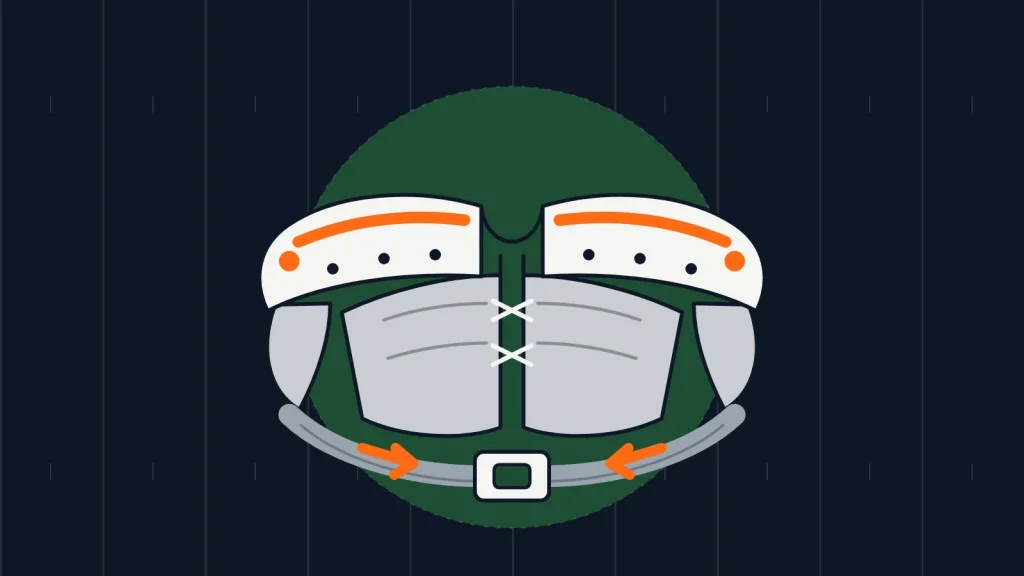
A correctly sized pad that sits in the wrong place protects badly: the cap slides onto the arm and the collar pinches. Riddell and Xenith both publish the procedure, and they describe the same movement. Here it is, with the adjustments each model in our catalogue allows.
Contents · 11 parts
The 2-minute summary
- Putting them on: Riddell and Xenith describe the same movement, over the head, with Riddell adding a warning about the eyes and the nose.
- The main landmark: the hinge of the shoulder caps must line up with the acromioclavicular joint, which sits directly above the underarm.
- Tightening: connect front and back, buckle the belts, then establish a tight fit across the chest and back, with no painful spot.
- Coverage: sternum and front of the shoulders at the front, scapula and rhomboid at the back, without limiting arm movement.
- Adjustment: it depends on the model, from Schutt's swivel belts to the adjustable cap length on the VICIS Elite, which needs a tool.
- The rule: IFAF lists shoulder pads as mandatory equipment and requires a jersey whose sleeves completely cover them.
Before you tighten anything
No amount of adjustment saves the wrong size. Riddell asks for two measurements before a model is chosen: chest circumference, with the tape around the upper torso, and shoulder width, taken "from tip of left humerus to tip of right humerus" along the contour of the shoulders. Xenith keeps only the second one, measured across the back from one acromioclavicular joint to the other.
Both makers add that the cut matters as much as the size: Riddell publishes two separate charts depending on whether the pad is flat or cantilevered, and asks you to identify the player's position first. The full charts for the models sold in Europe are in our shoulder pad sizing guide, and the choice of cut is covered in our guide to shoulder pads by position. Our catalogue of football shoulder pads lists the sizes published by each manufacturer.
Putting the pad on
Riddell and Xenith describe the same manoeuvre. Riddell: bring the pads down over the head, taking care of the eyes and the nose. Xenith: pull the pads over your head so they rest on top of your shoulders. On models with front lacing, front and back are connected once the pad is resting in place, before any tightening.
Neither manufacturer offers a front-entry alternative, and neither Schutt nor VICIS publishes an equivalent procedure: their product pages describe the adjustments available, not the movement. We are not filling that gap.
Setting the caps over the shoulder joint
This is the point Xenith puts first: the hinge of the shoulder caps should align with the acromioclavicular joint, which the manufacturer locates directly above the underarm. A cap set too far out leaves the joint bare and flaps against the arm; set too far in, it climbs towards the neck.
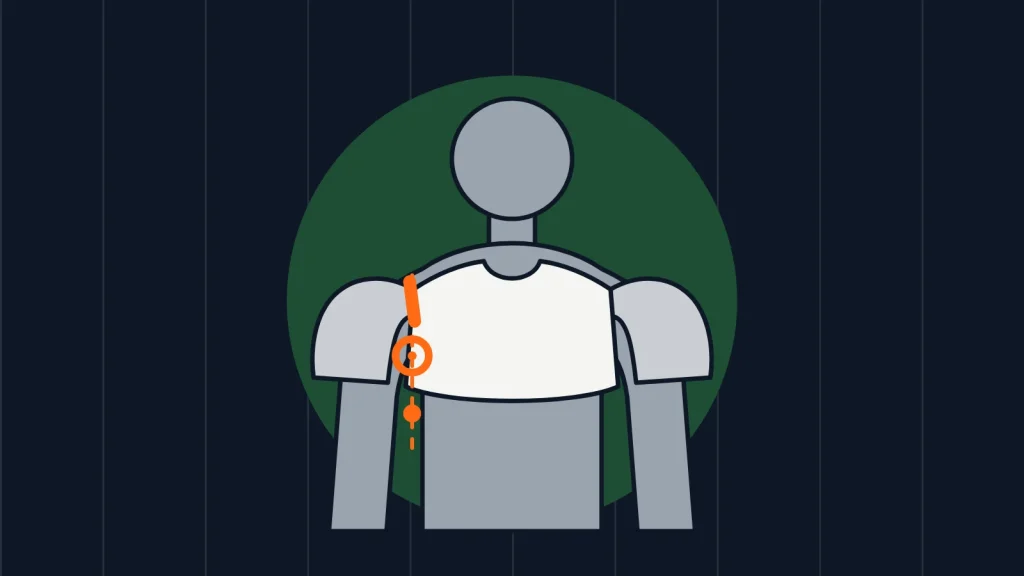
Riddell gives the same landmark in another form, and it is the only figure in the whole corpus: the foam padding should be above the tip of the humerus, by at least a quarter of an inch, roughly 0.6 cm. The maker adds an immediate check: make sure there is no pinching in the collar.
Tightening the belts in order
Riddell splits tightening into three moves: connect the front and back of the pads, buckle the belts and connect the straps where the model has them, then establish a tight fit in the chest and back area. Xenith sums the same step up in one line: tighten both belt straps, which should feel snug and secure but should not be painful in any areas.
The hardware differs from one model to the next: one-inch swivel belts and a rear neck relief on the Schutt XV Flux All-Purpose, a nylon Traditional Fit System belt and a low sternum plate on the Xenith Velocity 2 Pro, a traditional belt on the VICIS ARC_V1 Varsity Skill, two elasticated side bands on the Barnett MARK I.
What the pad must cover once tightened
The two sets of instructions agree on the zones. At the front, the pad must cover the sternum and the front of the shoulders. At the back, it must cover the scapula, Riddell adding the rhomboid, the muscle between the shoulder blades, and asking you to confirm that coverage is complete.
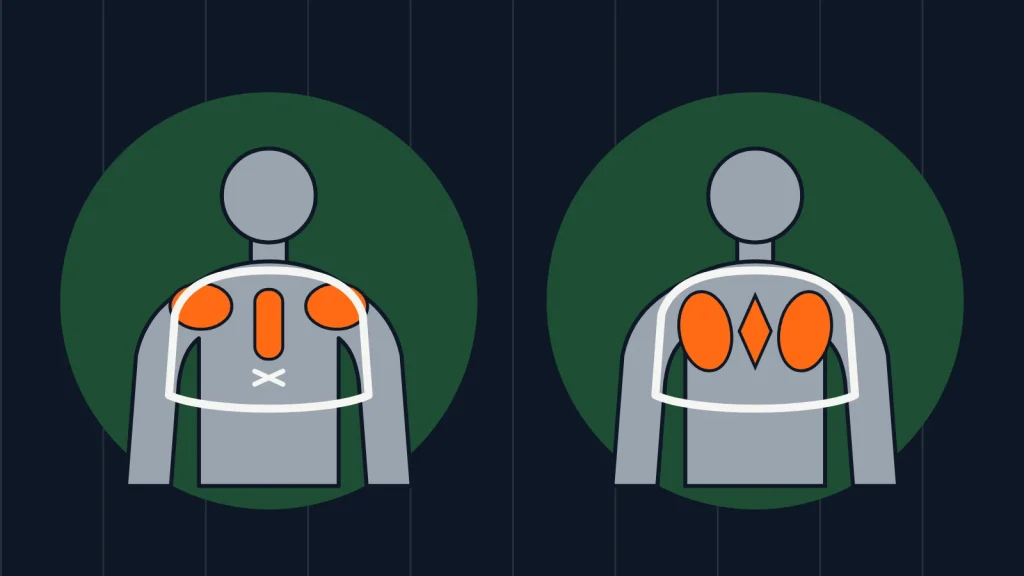
Xenith attaches a condition to it: the rear arch should fully cover the scapula without limiting range of motion in the arms. That is Riddell's last check too, phrased as confirming optimal range of motion. A pad that covers everything but blocks the throwing arm is badly fitted, not better protected.
Model-specific adjustment
Beyond the belts, the scope for adjustment varies widely, and few models offer any.
| Model | What the manufacturer lists as adjustable |
|---|---|
| Schutt XV Flux (All-Purpose, Skill) | One-inch swivel belts |
| Xenith Velocity 2 Pro | Traditional Fit System belt, removable deltoid pads |
| VICIS ARC_V1 Varsity | Traditional belt |
| VICIS ARC_V1 Elite | Adjustable cap length, customisable axial fit system, quick-adjust in-game belt |
| Barnett MARK I | Two elasticated side bands |
The VICIS ARC_V1 Elite is the only pad in our catalogue to advertise fine adjustment of cap height. VICIS sells the matching tooling separately, a T-Nut tool and a Torx 15: that kind of adjustment is made once, at the club, not on the touchline.
Mounting a backplate or a rib protector
Accessories mount on anchor points the manufacturer has planned for, with the hardware supplied. The Schutt XV Varsity Back Plate attaches through a coated belt connection with multi-height adjustment, designed for Schutt XV Varsity pads, mounting hardware included. At VICIS, the Elite back plate comes pre-installed on every ARC_V1 pad: the job is to remove or reposition it, not to add it. The VICIS ARC_V1 rib protector attaches to those same pads with the same tooling, and its elasticated hook-and-loop closure is then set on the torso.
Two consequences: a backplate is chosen for the brand and range of the pad, not for its size alone, and a fitted accessory changes the balance of the whole assembly, so redo the belts once it is on. The models available in euros are in our backplates and rib protectors collections.
The checks before you walk out
The checkpoints published by both makers come down to five: no pinching in the collar, foam above the tip of the humerus, sternum and front of the shoulders covered, scapula and rhomboid covered, arm movement preserved.
Then there are the rules. Shoulder pads appear in the IFAF list of mandatory equipment (rule 1-4-3), and rule 1-4-5-a-1 requires a jersey whose sleeves completely cover them, as it does for every pad worn at or above the waist. A jersey that is too short, or pushed up by a badly placed pad, becomes an officiating problem, as set out in our article on uniform rules.
FAQ
Should shoulder pads go on over the head?
That is the only manoeuvre the manufacturers in our catalogue publish. Riddell asks you to bring the pads down over the head, taking care of the eyes and the nose; Xenith, to pull them over your head until they rest on top of your shoulders.
How do I know a cap is correctly placed?
The hinge of the cap lines up with the acromioclavicular joint, directly above the underarm according to Xenith. Riddell also asks that the foam sit at least a quarter of an inch, about 0.6 cm, above the tip of the humerus, with no pinching in the collar.
Can cap height be adjusted?
Only the VICIS ARC_V1 Elite advertises it, with an adjustable cap length and a customisable axial fit system; the T-Nut and Torx 15 tooling is sold separately. The other pads in our catalogue publish no such adjustment.
Does the jersey have to cover the shoulder pads?
Yes. IFAF rule 1-4-5-a-1 requires a jersey whose sleeves completely cover the shoulder pads, and which covers every pad worn at or above the waist.
Sources
- Riddell, Shoulder Pad Fitting Guide (official PDF): https://content.riddell.com/wp-content/uploads/2019/12/Shoulder-Pad-Fitting_01.pdf
- Xenith, How to Properly Fit Football Shoulder Pads: https://xenith.com/blogs/the-huddle/how-to-properly-fit-football-shoulder-pads
- Xenith, Shoulder Pad Fitting Guide: https://xenith.com/pages/shoulder-pad-sizing-guide
- Schutt, XV All-Purpose Shoulder Pads – Flux: https://schuttsports.com/products/xv-all-purpose-shoulder-pads-flux
- Schutt, XV Varsity Back Plate: https://schuttsports.com/products/xv-varsity-back-plate
- VICIS, ARC_V1 Elite Shoulder Pads – All-Purpose: https://vicis.com/products/arc-v1-elite-shoulder-pads-all-purpose
- VICIS, ARC_V1 Elite Back Plate: https://vicis.com/products/arc_v1-elite-back-plate
- Xenith, Velocity 2 Pro: https://www.xenith.com/products/velocity-2-pro
- IFAF, Football Rules and Interpretations 2025, rules 1-4-3 and 1-4-5-a-1: https://amerikanskeidretter.no/wp-content/uploads/2025/02/IFAF-Football-Rules-and-Interpretations-med-norske-tilpasninger-2025.pdf