Football shoulder pads are sized from a single body measurement: the width of the shoulders. This guide brings together the size charts that Schutt, VICIS and Xenith actually publish for the shoulder pads in the AFG catalogue, explains the difference between skill, lineman and all-purpose cuts as the manufacturers describe them, and covers back plates.
Contents · 8 parts
The 2-minute summary
- One measurement: for the shoulder pads in our catalogue, Schutt, VICIS and Xenith only ask for shoulder width, in inches.
- How to take it: only Xenith explains it, across the back, from one AC joint to the other, with a soft tape measure.
- Cut first: skill for QBs, WRs and DBs, all-purpose, or lineman, which starts at L.
- Then the size: from the chart for the exact model; an L covers 18 to 20 in at Xenith but 18 to 19 in at Schutt and VICIS.
- Between two sizes: no manufacturer gives a rule, so ask the retailer.
- Back plate: simply chosen in a youth or adult version.
 Play the video: Football Shoulder Pad Sizing: How To Measure & Choose Your Size
How to measure for football shoulder pads
The measurement manufacturers use
All the adult charts we checked (Schutt, VICIS, Xenith) rely on one figure only: shoulder width, given in inches. None of them asks for chest circumference, height or weight for these models.
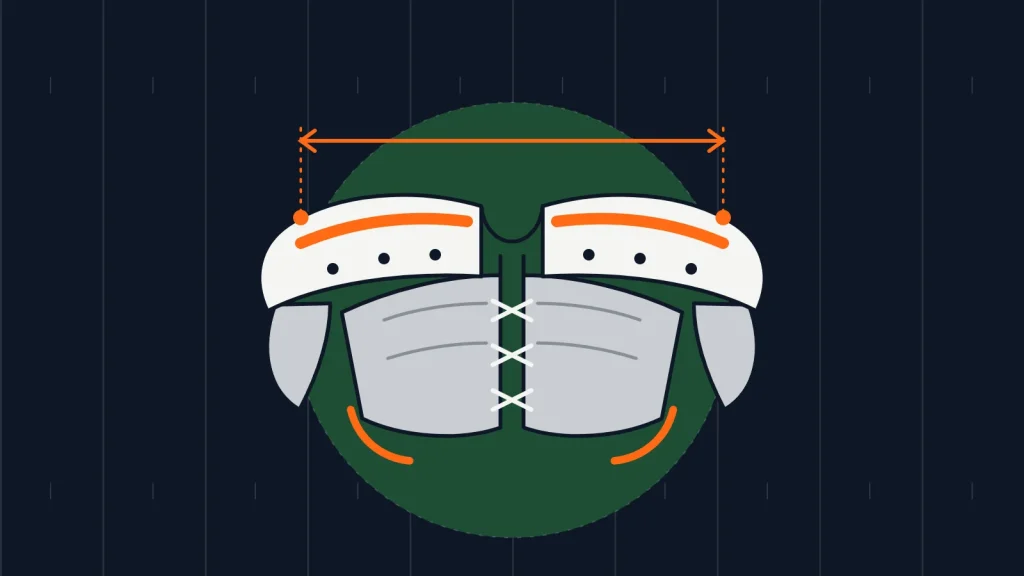
Xenith is the only brand in our selection that explains how to take the measurement. Its instruction is: using a standard, soft measuring tape, measure the width of the player's back from the left shoulder AC joint to the right shoulder AC joint. The AC (acromioclavicular) joint is the bony point at the top of the shoulder, where the collarbone meets the shoulder blade. Xenith's diagram shows the tape held across the upper back, from one AC joint to the other.
What to watch out for
- Measure across the back, not across the chest: that is the method Xenith describes.
- Use a soft tape measure, as Xenith specifies.
- Note the result in inches: all charts are published in inches. Our centimetre values are conversions (1 in = 2.54 cm, rounded to 0.5 cm).
- Schutt and VICIS publish no measuring method alongside their charts. They simply label the column "Shoulder Width". Using the Xenith method with their charts is a reasonable reading, but it is not an instruction from Schutt or VICIS.
One inconsistency worth knowing: on the same Velocity 2 page, Xenith's product description says to measure "from the edge of the left shoulder to the edge of the right shoulder", while its dedicated sizing block specifies the AC joints. We follow the sizing block.
Skill, lineman or all-purpose: what the cut changes
Manufacturers design shoulder pads in several cuts, and each cut comes with its own size range. Here is how they describe them.
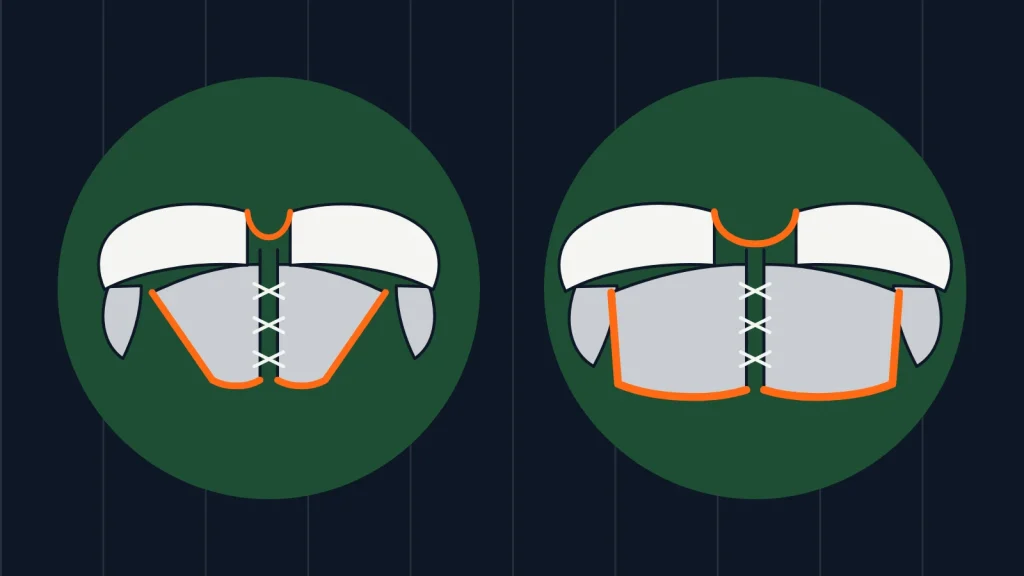
Skill cut
Schutt: "Skill is the shoulder pad cut, designed for skill positions (QB, WR, DB)". On the Schutt XV Flux Skill, this means a split-back arch that contours to the player's shape, a tapered V-shape and 1-inch swivel belts. Sizes run from S to XL (16 to 20 in).
All-purpose cut
Schutt: "All-Purpose is the shoulder pad cut, designed for a wide range of positions", with "Tactical Full-Arch Protection for All-Purpose impact players". The Schutt XV Flux All-Purpose goes from S to 2XL (16 to 21 in). Xenith presents the Velocity 2 as an all-purpose pad for QB, RB, WR and DB, with a full arch and a universal cut.
Lineman cut (Trench, Line)
VICIS: "TRENCH cut is designed for OL, DL, DE, TE, and those on the line". The VICIS ARC_V1 Varsity Trench only exists in large sizes, from L to 3XL (18 to 22 in). Schutt's own lineman cut, the XV Line, is designed for OL, DL and DE, with "increased chest width for larger players" and a wider neck opening; it is also sold from L to 3XL.
What this means for sizing: the cut shifts the size range. Lineman cuts start at L and go up to 3XL, while skill cuts stop at XL. Xenith's sizing chart shows the same pattern across its range: the Xenith Pro, sold in 3 position-specific cuts (Skill, All-Purpose, Lineman), covers 16 to 20 in as a Pro Skill and 18 to 22 in as a Pro Lineman. Choose the cut for your position first, then the size. Our shoulder pads by position guide details which cut each manufacturer recommends, position by position.
Not every brand uses the same measurement. The Barnett MARK I, built for QB, WR and DB, cross-references shoulder width with chest circumference, height and weight: size M, for instance, covers 165 to 180 cm and 68 to 80 kg. Six adult sizes run from XS to 2XL. The Battle Defender Lightweight is measured differently again: Battle publishes no chart of its own for it, so the S to XL chart used on its product page comes from European retailer Reyrr, running from 17–18 in for S to 20–21 in for XL.
Size chart by model
Shoulder width by size, as published by each manufacturer (inches, with our centimetre conversion). A dash means the size does not exist for that model.
| Size | Schutt XV Flux Skill | Schutt XV Flux All-Purpose | Xenith Velocity 2 | VICIS ARC_V1 Trench |
|---|---|---|---|---|
| S | 16–17 in (40.5–43 cm) | 16–17 in (40.5–43 cm) | 16–17 in (40.5–43 cm) | – |
| M | 17–18 in (43–45.5 cm) | 17–18 in (43–45.5 cm) | 17–18 in (43–45.5 cm) | – |
| L | 18–19 in (45.5–48.5 cm) | 18–19 in (45.5–48.5 cm) | 18–20 in (45.5–51 cm) | 18–19 in (45.5–48.5 cm) |
| XL | 19–20 in (48.5–51 cm) | 19–20 in (48.5–51 cm) | 20–21 in (51–53.5 cm) | 19–20 in (48.5–51 cm) |
| 2XL | – | 20–21 in (51–53.5 cm) | – | 20–21 in (51–53.5 cm) |
| 3XL | – | – | – | 21–22 in (53.5–56 cm) |
Two things stand out:
- Sizes are not interchangeable between brands. An L from Xenith covers 18 to 20 in, an L from Schutt or VICIS 18 to 19 in. A player measuring 19.5 in is an L at Xenith but an XL at Schutt.
- Every chart is model-specific. Always check the chart of the exact model you are buying: it is shown on each AFG product page, in the size section.
All these models are adult (varsity) pads. For youth players, charts are different: Xenith, for example, sizes its youth FLYTE 2 pad from 11 to 15 in. VICIS extends its range to youth players with the ARC_V1 Youth, designed for all positions, and Schutt with the Youth Flux from its XV line and the T-Flex Youth, sized from 33 to 45.5 cm (13 to 18 in) of shoulder width depending on size.
Between two sizes
The published ranges share their limits (16–17 in for S, 17–18 in for M, and so on), and none of the three manufacturers says which size to pick when a measurement falls exactly on a limit or between two sizes. We would rather not invent a rule: in that case, ask the retailer or the manufacturer before ordering.
Xenith simply reminds buyers that properly fitted shoulder pads are "imperative to an athlete's performance and safety". None of the official pages we consulted gives further adjustment steps (belts, laces, neck opening) for these models.
Back plates
A back plate (or backplate) attaches to the rear of the shoulder pads to extend protection to the lower back. Our guide to what a football backplate does covers its role, how it attaches and the sizes each brand offers.
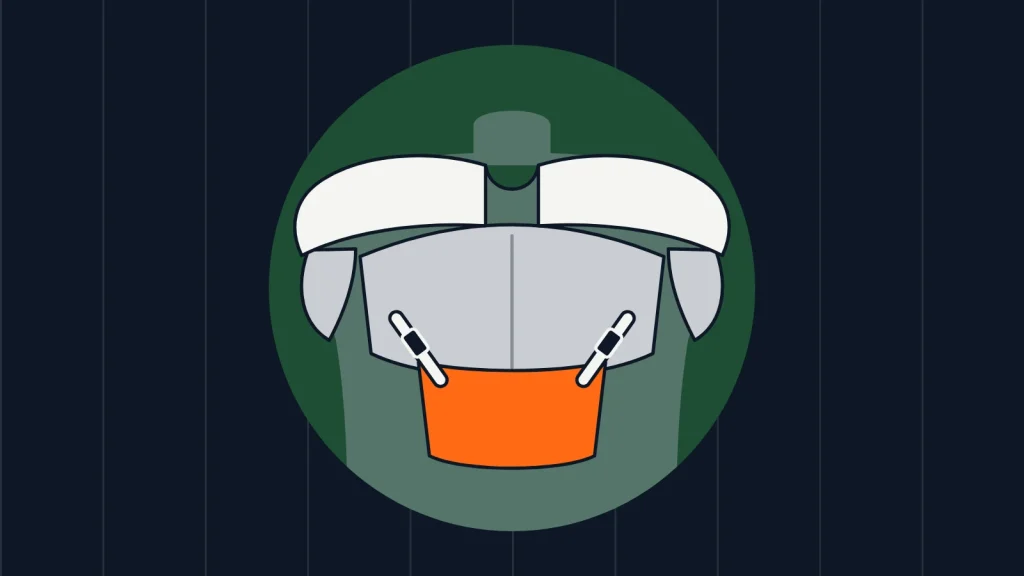
- The Xenith Velocity Back Plate comes in two sizes only: Small (youth) and Large (varsity). Xenith publishes no measurement chart for it. According to the manufacturer, it attaches to all Xenith shoulder pads and most other brands, with adjustable coated nylon straps.
- The VICIS ARC_V1 Trench comes with a VICIS back plate included.
For a back plate, the choice is therefore between youth and adult, not a measurement. More models are in the back plates category.
Shoulder pads and a back plate still leave part of the torso open: our guide to rib protection covers the families that fill that gap.
FAQ
How do I measure for football shoulder pads?
Following Xenith's method, measure the width of the back from the left shoulder AC joint to the right one with a soft tape measure, then compare the result, in inches, with the chart of the model you want.
Do I need my chest measurement to choose shoulder pads?
Not for the models in our catalogue: Schutt, VICIS and Xenith size them by shoulder width only.
Is an L the same size from one brand to another?
No. An L covers 18 to 20 in at Xenith (Velocity 2) and 18 to 19 in at Schutt and VICIS. Always use the chart of the exact model.
Which cut should a lineman choose?
A lineman cut: VICIS designs its Trench cut for OL, DL, DE and TE, and Schutt its XV Line for OL, DL and DE. Both start at size L.
All our shoulder pads are in the football shoulder pads collection.
Sources
- https://www.xenith.com/products/velocity-2-adult
- https://xenith.com/pages/shoulder-pad-sizing-guide
- https://www.xenith.com/products/back-plate
- https://schuttsports.com/products/xv-skill-shoulder-pads-flux
- https://schuttsports.com/products/xv-all-purpose-shoulder-pads-flux
- https://schuttsports.com/products/xv-line-shoulder-pads-flux
- https://vicis.com/products/arc_v1-varsity-shoulder-pads-trench