A short-sighted player has three questions before kick-off: what the officials will accept, what survives under a helmet, and what actually corrects their sight. The rulebook answers the first, manufacturer pages answer the other two, and the answers are not the ones most players expect. None of this replaces medical advice: a correction is chosen with an optometrist or an ophthalmologist.
Contents · 8 parts
The 2-minute summary
- Glasses are allowed: rule 1-4-6-c of the BAFA 2026 rulebook names eyeglasses and goggles explicitly, provided they are clear and not tinted.
- No medical exception for tint: the same article states "No medical exceptions are allowed". A prescription does not make a tinted shield legal.
- Germany is the exception: AFVD rule 1-4-6-c allows clear, tinted, mirrored or coloured visors, and places the use of visors, glasses or any other eye protection at the player's own risk.
- A visor does not correct anything: none of the five visors in our catalogue exists in a prescription version or with a corrective insert.
- A sports frame can be glazed: Demetz offers lab glazing of its wrapped frames, or clip-in kits, with no stated limit on the correction.
- ASTM F803 does not cover American football: the sport is absent from the list of disciplines in the F803-19 edition.
What the rulebook allows
The text is short and leaves no room. Rule 1-4-6-c of the BAFA 2026 rulebook, which follows the NCAA rules also used by IFAF, reads: eye shields must be clear, not tinted, and made from moulded or rigid material, and "eyeglasses and goggles also must be clear and not tinted". Then comes the sentence that closes the argument: no medical exceptions are allowed.
Two qualifiers matter as much as the ban itself. Eyewear is not clear if it obscures a player's eyes at any time, from any angle, or in any light condition. And anything mirrored is expressly prohibited. In other words, the referee must be able to see your eyes, and that is the only test being applied. Tints and mounting are covered in our guide to visor rules, and the models sold in Europe are listed in the visors collection.
Germany took a different route. AFVD rule 1-4-6-c allows visors that are clear, tinted, mirrored or coloured, and adds that using a visor, glasses or any other eye protection is at the player's own risk. Play in Germany and in a BAFA or IFAF competition in the same season and you will not have the same latitude twice.
A visor shields, it does not correct
This is the most common misunderstanding. A visor is a screen in front of the face, not a corrective lens. None of the five references in our collection comes in a prescription version, and none of these brands publishes a corrective insert to fit behind the shield.
| Model | Published material | Stated compatibility | Price on file |
|---|---|---|---|
| Barnett Premium A visor | Polycarbonate | Two-clip system | €29 |
| Battle Eclipse | Impact-resistant polycarbonate | Riddell SpeedFlex platform | not recorded |
| Oakley Edge Visor | not published | VICIS ZERO2 facemasks | €115.99 |
| Schutt F7 Switch Shield by Oakley | not published | Schutt F7 Pro and F7 AiR Varsity | €98.99 |
| Schutt F7 Exclusive Shield by Oakley | Plutonite lens | All Schutt helmets | €82.99 |
What these shields do bring is real, but it is not correction: Barnett states 100% blocking of UVA, UVB and UVC rays with anti-fog and anti-scratch treatments, Battle an anti-fog treatment and tool-free fitting, Oakley optics cut to the exact shape of the facemask. So the shield is chosen after the eyesight question, not instead of it. Mounting depends on the facemask and the helmet model, and everything starts with football helmets.
Contact lenses
Rule 1-4-6-c does not mention them. The text covers shields, eyeglasses and goggles; contact lenses appear nowhere in it, nor do tinted or coloured lenses. A lens does not change the outward look of the equipment and does not obscure the player's eyes, which is exactly the test the rule applies.
That leaves everything the rulebook does not deal with: tolerance to sweat, losing a lens mid-game, wearing lenses all day through a tournament. Those are medical questions, they are not settled in an equipment guide, and we found no official source that answers them for American football. An eye care professional is the right person to ask.
Sports glasses under the helmet
This is the route the rulebook allows in writing, as long as the frame is clear and untinted. A street frame is not built for it: it is neither retained nor designed to take a hit.
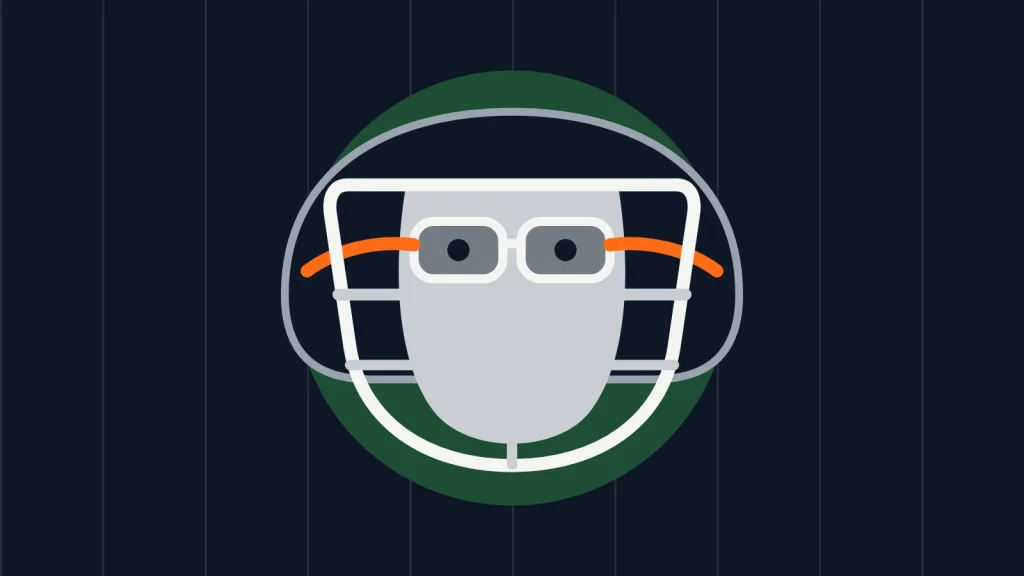
Demetz, a French manufacturer of sports eyewear, describes frames for ball sports with shock absorbers on the temples and the nose, a quick-adjust strap and polycarbonate lenses. The brand cites ASTM F803-11 as its impact-resistance reference. One point is worth knowing: that standard, titled "Standard Specification for Eye Protectors for Selected Sports", only covers a listed set of sports, and American football is not on the list in the F803-19 edition. A frame certified to F803 has therefore been tested for other disciplines, not for this one.
Bulk is the other constraint. The frame has to live between the face and the facemask, which runs across the field of view: this is one of the rare cases where the number and position of the bars matter before the position you play. No manufacturer publishes a clearance figure in millimetres, so the fitting is done with the helmet on and the facemask mounted.
Glazing a sports frame to your prescription
A wrapped frame does not take corrective lenses the way a flat frame does. Demetz lists four routes: optical glazing at the brand's own lab, presented as the option with the widest field of view; clip-in kits for athletes who switch between sports; non-wrapped rims that replace the original lenses; and conventional glazing at an optician.
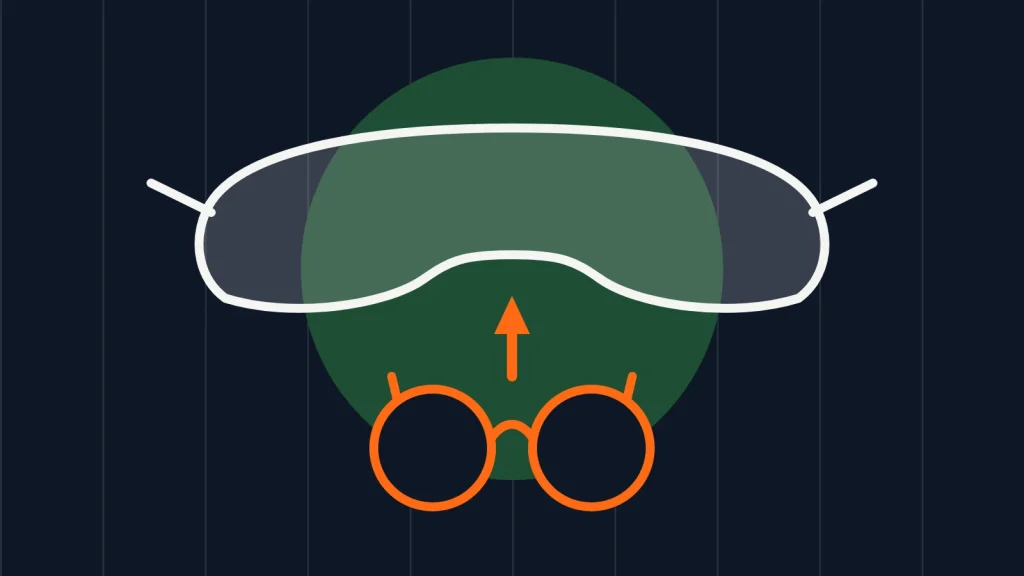
The brand offers mineral, organic or polycarbonate lenses and states glazing with "no limit of correction, for all visual defects". The route runs through a partner optician, with a prescription: here too, the decision is not an equipment maker's to take.
FAQ
Is a tinted visor allowed with a doctor's note?
No, not under the BAFA 2026 rulebook or the NCAA rules it follows: rule 1-4-6-c states that no medical exceptions are allowed. In Germany, AFVD rule 1-4-6-c allows tinted, mirrored or coloured visors for everyone, at the player's own risk.
Can you play in your everyday glasses under a helmet?
The rulebook allows eyeglasses and goggles provided they are clear and not tinted. It says nothing about how well a street frame survives contact, which it is not designed for; sports eyewear makers offer strap-retained frames with polycarbonate lenses.
Does a prescription football visor exist?
None of the five visors in our catalogue is offered in a prescription version, and none of these brands publishes a corrective insert to fit behind the shield. We could not open the official Oakley and Rec Specs pages during this review, so this covers what we were able to verify.
Are contact lenses banned?
They are not mentioned in rule 1-4-6-c, which only covers shields, eyeglasses and goggles. Wearing lenses during play is a matter for an eye care professional, not for the rulebook.
Sources
- BAFA, 2026 rulebook, rule 1-4-6-c and rule 1-4-8-b: https://rules.bafra.info/rulebook/bafa2026/1.html
- AFVD / AFVBY, rule change on visors, rule 1-4-6-c: https://www.afvby.de/regelaenderung-visiere/
- ASTM F803-19, Standard Specification for Eye Protectors for Selected Sports: https://store.astm.org/f0803-19.html
- Demetz, glazing sports frames to prescription: https://demetz.fr/fr/page/38-mise-a-la-vue
- Demetz, eye protection and ball sports: https://demetz.fr/fr/blog/bien-proteger-les-yeux-des-enfants-dans-toute.html?id_post=57