American football looks impenetrable mostly because we meet it through American television rather than through the rule book. Strip it back and one idea carries the whole sport: a team gets four attempts to advance ten yards, and keeps the ball as long as it manages it. This article works through the framework using the official IFAF rule book, the one that governs international competition and the European federations, and flags where the NFL does things differently.
Contents · 10 parts
The 2-minute summary
- Eleven a side: Rule 1-1-1 caps each team at eleven players on the field.
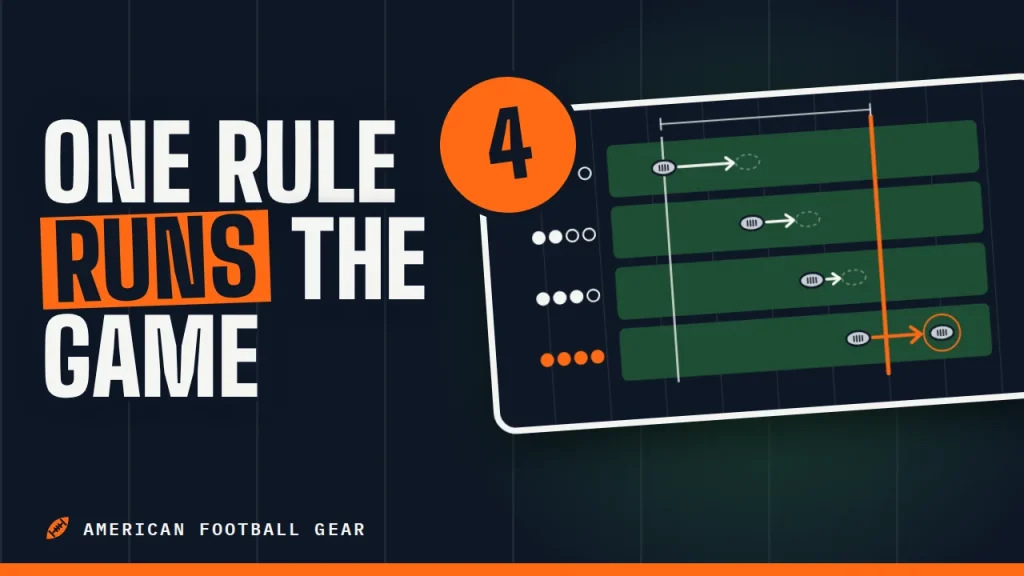
- Four downs, ten yards: clear the line and the series starts again from scratch.
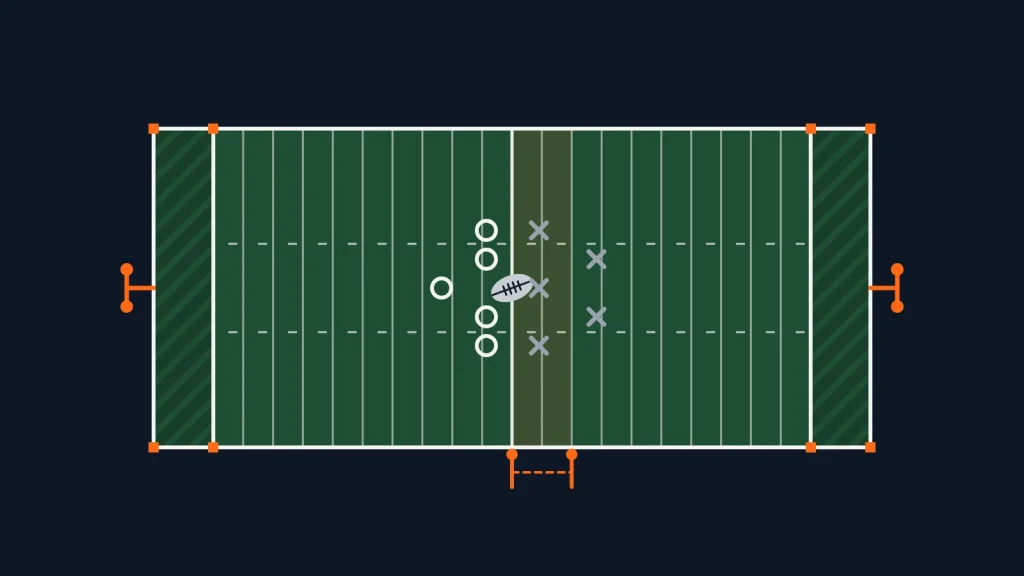
- A narrow pitch: 109.73 m long by just 48.77 m wide, end zones included.
- 48 minutes of play under IFAF, in four 12-minute quarters, against four 15-minute quarters in the NFL.
- Six points for a touchdown, three for a field goal, two for a safety, then a try worth one or two.
- Kit is part of the rules: a NOCSAE-certified helmet, shoulder pads, mouthpiece, thigh guards, knee pads and hip pads are all compulsory.
 Play the video: American Football Rules Explained: Downs, Clock, Scoring & Kit
The pitch, the ball and the eleven players
The IFAF rule book is written in yards and says so bluntly: "there is no such thing as a metric American football field." The federation does publish a conversion table, which is the one worth pinning up in a European clubhouse.
| Dimension | Official measure | In metres |
|---|---|---|
| Length between end lines | 120 yd (360 ft) | 109.728 m |
| Length between goal lines | 100 yd | 91.440 m |
| Width | 53.33 yd (160 ft) | 48.768 m |
| Depth of one end zone | 10 yd | 9.144 m |
| Hash marks, from the sideline | 20 yd (60 ft) | 18.288 m |
| Distance between the uprights | 18 ft 6 in | 5.639 m |
| Height of the crossbar | 10 ft | 3.048 m |
One warning in the rule book matters to any club hunting for a ground: the pitch is significantly narrower than a football, rugby or hockey pitch, and that width cannot be varied. Only the length may be shortened, by reducing the working yard to no less than 86.67 cm. The goals are more forgiving: "a standard rugby goal that has a 3 m crossbar and uprights 5.6 m apart is acceptable."
The ball is specified just as tightly: pebble-grained leather in four panels, eight lacings, natural tan, 14 to 15 ounces, inflated to between 12.5 and 13.5 psi. That is the spec sheet of the Wilson The Duke, and the reason match balls look so alike from one brand to the next. Competitions for women and junior players may authorise a smaller ball (see our guide to football sizes by age), as our range of American footballs shows.
On the field each side fields no more than eleven players. At the snap the offence must have at least five players wearing numbers 50 to 79 on its scrimmage line, and no more than four behind it. Because substitution between plays is unlimited, a squad splits into three units: offence, defence and special teams.
Four attempts to gain ten yards
This is the engine of the game. The team with the ball is awarded a series of up to four downs. The line to gain sits ten yards ahead of the ball's most forward point; if the goal line is closer, the goal line becomes the target.

- Reach the line and the offence is awarded a fresh set of four downs.
- Fail on fourth down and the defence takes over where the ball lies.
- Hence the familiar fourth-down decision: punt, attempt a field goal, or go for it.
A down ends when the ball carrier is tackled or goes out of bounds, when a pass hits the ground, or when there is a score. Play then restarts with a snap, on or between the hash marks.
The clock: 48 minutes, not 60
This is the difference that catches out anyone raised on the NFL. IFAF sets normal playing time at 48 minutes, in four periods of 12 minutes, with one minute between the periods of each half and a 20-minute interval at half-time. Competitions and national federations may set the total at 60, 48, 40 or 32 minutes, provided the four periods stay equal in length.
Between plays the offence works to a 40-second play clock, reset to 25 seconds after a penalty, a charged team timeout or a media timeout. Each team gets three timeouts per half, one minute each.
If the scores are level after four periods, IFAF uses a possession-series tiebreaker: each team starts on the opponent's 25-yard line. From the second extra period a touchdown must be followed by a two-point attempt; from the third, each side plays a single snap, a two-point try from the three-yard line.
Scoring
| Play | Points |
|---|---|
| Touchdown | 6 |
| Field goal | 3 |
| Safety (awarded to the opponent) | 2 |
| Touchdown during the try | 2 |
| Field goal during the try | 1 |
| Safety during the try (to the opponent) | 1 |
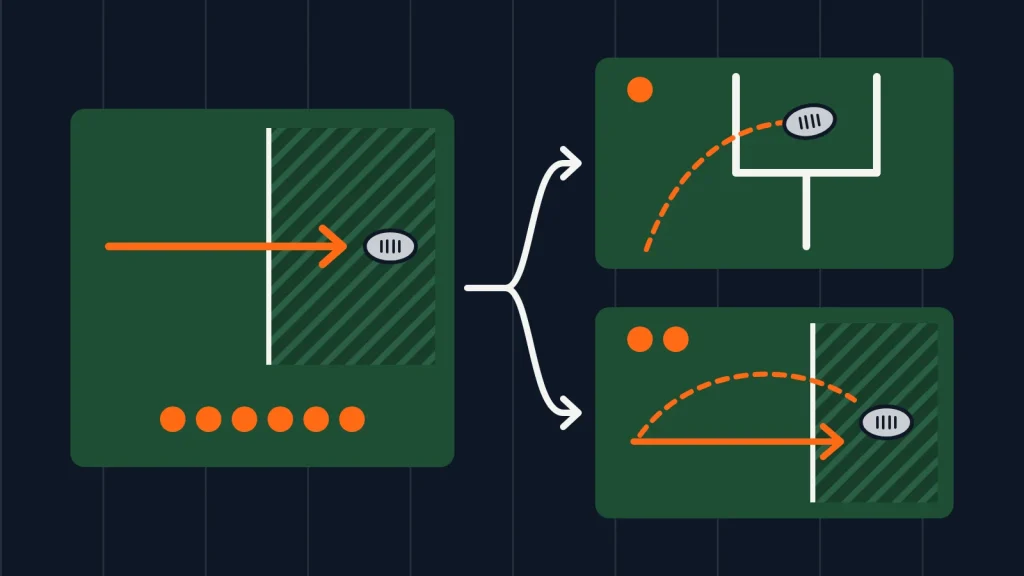
After a touchdown the scoring side plays one extra down, the try, snapped from the opponent's three-yard line under IFAF rules. It chooses between a kick, worth one point, and a run or pass into the end zone, worth two.
Penalties: 5, 10 or 15 yards
The summary of penalties sorts fouls by distance, and the logic is easy to hold in your head.
- 5 yards: false start, offside, delay of game, illegal formation, ineligible receiver downfield.
- 10 yards: offensive holding, illegal block in the back. Defensive holding costs 10 yards and hands over an automatic first down.
- 15 yards: personal foul, roughing the passer, horse-collar tackle, helmet and face mask fouls, unsportsmanlike conduct, offensive pass interference.
- Targeting: 15 yards, automatic first down and disqualification. The rule covers forcible contact made with the crown of the helmet, or aimed at the head or neck of a defenceless player. Our guide to tackling covers this rule and the practice contact levels in detail.
Two safeguards round it off: no distance penalty may exceed half the distance to the offending team's goal line, and defensive pass interference puts the ball at the spot of the foul with a first down, as long as that works out at less than 15 yards.
The kit list is part of the rule book
This is the section European players tend to read last, usually after buying their gear. Rule 1-4-3 lists nine compulsory items: helmet, hip pads, jersey, knee pads, mouthpiece, pants, shoulder pads, socks and thigh guards. Jersey and pants fall under football apparel, such as the Barnett FJ-2 jersey and Barnett FP-2 pants. Our guide to the uniform rules covers numbers, team colours and accessories in detail.
The detail matters as much as the list:
- the helmet must carry the manufacturer's NOCSAE certification and a warning label; a reconditioned helmet must show its recertification. See our football helmets, such as the Riddell SpeedFlex;
- the chin strap is a four- or six-point strap, with every point secured whenever the ball is in play, such as the Riddell CAM·LOC Hard Cup;
- hip pads must include a tailbone protector, and knee pads must be covered by the pants: nothing is worn on the outside, such as the McDavid HEX Knee/Elbow/Shin Pads or the hi-vis HEX Viz version;
- the mouthpiece is intra-oral, in a readily visible colour, neither white nor transparent, and covers all the upper teeth. That is the case for the Shock Doctor Gel Max and the rest of our mouthguards; our mouthguard buying guide covers the families and the rule in full;
- cleats may not exceed half an inch, that is 12.7 mm, and non-detachable cleats are never metal. Worth checking before you order football cleats: see our buying guide;
- eye shields must be clear and untinted, and mirrored eyewear is expressly prohibited: read that before buying a visor, such as the Schutt F7 Switch Shield, which is offered in a clear tint.
One detail stands out: for shoulder pads, as for thigh guards, the rule book states that there are no specifications at all. The choice is entirely yours, which is why the cuts vary so widely between a lineman's set and a light receiver's set. Browse our football shoulder pads, the Schutt XV Flux All Purpose among them.
If that list feels heavy, the non-contact version is played without a helmet or shoulder pads: see the flag football rules and our flag football kit.
What the NFL does differently
The professional and international codes share the same skeleton, but not all the numbers.
| Point | IFAF | NFL |
|---|---|---|
| Length of a period | 12 minutes | 15 minutes |
| Half-time | 20 minutes | 13 minutes |
| Try by kick | three-yard line | 15-yard line |
| Try by run or pass | three-yard line | two-yard line |
| Hash marks, from the sideline | 60 ft | 70 ft 9 in |
| Timeouts | 3 per half | 3 per half |
Those hash marks explain part of the difference in playing style: the tighter they are, as in the NFL, the closer to the middle the ball is spotted, and the more usable both sides of the field remain.
FAQ
How long is an American football match?
IFAF sets official playing time at 48 minutes, in four periods of 12 minutes, with a 20-minute half-time. A competition may choose 60, 40 or 32 minutes instead. NFL quarters last 15 minutes.
What does a "down" mean?
It is an attempt. The offence gets four of them to gain ten yards; clear that line and it receives four more.
Why is a touchdown worth six points?
That is the value set by the rule book, which then adds a try worth one point by kick or two points by running or passing the ball in.
What kit is compulsory?
Nine items: a NOCSAE-certified helmet, shoulder pads, mouthpiece, hip pads with a tailbone protector, knee pads, thigh guards, jersey, pants and socks.
Sources
- IFAF, Football Rules and Interpretations, 2026 edition (in force since 1 March 2026): https://amerikanskeidretter.no/wp-content/uploads/2026/02/IFAF-Rules-and-Interpretations-2026.2.4.pdf
- IFAF, Football Rules and Interpretations, 2023 edition, on the international federation's own site: https://americanfootball.sport/wp-content/uploads/2023/05/ifafrules.pdf
- NFL, 2026 Official Playing Rules of the National Football League: https://operations.nfl.com/the-rules/nfl-rulebook/