In American football, the kit you wear is not a matter of personal caution: it is written into the rule book. Rule 1-4 of the IFAF Football Rules and Interpretations, the text European federations play under, lists nine compulsory pieces, sets out what each must meet, and spells out what happens to a player who turns up without one. Here is that list, article by article.
Contents · 10 parts
- The 2-minute summary
- The nine pieces the rule book demands
- Helmet, face mask and chin strap: the most regulated piece
- The jersey has to cover every pad
- Hips to knees: what a girdle takes care of
- The mouthpiece, the piece most often forgotten
- What is optional, and what is illegal
- What happens when a piece is missing
- FAQ
- Sources
The 2-minute summary
- Nine compulsory pieces: helmet, hip pads, jersey, knee pads, mouthpiece, pants, shoulder pads, socks and thigh guards.
- The helmet carries the most requirements: a face mask, a four- or six-point chin strap with every point secured, a warning label and NOCSAE certification.
- Nothing is worn outside the pants: knee pads go underneath, and the pants must cover the knees.
- The mouthpiece may be neither white nor transparent and must cover all the upper teeth.
- Gloves, rib pads, back plates and visors stay optional, but a visor must be clear and any rigid pad must be completely covered.
- The penalty falls on the player: he or she leaves for at least one down unless the team spends a timeout, and may not play until properly equipped.
The nine pieces the rule book demands
The IFAF publishes the Football Rules and Interpretations used by its member federations in competition. Rule 1-4-3 runs to nine lines: helmet, hip pads, jersey, knee pads, mouthpiece, pants, shoulder pads, socks, thigh guards. No ranking, no exception by position: anyone who takes the field wears all nine. That list is also the backbone of our football protection range, which covers everything that goes under the jersey and the pants.

Two absences are worth noting. Boots are not on the list: the rule book does not require them, it only limits how far the studs may protrude. Nor are gloves, even though they have become standard at several positions. Three pieces many beginners overlook, on the other hand, are very much on it: hip pads, thigh guards and knee pads, in other words the whole lower body.
Helmet, face mask and chin strap: the most regulated piece
Rule 1-4-4-a sets four requirements for the helmet. It must be fitted with a face mask and a secured four- or six-point chin strap, with all points secured whenever the ball is in play. Every helmet in a team must be the same colour and design. And the helmet must carry a warning label about the risk of injury together with a manufacturer's or reconditioner's certification that it meets the NOCSAE test standards; a reconditioned helmet must show its recertification.
NOCSAE publishes separate standards for each case: ND002 for newly manufactured helmets, ND004 for recertified ones, ND006 and ND007 for youth models, ND087 and ND089 for faceguards. Our product pages quote the exact reference whenever the manufacturer publishes it: the Riddell SpeedFlex, for instance, is listed under NOCSAE ND002-17 with SEI certification. Face masks and chin straps are sold separately by most brands, and the Riddell CAM·LOC Hard Cup attaches to the helmet thumb screw, which is not supplied with it. Before buying second-hand, then, there is one question to ask: does the shell still carry its certification label? The rest of the range sits in our football helmets.
The jersey has to cover every pad
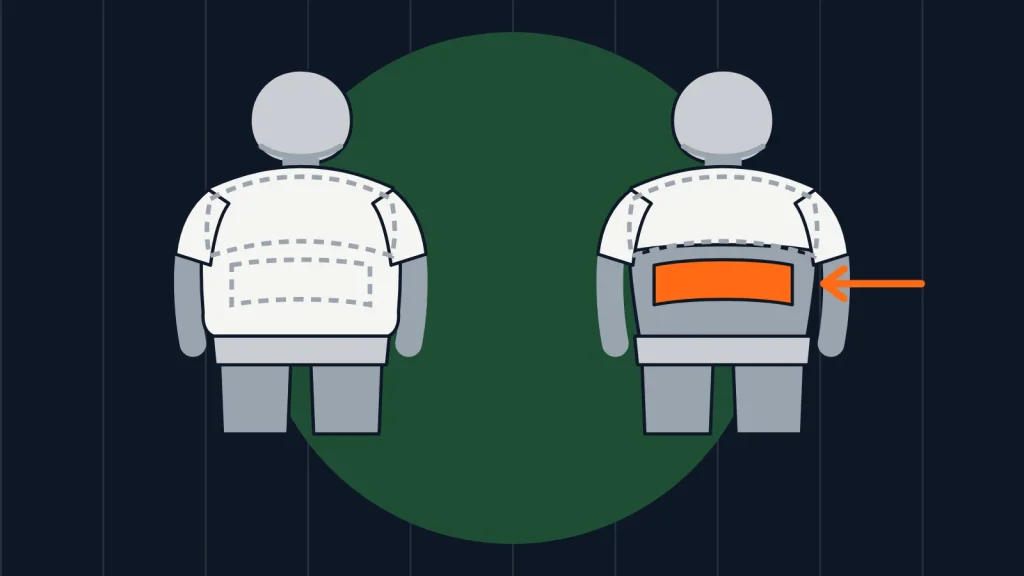
Rule 1-4-5 is stricter than it looks. The sleeves must completely cover the shoulder pads, the jersey must be full-length and tucked into the pants or made even with the waistline, and it must cover all pads worn at or above the waist. Altered jerseys, and jerseys with zips, Velcro or clasps, are not allowed. Rule 1-4-7-i closes the loop: rib pads, shoulder pad attachments and back protectors that are not totally covered make the equipment illegal. Our guide to the uniform rules covers the rest of the kit: numbers, team colours and accessories.
The rule book gives no specification at all for the shoulder pads themselves (rule 1-4-4-g): it is the one article that defers entirely to manufacturers. A set such as the Schutt XV Flux All-Purpose, with its 5/8-inch closed-cell foam padding, answers the needs of a position rather than a standard. The same goes for back plates and rib protectors, optional but bound by the covering rule. The full range is in our football shoulder pads.
Hips to knees: what a girdle takes care of
Three of the nine compulsory pieces protect the lower body, and they are rarely bought separately. Hip pads must include a tailbone protector (1-4-4-b). Thigh guards are required with no specification attached (1-4-4-i). Knee pads must be covered by the pants, and both pants and knee pads must cover the knees; no pad or protective equipment may be worn outside the pants (1-4-4-d).
In practice one girdle fills all three slots: the McDavid HEX Thudd Short builds 9 mm pads into the hips, thighs and tailbone, while the VICIS Padded Compression Shorts use five separate protection zones. Barnett's FS-06 does the same in a five-piece compression short, covering the hips, thighs and tailbone. That leaves knee pads, usually sold in pairs, and the pants themselves, best chosen with pockets made for pads, like the Barnett FP-2 in our football apparel range. Our guide to choosing a girdle covers the five-pad and seven-pad layouts, and our guide to football knee and elbow pads covers sizing and the protected zones. For the full layering order, from skin to jersey, see our guide to what to wear under football pads.
The mouthpiece, the piece most often forgotten
The mouthpiece gets a specification of its own (1-4-4-e): an intra-oral device of any readily visible colour, neither white nor transparent, made with FDA-approved base materials, covering all the upper teeth. The rule book also recommends, without requiring, that it be properly fitted. The colour requirement is not a whim: it lets an official check from a distance, at a glance, that the piece is actually in the mouth. A boil-and-bite model such as the Shock Doctor Gel Max moulds in hot water and comes with a detachable helmet strap, while the Battle Speed Pro ships ready to wear with no boiling and a fixed strap; the rest of the choice is in our mouthguards.
What is optional, and what is illegal
Rule 1-4-6 lists what is allowed without being required, and rule 1-4-7 lists what is banned outright.
| Piece | Status | What the rule book requires |
|---|---|---|
| Helmet | Compulsory | Face mask, secured 4- or 6-point chin strap, warning label, NOCSAE certification (1-4-4-a) |
| Shoulder pads | Compulsory | No specification, but covered by the jersey (1-4-4-g, 1-4-5) |
| Hip pads | Compulsory | Must include a tailbone protector (1-4-4-b) |
| Thigh guards | Compulsory | No specification (1-4-4-i) |
| Knee pads | Compulsory | Under the pants, knees covered (1-4-4-d) |
| Mouthpiece | Compulsory | Intra-oral, visible colour, neither white nor transparent (1-4-4-e) |
| Jersey, pants, socks | Compulsory | Same colour and design across the team (1-4-4-f, 1-4-4-h, 1-4-5) |
| Gloves | Optional | Separate sections for each finger and thumb, "NF/NCAA Specifications" label unless plain cloth (1-4-6-b) |
| Visor | Optional | Clear, not tinted, moulded or rigid, no medical exceptions (1-4-6-c) |
| Rib pads, back plate | Optional | Totally covered, otherwise illegal (1-4-7-i) |
| Towel | Optional | Solid colour, 4 × 12 to 6 × 12 inches, no wording (1-4-6-a) |
| Boots | Not listed | Studs no more than ½ inch, or 12.7 mm, from the sole (1-4-7-d) |
Football gloves are defined word by word: a glove is a fitted covering for a hand with separate sections for each finger and thumb, without any material connecting them. There is no restriction on colour, but a label or stamp reading "NF/NCAA Specifications" should show voluntary compliance with SFIA or NOCSAE test specifications, unless the glove is made of unaltered plain cloth. Tinted visors, tinted eyewear and anything mirrored are expressly prohibited, with no medical exception.
The illegal list also catches adhesive material, grease and any slippery substance, visible bandannas, non-standard overbuilt face masks, equipment modified in a way that reduces the protection it offers, and hoodies whose hood sits outside the shoulder pads. On footwear, only stud length is regulated: no more than half an inch from the base of the shoe, which rules out some athletics and rugby models. Every pair in our football cleats range stays within that limit.
What happens when a piece is missing
Rule 1-4-8 leaves no room for doubt: no player wearing illegal equipment, or failing to wear mandatory equipment, is permitted to play. Once an official spots it, the player leaves the game for at least one down and may not return until the equipment is made legal. The team can save the player from missing a snap by taking a charged timeout, but even then the player may not play until the problem is fixed.
One useful nuance: if equipment becomes illegal during play, a shoulder pad working its way out from under the jersey for instance, the player does not have to leave, but may not take part until the kit is put right. And if a player told to leave the field does not respond after two notifications, a timeout is charged to the team; once the timeouts are gone, the next infraction becomes a five-yard delay-of-game penalty.
Responsibility does not stop with the player, either. Rule 1-4-9 requires the head coach to certify in writing to the umpire, before the game, that the players have been told what is mandatory and what is illegal, that they have been given that equipment, and that they have been instructed how to wear it.
FAQ
Are gloves compulsory in American football?
No. They sit under rule 1-4-6, the optional equipment article. If they are worn, they must have separate sections for each finger and carry an "NF/NCAA Specifications" label, unless they are made of unaltered plain cloth.
Are rib pads or a back plate required?
Neither appears among the nine compulsory pieces. If they are worn, though, they must be totally covered: rule 1-4-7-i makes any exposed back protector or shoulder pad attachment illegal.
Can a tinted visor be worn on medical grounds?
No. Rule 1-4-6-c requires a clear, untinted eye shield, states that no medical exceptions are allowed, and expressly prohibits mirrored eyewear.
What happens if a mouthpiece is left hanging from the face mask?
The official notifies the player. If it is still not worn properly after two notifications, the team is charged a timeout or a delay penalty. A player with no mouthpiece in at all, by contrast, leaves the game for at least one down.
Sources
- IFAF, Football Rules and Interpretations 2026 Edition, rule 1-4 (articles 3 to 9): https://amerikanskeidretter.no/wp-content/uploads/2026/02/IFAF-Rules-and-Interpretations-2026.2.4.pdf
- NOCSAE, standards library (ND002, ND004, ND006, ND007, ND087, ND089, ND019, ND020): https://nocsae.org/standards/