A loose facemask screw, a snapped chin strap buckle, an air liner that no longer holds its charge: these failures happen between two series and take a player off the field. Manufacturers publish the spare parts and the way to fit them; this guide repeats only what they put in writing.
Contents · 8 parts
The 2-minute summary
- The wear parts are catalogued: Schutt sells its chin strap buckles by the dozen, Riddell gives part numbers for the valve, the lubricant and the needle of its liners.
- Hardware is not universal: the Schutt kit for the F7 AiR covers the Standard and Varsity versions only.
- Removing a chin strap takes a specific tool: a 15/16 inch socket or Riddell's Quick Release tool for the SpeedFlex thumb screw.
- A liner that will not inflate has three causes: a missing valve, a damaged valve, or a punctured bladder.
- Nothing is tightened down hard: Riddell writes that once the part is secure you must not tighten any further, on pain of damaging the valve stem.
- Another brand's part can cost you the certification: NOCSAE makes it voidable as soon as an addition alters the helmet.
What gives way, and where the part comes from
A helmet is not a single moulded piece: it is an assembly of screwed, clipped and inflated parts, and those are the first to fail. Our chin straps and helmet accessories collection gathers the ones sold singly or in kits, alongside complete football helmets and facemasks.
Riddell opens its SpeedFlex care guide with a blunt instruction: inspect the helmet before each use. Schutt writes in the same spirit that the fit of the helmet and the presence of all pads should be checked each time before play.
Screws, T-nuts and loop straps
Nothing describes what wears out on a helmet better than the contents of a kit. The Schutt F7 AiR Mini Hardware Kit holds twelve short T-nuts (1/8 inch), twelve medium T-nuts (1/2 inch), twelve standard screws, twelve mechanical fastening screws, twelve chin strap buckles, twelve chin strap snaps, twelve clear loop straps, one metal T-nut wrench and one tape measure.
Schutt states that the kit supports the F7 AiR Standard and Varsity only, and that it does not fully support the F7 AiR Youth models or the F7 AiR Elite: hardware does not carry over from one platform to the next. The brand presents it as a stock of parts for coaches, parents or athletes looking after several helmets, not as a full team kit.
Quarter-turn systems follow the same logic: the Schutt Quarter-Turn Hardware, sold in pairs, is listed for the F7 2.0 Professional and the F7 VTD Professional, and for nothing else. Taking a facemask off is covered in our guide on changing a facemask.
The chin strap: housing, thumb screw and buckles
The chin strap is the most handled part of a helmet, so it is the one that wears out first. On the SpeedFlex, for the top strap, Riddell says to loosen the Strap·Loc screws without removing them, glide the upper straps through, then tighten the screws again. To release the bottom straps, place your index fingers over the lever on the Cam·Loc housing on each side of the helmet, press and hold, then pull the chin cup forward with your thumbs.
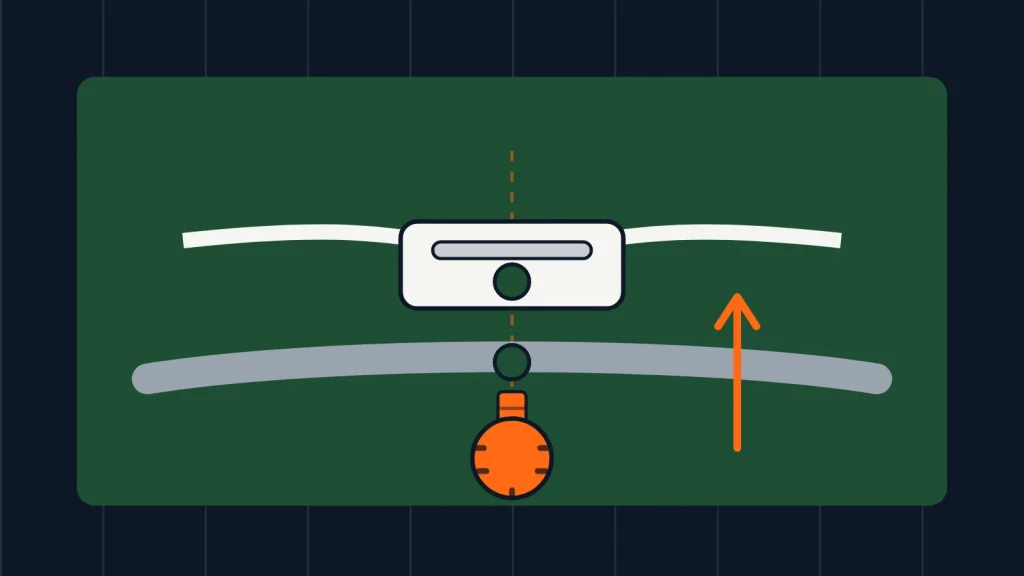
Full removal goes through a part that is easy to forget: the thumb screw behind the Cam·Loc housing. Riddell says to turn it counter-clockwise, with a 15/16 inch socket or its Quick Release tool (catalogue number R2764022), before pulling the housing away from the shell. On reassembly the upper straps are twisted 180 degrees, the housing is centred over the rectangular cutout in the shell, and the thumb screw is presented from the inside, tightened by hand and then with the tool. Setting the final height is covered in our guide on fitting a chin strap; when the strap itself has split, a complete model such as the Riddell Cam·Loc Hard Cup chin strap is the answer.
On the consumable side, Schutt sells its chin strap buckles in packs of twelve, in black or white, and lists them as compatible with all its own helmets and with most competitors' helmets. The brand also offers the Grip Clip Kit, a clip with a polycarbonate outer shell and an internal stainless-steel frame, which attaches with one click and releases with a pinch of a double button, and which works, says Schutt, on any helmet once the snap screw has been replaced.
The liner that no longer holds air
Riddell publishes a three-case diagnosis for a bladder that will not inflate. Valve missing: fit a new valve (part R45926), lubricated with water or P-80 lubricant (R45900) and inserted into the valve stem with an inflation needle (R60120). Valve damaged: remove it with needle-nose pliers and replace it. Bladder punctured: the whole liner component has to go, as covered in our guide on replacing jaw pads and liners.

The tool fits in a pocket. The Schutt Air Inflator Pump is described by the manufacturer as a hand-operated pump with an air release valve, supplied with a 20 mm needle, half an inch long, designed for football helmet inflatable liners; the bulb is rubber and the flexible hose lets you inflate from any angle. Riddell adds that a fitting starts with every inflatable liner deflated.
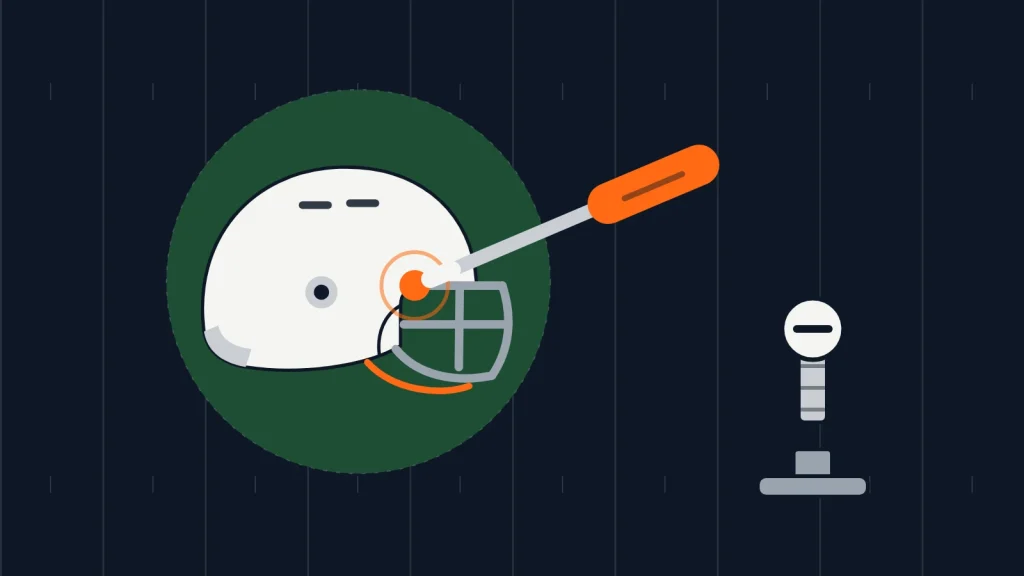
The cap that holds the liner to the shell comes off with a flathead screwdriver, counter-clockwise. On refitting, Riddell asks you to check the liner is secure by pulling on it from inside the helmet, then sets an explicit limit: if it is secure, do not tighten any further, because overtightening may damage the liner valve stem.
What a repair must not cost you
Replacing a part with the original part is one thing; adding something else is another. NOCSAE published a statement on 8 May 2018 that leaves no room for doubt: adding a product to a previously certified helmet makes that certification voidable by the helmet manufacturer, because anything beyond a change of size, colour or graphics creates a model that has not been tested. Items that stay detached from the helmet, such as a skull cap or a mouthguard, are not affected.
Both manufacturers hold the same line. Riddell recommends against any third-party aftermarket accessory that alters the fit, form or function of the helmet or face mask, since such modifications void the NOCSAE certification and render the equipment illegal for most organised play. Schutt and Certor Sports likewise recommend against any non-approved third-party product, and state that the warranty falls when an add-on requires a modification of the helmet, chemical affixation such as adhesive, or an attachment method that harms proper helmet function. One exception is named: Schutt helmets worn with a properly installed Guardian Cap remain, the brand writes, fully certified and warrantied.
The Riddell warranty lists what voids it: used parts fitted instead of new ones, a guard, facemask or component from another manufacturer, a new hole drilled less than half an inch from another hole or from the edge of the shell, removal of the labels. The brand also recommends reconditioning every year, and at least every two years at a NOCSAE licensed reconditioner: that calendar is the subject of our guide on helmet reconditioning and replacement.
FAQ
Can you replace a facemask screw or a chin strap buckle yourself?
Manufacturers sell these parts separately and publish the removal and refitting procedures. Riddell nonetheless writes that the helmet must not be modified, changed or altered in any way.
Will another brand's part do?
Riddell and Schutt both recommend against third-party accessories that alter the fit, form or function of the helmet or facemask, and the Riddell warranty names the attachment of a component from another manufacturer among the conditions that void it.
What should you do when a liner deflates between series?
Examine the valve: if it is missing, fit a new one; if it is damaged, remove it with needle-nose pliers; if the bladder itself is at fault, the whole component has to be replaced.
Is a special tool needed to remove a chin strap?
On the SpeedFlex, Riddell names a 15/16 inch socket or its Quick Release tool (R2764022) for the thumb screw.
Sources
- Riddell, SpeedFlex Platform Helmet Fitting Guide (R41195, R61195, R41196, R61196): https://content.riddell.com/wp-content/uploads/2021/01/SpeedFlex-Platform-Helmet-Fitting-Guide-min.pdf
- Riddell, Response to Address Aftermarket Accessories and NOCSAE Certification: https://news.riddell.com/info/releases/updated-riddell-response-to-address-aftermarket-accessories-and-nocsae-certification
- NOCSAE, Statement on Certification to Standards and Add-On Helmet Products (8 May 2018): https://nocsae.org/wp-content/uploads/2018/05/NOCSAE-Add-On-Products-Release-5-8-18-Updated.pdf
- Schutt Sports, Product Warnings: https://schuttsports.com/pages/product-warnings
- Schutt Sports, product pages for the F7 AiR Mini Hardware Kit, Quarter-Turn Hardware, Chinstrap Buckles, Grip Clip Kit and Air Inflator Pump: https://www.schuttsports.com/products/f7-air-mini-hardware-kit