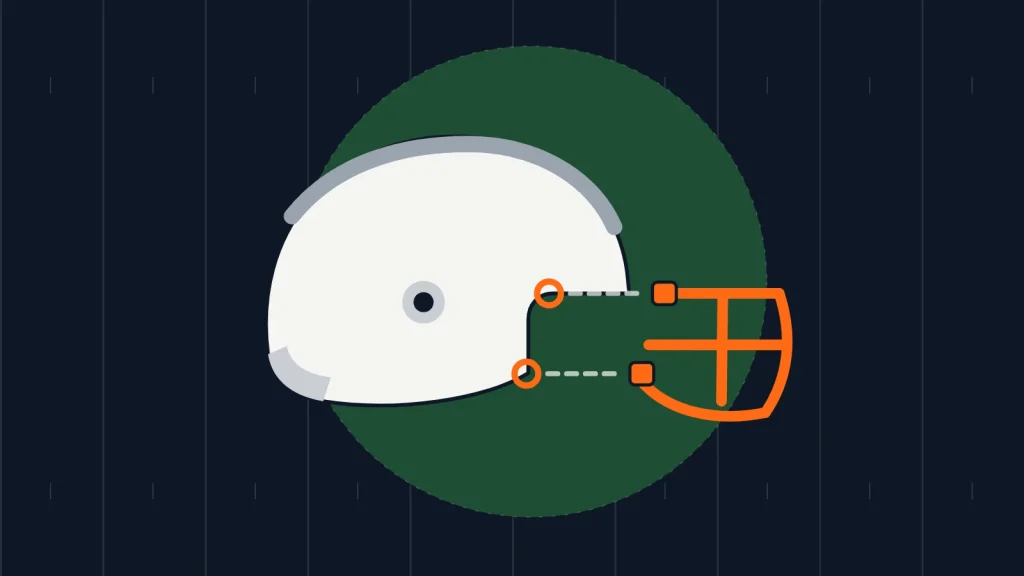
A bent bar, a change of position, a second-hand helmet: sooner or later the facemask comes off and goes back on. Not every brand publishes instructions, and those that do keep them to a few lines. Here is what they say, and what they leave out.
Contents · 9 parts
The 2-minute summary
- Compatibility comes first: NOCSAE standard ND087 has every faceguard tested on every helmet model it is meant to fit, and makes the manufacturer publish that list.
- Four mounting points: a clip, a screw and a T-nut at each one; the Xenith instructions have you remove four screws.
- The hardware is not in the box: Schutt and VICIS sell their faceguards without it, and Schutt offers a kit of four screws, four T-nuts and four loop straps.
- The tightening order is written down: Xenith fits the front clips first, then the side clips, and tightens the top screws before the side ones, without overtightening.
- None of the instructions we read gives a torque figure.
- Refitting is not recertifying: only NOCSAE-licensed reconditioners requalify a helmet and its faceguard.
The faceguard has to belong on that shell
NOCSAE standard ND 087 never tests a faceguard on its own. The sample has to be mounted on a helmet that complies with ND002 and is "listed by the faceguard's manufacturer as being compatible", and the test has to be repeated "on every helmet model that the faceguard is intended to fit". The manufacturer must also make public the list of helmets its faceguard has been tested and certified on.
That list takes one line on a product page. The Schutt F7 ROPO-SW-NB-VC, the F7 EGOP III, the F7 EGOP II-DW-NB-VC and the F7 EGOP IV-NB-VC cover every size of the F7 2.0, VTD and LX1; the F7X-EGOP, by contrast, states that it only fits the F7 Pro and F7 AiR and does not fit earlier F7 models. The VICIS ZERO2 SC-237, the SO-212 and the SO-212E cover all sizes of the ZERO2, and the Riddell SF-2BD-SW the SpeedFlex platform. The rest sit in the facemasks collection, alongside the football helmets they belong to. If it is the bar pattern rather than the fixing you are weighing up, our guide to choosing a facemask for your position covers that question.
Mixing brands has a consequence set down in writing. Riddell's warranty is void in the event of "attachment of a guard, facemask or component of another manufacturer or mismated material". The same booklet also tells you not to modify, change or alter the helmet in any way.
Four points, three parts at each one
On a helmet with conventional hardware, each mounting point brings together a clip that grips the facemask bar, a screw, and a T-nut sitting behind the shell, plus the loop strap where the model uses one. Schutt's replacement kit, listed for the F7 2.0, F7 VTD, F7 LX1, Vengeance A11 2.0 and Vengeance Pro LTD II, holds four screws, four T-nuts and four loop straps. Schutt notes that it fits neither the F7 AiR nor the F7 Pro: those two helmets use their own system.

That hardware almost never ships with the faceguard. Schutt prints "facemask attachment hardware not included" on its F7 pages, and VICIS states that the hardware comes with its helmets rather than with faceguards bought separately. So order the kit that matches your helmet before you undo anything.
Taking the facemask off
Of the brands in our catalogue, Xenith publishes the most detailed instructions. They call for a Phillips-head screwdriver and amount to two moves: take out all four screws from the facemask clips, then remove the facemask. On helmets that ship with eyeshield mounting brackets already fitted, the instructions have you take out the two matching screws and T-nuts as well.

At Riddell, the SpeedFlex and SpeedFlex Diamond fitting and care booklets, read from cover to cover, describe the liner, the face frame pads and the chin straps, but not facemask removal. They do name an in-house tool, the Riddell Quick Release (catalogue reference R2764022), but for the chin strap thumb screw. With no published instructions on that point, the safe route is to ask the manufacturer or an authorised dealer for the procedure.
Refitting, and tightening in order
The Xenith instructions walk through the refit. The clips go onto the new facemask with the logo facing out, each one lined up with a T-nut and sticking out slightly on the front and the side of the helmet. The front clips go on first, over the T-nuts, with a finger holding each T-nut in place from behind; the side clips are then aligned. The screws go through the clips at the top of the facemask and into the T-nut to secure, without overtightening; those top screws are tightened first, then the ones on either side of the helmet.
None of the pages we consulted publishes a torque figure. Xenith stops at "do not overtighten", the same wording Riddell uses for its face frame pad caps. We will not put a number on it either: sticking to the manufacturer's instruction is the only defensible position. The Xenith page is also a reminder that the eyeshield brackets go back on with the facemask, worth checking if you run a visor.
What a refit does not replace
Reconditioning and recertification are two separate acts, defined by NOCSAE together with the reconditioners' association NAERA. Reconditioning is the inspection, cleaning, sanitising and repair or restoration of equipment to its original performance standard; recertification is the retesting of previously certified equipment to make sure it still meets the original requirements of the NOCSAE standard, updated labelling included. To keep its original certification, a helmet or faceguard must be reconditioned and recertified according to manufacturer instructions; if a certified helmet is not recertified within the interval its manufacturer specifies, the existing certification expires and only comes back through recertification. NAERA members are licensed by NOCSAE for that work, take six weeks or more, add a dated label, and in most cases helmets can be recertified until they are ten years old.
Riddell recommends reconditioning every year by a Riddell Factory Authorized Reconditioner and sets a floor: the warranty is void if the helmet has not been reconditioned at least every two years by a NOCSAE Licensed Reconditioner, or if new holes have been drilled less than half an inch from each other or from the edge of the shell. Recertified faceguards even have a standard of their own, ND089. Changing a facemask at home is therefore maintenance, never requalification; our guide to helmet reconditioning and replacement sets out that calendar.
The check before you play again
Riddell opens its booklets with a line to inspect the helmet before each use. The rulebook only looks at the result: a facemask in place and a secured four- or six-point chin strap, all points secured whenever the ball is in play (rule 1-4-4-a-1 of the 2023 BAFA/IFAF edition), which is where the list of mandatory football equipment begins. ND087 notes that the chin strap system is part of the system tested with the faceguard, so check it during the refit, with our guide to fitting a chin strap and the chin straps collection.
FAQ
Can I fit another brand's facemask on my helmet?
Manufacturers do not provide for it. ND087 only certifies a faceguard on the helmets its maker lists, and Riddell voids its warranty where a facemask from another manufacturer is attached.
Does the hardware come with the facemask?
Not at the two brands that spell it out: Schutt states that attachment hardware is not included, and VICIS that it comes with its helmets. Schutt sells a separate kit of four screws, four T-nuts and four loop straps.
What tool do I need?
Xenith calls for a Phillips-head screwdriver. The other brands in our catalogue publish no facemask removal instructions on the pages we consulted.
Does changing the facemask void the helmet's certification?
None of the pages we read says so. What they do say is more precise: the original certification is kept up through reconditioning and recertification carried out according to manufacturer instructions, and Riddell rules out both altering the helmet and attaching another brand's facemask.
Sources
- NOCSAE, standard ND087-24m25 (football faceguards): <https://nocsae.org/wp-content/uploads/2025/02/ND087-24m25-football-faceguard.pdf>
- NOCSAE and NAERA, "Recertification and Reconditioning of Sports Equipment": <https://nocsae.org/wp-content/uploads/2023/06/FINAL-NOCSAE-NAERA-Recertification-Reconditioning-1.pdf>
- Xenith, facemask installation fitting guide: <https://xenith.com/pages/fitting-guide-facemask-installation>
- Riddell, SpeedFlex Diamond fitting instructions and helmet care guide: <https://content.riddell.com/wp-content/uploads/2021/01/SpeedFlex-Diamond-Helmet-Fitting-Guide-min.pdf>
- Riddell, SpeedFlex Platform fitting instructions and helmet care guide: <https://content.riddell.com/wp-content/uploads/2021/01/SpeedFlex-Platform-Helmet-Fitting-Guide-min.pdf>
- Schutt, facemask hardware pack: <https://schuttsports.com/products/schutt-hardware-pack>
- BAFA / IFAF, 2023 rulebook, Rule 1 (equipment): <https://rules.bafra.info/rulebook/bafa2023/1.html>