The pads inside a helmet are not comfort padding: they are what holds the shell on the head. No manufacturer publishes how many seasons a pad lasts, but every one of them publishes the checks to run and the replacement thicknesses on sale. This guide sticks to what they write.
Contents · 9 parts
The 2-minute summary
- Check before every session: Schutt asks for the fit and the presence of all pads to be checked each time before play; Riddell prints "INSPECT HELMET BEFORE EACH USE" on the first page of its fitting guides.
- No published service life: neither Riddell nor Schutt states a number of seasons. The only dated figure is the warranty on internal parts, one year at both brands.
- Three signals: a missing or damaged pad, a helmet that fails the fit checks, an inflatable liner that no longer holds air.
- Change thickness before changing helmet: Schutt lists its HSS jaw pads from 3/8" to 1 1/4", plus 1/4" inserts that slide underneath.
- Factory parts only: Schutt does not cover damage caused by parts that are not factory parts, and Riddell voids its warranty if used parts go in during a liner replacement.
What is actually inside a helmet
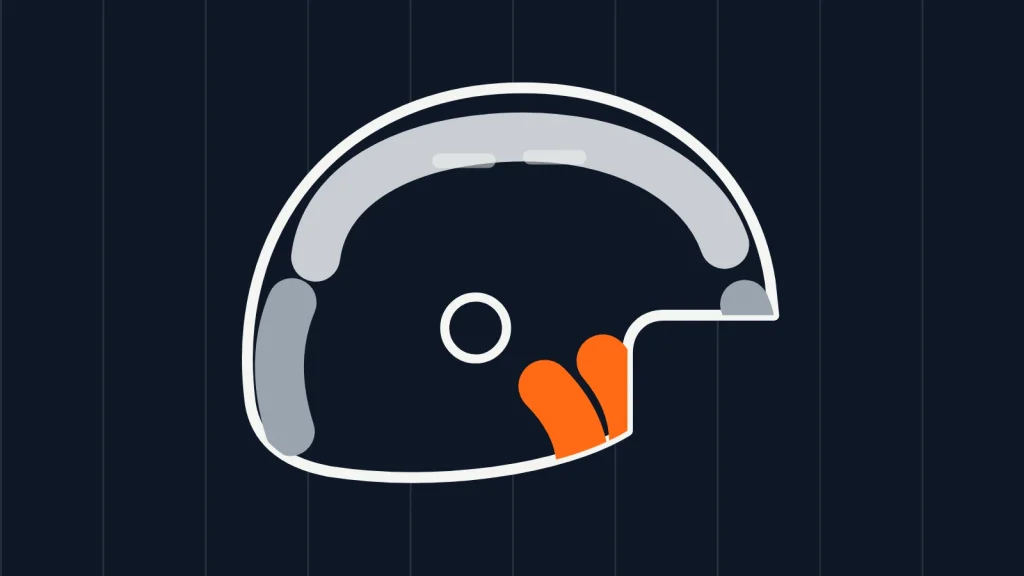
A football helmet does not have "a" pad but a set of separate pieces, each fixed to a precise spot on the shell. On the Riddell SpeedFlex platform, the fitting guide names the Crown Pad, the Back/Side Liner, the Face Frame Pads, the Front Pad, the Occipital Lock and the Flexliner. On the Speed platform, the side pads are called S-Pads and the rear liner becomes the Back/Neck/Side Liner.
These pieces are sold individually: the chin straps and helmet accessories sub-collection gathers them alongside the attachment hardware, such as the Schutt Grip Clip Kit, which fits any helmet model once its snap screw has been replaced and installed. Jaw pads, on the other hand, belong to one attachment system: the Schutt Universal HSS Jaw Pads are compatible with every Schutt entry in our football helmets collection that uses the Helmet Stabilization System, and are not compatible with Inter-Link pads. The crown pad and the side liner are also sold on their own, but fit one platform only: the F7 VTD crown liner and the F7 VTD lateral liner only fit the Schutt F7 VTD Collegiate and Professional.
The checks the manufacturers publish
Riddell describes three verifications in its fitting guides, and they double as a wear test:
- the front of the helmet sits roughly one inch above the eyebrows;
- the skin of the forehead moves with the front pad when the helmet is turned side to side, and if it does not, the helmet is too loose;
- all liners touch the head: interlock your hands on top of the helmet and press down, and the pressure should be felt on the crown rather than on the brow.
Xenith adds a check once all four chin strap buckles are snapped into place: mild force applied to the facemask in several directions should not move the helmet. The brand notes that Sizing Pads, Comfort Pads and Jaw Guards are available to fine-tune the fit. Schutt is the blunt one: "the fit of the helmet and the presence of all pads (jawpads, front pad, and full liner set) should be checked each time before play". Chin strap tension, which decides how the jaw pads sit, is covered in our guide on fitting a football chin strap.
Three signals that force a decision
A missing or damaged pad. NOCSAE writes that you should not use any helmet that is cracked or has missing padding or fitting pieces. It is the only criterion phrased as a prohibition, and it does not depend on the age of the helmet.
A helmet that fails the checks. If the forehead skin no longer moves with the front pad, if the helmet turns under mild force on the facemask, if the liners no longer all touch the head, the fit has been lost. Check size and adjustment first, with our guide on football helmet sizing; if the size is right, pad thickness is what needs revisiting.
An inflatable liner that no longer holds air. At Riddell, inflation is done with a glycerin-lubricated 5/8" needle, into the crown pad and the back/side liner first, then into the side pads. If a cushion refuses to inflate, either the valve is missing, and a new one (catalogue number R45926) is enough; or it is damaged, and it has to be pulled out with needle-nose pliers, replaced, and the damaged liner component replaced too. On the Schutt side, air cushions are inflated with a hand pump fitted with an air release valve and a 20mm needle.
Change thickness rather than helmet
The usual case is not a destroyed pad but a helmet that fits the head and stays loose around the cheeks. Schutt sells a part for exactly that: 1/4" inserts that slide underneath the HSS jaw pads already in place.
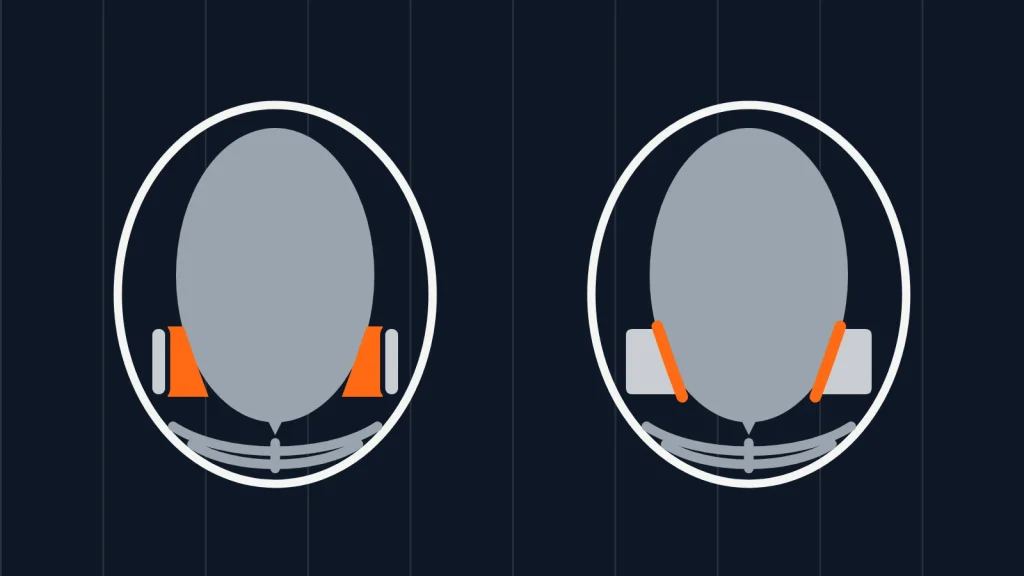
The thicknesses the brand publishes, in inches, show how much room there is before a new helmet becomes the only answer:
| Schutt part | Published thicknesses | Helmets covered |
|---|---|---|
| Universal HSS jaw pads | 3/8", 1/2", 3/4", 1", 1 1/4" | all Schutt helmets using the HSS system |
| F7 AiR HSS jaw pads | 3/8", 1/2", 3/4", 1", 1 1/4", 1 1/2" | F7 AiR, F7 2.0, F7 VTD, F7 LX1, A11 2.0 (2024/2025) |
| HSS jaw pad fit inserts | 1/4" | underneath an existing HSS jaw pad |
| Inter-Link jaw pads (bases and cover or covers only) | 5/8", 1", 1 1/8", 1 3/8" | Schutt helmets without HSS, F7 models excluded |
| F7 2.0 fit kit | 1/4" pods | F7 2.0 |
Recent HSS pads are described by Schutt as TPU 2.0, impervious to moisture; the Inter-Link pads are mechanically attached, and their covers are sold separately from the bases. On the adult helmets collection, that range of thicknesses is often what separates a helmet that moves from one that stays put.
Refitting a pad without taking the helmet out of the rules
Riddell describes removal piece by piece: unscrew the attachment cap from the outside of the shell, peel back the upper Velcro, then pull the pad out. On refitting, the valve stem lines up with its hole, the cap is screwed back without forcing it (overtightening can damage the stem), and the hold is checked by pulling on the liner from inside.
Both manufacturers then set out what is allowed. Schutt permits you to replace any part of the helmet system as long as you follow its guidelines, but warns that alterations, additions and removals of components may void the warranty and adversely affect the protective capabilities of the helmet; damage caused by parts that are not factory parts is not covered, and internal parts are warranted for one year. Riddell also warrants its component parts for one year, and voids the warranty where used parts are installed during a liner replacement. Schutt finally recommends against any third-party accessory that alters the fit, form or function of the helmet or facemask: fitted outside its guidelines, it voids the certification and makes the helmet illegal in most organised leagues and games.
So what about service life?
There is none published for pads on their own. What is dated are the reconditioning cycles: Riddell recommends a yearly visit to an authorised reconditioner and requires one at least every two years by a NOCSAE licensed reconditioner, using only new factory replacement liners. Schutt ties its own shell warranty, after the first year, to reconditioning every two years by a NAERA-certified reconditioner. That is where tired pads go. The subject is covered in our guide on helmet reconditioning and replacement.
FAQ
How often should helmet pads be checked?
Before every use. Schutt asks for the fit and the presence of all pads to be checked each time before play, and Riddell puts the same instruction on the first page of its fitting guides.
Can you fit another brand's pads in your helmet?
Manufacturers advise against it. Schutt recommends against any third-party accessory that alters the fit, form or function of the helmet, on pain of voiding the certification.
My helmet fits my head but is loose at the cheeks, do I need a new one?
Not necessarily. Schutt sells 1/4" inserts for that exact case, and offers its jaw pads in five or six thicknesses depending on the model.
How long is a helmet pad under warranty?
One year from the date of purchase at both Schutt and Riddell. Neither brand publishes a service life beyond that.
Sources
- Schutt — Product Warnings
- Schutt — Warranty
- Schutt — Universal HSS Jaw Pads (Pair)
- Schutt — F7 AiR HSS Jaw Pads
- Schutt — HSS Jaw Pad Fit Inserts (Pair)
- Schutt — Inter-Link Jaw Pads Bases and Cover (Pair)
- Schutt — F7 2.0 Fit Kit
- Schutt — Air Inflator Pump
- Riddell — SpeedFlex Platform Helmet Fitting Guide (PDF)
- Riddell — Speed Platform Helmet Fitting Guide (PDF)
- Xenith — Fitting Guide Shadow XR
- NOCSAE — What Players, Parents and Coaches Need to Know About Football Helmets (PDF)