
Flag football is played without a helmet and without shoulder pads, but rarely barefoot. No rulebook tells you which shoes to buy: they only tell you which ones you cannot wear, in a single sentence built around one number. This guide works from the IFAF, FFFA and AFVD rulebooks and from manufacturer specifications only.
Contents · 8 parts
The 2-minute summary
- One limit only: studs no longer than 1.25 cm, not sharpened, not pointed, not metal.
- Nothing is compulsory: shoes do not appear in the IFAF list of mandatory equipment.
- Moulded studs are the safe bet: the French wording names detachable studs explicitly.
- Nobody publishes stud height: only a ruler against the outsole will tell you.
- The surface decides: grass, artificial turf, indoor courts and sand call for four different soles.
- On sand: in beach flag, the rulebook bans every type of footwear.
Shoes only appear on the banned list
The IFAF International Flag Football Rules 2023 set out mandatory equipment in rule 1, section 3, article 1: a single-colour jersey tucked into the shorts with a number at least 15 cm high on the back, shorts or trousers "without pockets, press studs or clips", and a tight flag belt with pop sockets carrying two identical flags. Shoes are not on that list.
They turn up in the next article, the one on illegal equipment, whose first clause covers "shoes with cleats longer than 0.5 inch (1,25 cm), sharpened or pointed in any way or made of any metallic material". Everything else is allowed, which is why a flag football tournament is a parade of mismatched footwear: soccer boots, American football cleats, indoor court shoes. The rest of the rulebook is covered in our guide to the flag football rules.
Three official rulebooks, three wordings
The German AFVD text, 2026 edition, repeats the limit almost word for word: illegal equipment includes shoes with studs "longer than 1.25 cm, sharpened or pointed in any way, or made of a metallic material".
The French FFFA version adds one word. It bans "shoes with detachable cleats longer than 0.5 inch (1.25 cm), pointed or sharpened at the tip, or made of metal". Two rulebooks out of three draw no line at all between moulded and detachable studs, so the wider reading is the one to keep: 1.25 cm maximum, whatever the stud type.
On the American side, NFL FLAG keeps it to a single sentence: "Metal cleats are not allowed in flag football."
Measure one stud before the tournament
The measurement runs from the base of the outsole to the tip of the stud. None of the manufacturers in our catalogue publish that figure, not Nike, not adidas, not Under Armour: a ruler and thirty seconds remain the only way to know where you stand.

It is an easy check to skip, and it binds the whole squad: the IFAF asks every coach to hand a roster to the referee and certify that all players wear the mandatory equipment and have been told what counts as illegal equipment.
Moulded studs keep it simple
Under Armour sums up the two families in one line: moulded cleats "have fixed studs built into the outsole for a consistent feel and easy upkeep", while detachable cleats "let you change the studs to match the field, weather, or way you play".
In flag, that selling point works against you. Swapping studs is only worth it if length can go up, and here it is capped; and the French wording names detachable studs directly. Almost every pair of football cleats in our catalogue is a moulded cleat, with a single model listed under detachable cleats. Our guide to moulded or detachable cleats compares the two for the contact game.
The surface decides: grass, turf, indoor, sand
Flag is played on four surfaces, and the French rulebook treats three of them separately. On natural grass, Under Armour points to moulded cleats with permanently attached studs that "dig into the soil for better traction". On artificial turf, it recommends shoes built for turf, which "have small nubs or treads instead of spikes".
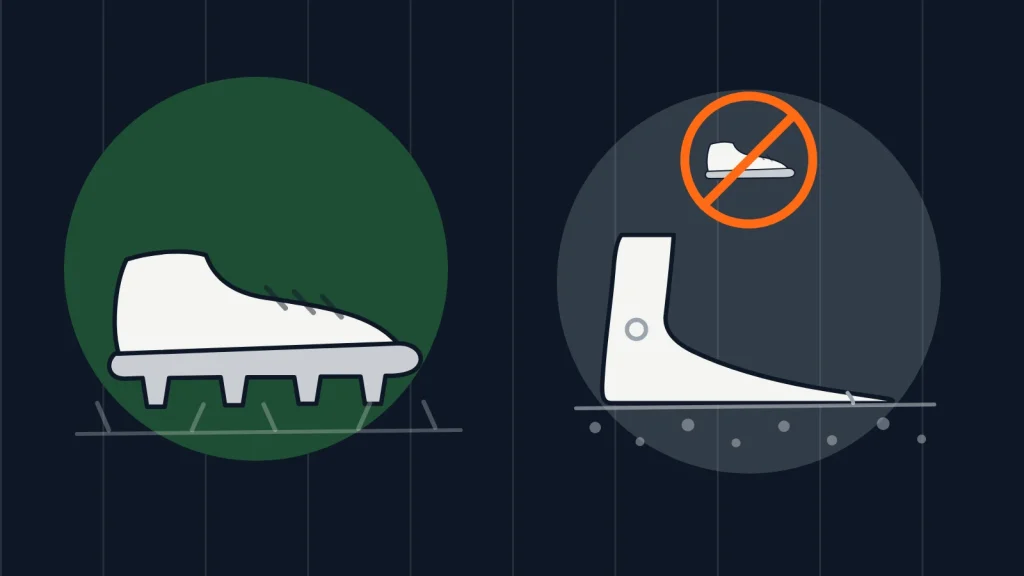
Indoors, the FFFA points back to the beach flag rules, or to the flag football rules where space allows, then states it plainly: "shoes suitable for indoor sport are to be used". On sand it goes further still, with a modification that leaves no room at all, "all types of footwear are forbidden"; the AFVD adds that a beach flag surface "should be sand and need not be firm".
| Surface | What the source says | Shoe |
|---|---|---|
| Natural grass | Under Armour: fixed studs that "dig into the soil" | Moulded studs, 1.25 cm or less |
| Artificial turf | Under Armour: "small nubs or treads instead of spikes" | Turf shoe, or short moulded studs |
| Indoor court | FFFA: "shoes suitable for indoor sport" | Indoor shoe, no studs |
| Sand (beach flag) | FFFA: "all types of footwear are forbidden" | None |
Plenty of European clubs train indoors through the winter and play on grass in spring: one pair will not cover both.
Low cut or mid cut: what can be said without testing
The FFFA flag code is blunt: "Flag football is a non-contact sport! Blocking, tackling and kicking are not allowed." The usual case for a high cut, holding a lineman together in the trenches, has no equivalent here. Under Armour, for its part, ties the low cut to "a lighter feel and fast footwork".
No rulebook prescribes a height, and AFG has tested no pair: we do not rank these models on feel.
What our catalogue carries
The four models below are moulded cleats, at the lowest prices recorded at European retailers. No manufacturer publishes a stud height for them: measure yours when the box arrives.
| Model | Lowest price recorded | What the manufacturer publishes |
|---|---|---|
| Nike Alpha Menace 3 Shark | €109.95 | All-terrain rubber outsole, mid-cut design, Fastflex technology |
| adidas Adizero Chaos II | €159.95 | REPETITOR midsole, padded collar, quick lacing |
| Nike Alpha Menace Varsity 3 | €169.95 | 12-stud outsole, side wings linked to the lacing |
| Nike Vapor Edge Pro 360 2 | €185.90 | Widely spaced studs "to make changes of direction easier", separate internal plate |
Our catalogue lists neither indoor shoes nor turf trainers: for those two surfaces you will have to look elsewhere. On sizing, Under Armour fits on one line, the shoe should be "snug, but not tight, with a sock-like feel", with "about a thumb's width of room" in front of the longest toe; our guide on how football cleats should fit covers the measurement, and how to choose football cleats deals with the contact game.
For the rest of the kit, belt, American footballs and mouthguard, see our list of what you need to play flag football and the mouthguards shelf.
FAQ
Can you play flag football in American football cleats?
Yes, as long as the studs are no longer than 1.25 cm, are neither sharpened nor pointed, and are not metal. That is the only condition the IFAF sets.
Are detachable studs banned in flag football?
The IFAF and AFVD texts only address stud length, tip and material, and say nothing about detachable studs. The French FFFA text does name "detachable cleats": in France, a moulded pair avoids the argument altogether.
Do you actually need shoes to play flag?
The IFAF list of mandatory equipment does not mention them. In beach flag it is the other way round: the French rulebook bans every type of footwear.
Which shoes for indoor flag football?
The FFFA asks for "shoes suitable for indoor sport". Studs, moulded ones included, stay outside.
Sources
- IFAF, International Flag Football Rules 2023: https://www.americanfootball.sport/wp-content/uploads/2023/05/FlagRules2023.pdf
- AFVD, Flag Football Regeln 2026: https://afvd.de/wp-content/uploads/2026/01/AFVD_Flag_Football_Regeln_2026.pdf
- FFFA, Règles Flag Football, 2021 edition: https://l2fa.fr/wp-content/uploads/2021/10/FFFA-Regles-flag-football-2021-CC.pdf
- NFL FLAG, Flag Football Equipment: https://nflflag.com/coaches/default/flag-football-rules/flag-football-equipment
- Under Armour, How To Buy The Best Football Cleats: https://www.underarmour.com/en-us/t/playbooks/football/best-football-cleats/