
In flag football the mouthguard is just about the only piece of protection a player actually wears. The rulebooks do not all say the same thing about it, though, and the model you bought for the contact season may not be usable as it stands. Here is what the texts require, and what that changes when you buy.
Contents · 8 parts
The 2-minute summary
- No helmet, no tether: flag bans the helmet, so there is no facemask bar for a mouthguard strap to clip onto.
- Required or recommended, depending on who runs the game: the 2023 IFAF rules call it "strongly recommended", while AFVD 2026 and NFL FLAG make it compulsory for every player.
- 1.25 cm: all three rulebooks we opened cap what may stick out of the mouth at 0.5 inch (1.25 cm).
- Colour: a visible, non-white colour under IFAF; the 2021 FFFA edition also rules out clear guards.
- Breathing: airflow channels are manufacturer claims, and AFG has measured none of them.
- Braces: silicone models exist that fit without any boiling.
What flag changes compared with contact football
In contact football the mouthguard arrives with everything else: helmet, facemask, chin strap, shoulder pads. In flag football, the rulebook files almost all of that under illegal equipment. The German text for 2026 lists "jede Art von Schulterpad, Helm oder Kopfbedeckung" — any kind of shoulder pad, helmet or headwear — and the French federation's edition says the same. A flag player therefore takes the field with a jersey tucked into the shorts, a flag belt, shoes with no metal studs, and a mouthguard.
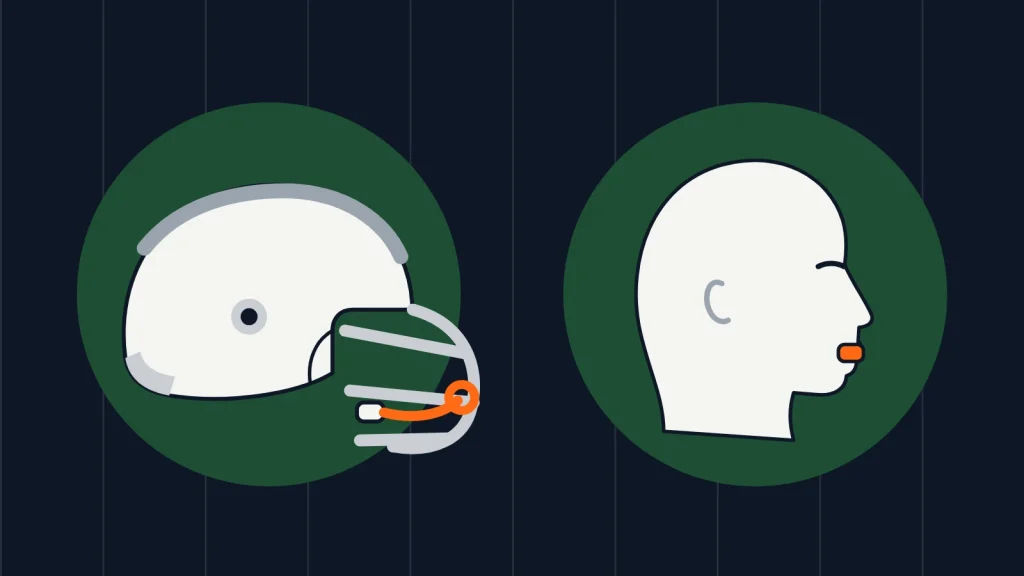
The consequence is very concrete. Most mouthguards sold for American football ship with a strap meant to clip onto a facemask bar. In flag, that strap has nothing left to attach to. At best it is useless; at worst it is a problem, because all three rulebooks we opened set the same limit: no part of the mouthguard may extend more than 1.25 cm out of the mouth. A dangling tether does not fit inside that limit. So if you are reusing gear from the contact season, store the strap away with your football helmets and facemasks, and play without it.
What your federation actually requires
The status of the mouthguard is not the same everywhere, and that is the part that catches most players out. Here are the texts we relied on.
| Rulebook | Edition | Status of the mouthguard | Colour | Protrusion |
|---|---|---|---|---|
| IFAF, 5-a-side flag | 2023 | Strongly recommended | Visible, non-white | 1.25 cm maximum |
| FFFA (France) | 2021 | Only applies if a player wears one | Visible, neither white nor clear | 1.25 cm maximum |
| AFVD (Germany) | 2026 | Compulsory for every player | Visible | 1.25 cm maximum |
| NFL FLAG | consulted November 2026 | Compulsory for every player | Not stated | Not stated |
The 2023 IFAF rulebook reads: "If an intra-oral mouthpiece is worn it shall be of a visible, non-white color and with no part extending more than 0.5 inch (1,25 cm) out of the mouth. The use of a mouthpiece is strongly recommended." The 2021 French edition sets the same limit but keeps the rule conditional on wearing one, and adds clear guards to the ban. The 2026 German rulebook leaves no choice: every player must wear a mouthguard in a visible colour. NFL FLAG, on its safety page, states: "We require that every NFL FLAG player wear a mouthguard and properly fitted flag belts."
In short, the two older texts we could open recommend it, while the 2026 texts require it. We were unable to open a 2026 English-language IFAF flag rulebook during our research, so before a tournament, check the edition your federation currently applies, along with the competition's own regulations, which may be stricter.
One procedural detail worth knowing, in France as in Germany: before kick-off the head coach certifies to the officials that every player has the mandatory equipment and has been told what counts as illegal equipment. A white mouthguard at a tournament run under the French text is the coach's problem, not just the player's.
Tethered, untethered, or both
Three models in our mouthguards collection settle the question without making you buy twice. The Shock Doctor Gel Max comes with a convertible attachment and a detachable helmet strap: take it off for flag, put it back on for the contact season. The Shock Doctor Max AirFlow works the same way. The Makura Tephra Max Convertible puts that idea in its name, with a removable helmet strap.
The Battle Oxygen, on the other hand, ships with a fixed, non-removable strap designed for a facemask. It is a sound contact-football mouthguard; it is not the right pick for flag. And if flag is all you play, a strapless model removes the question at the checkout: the Shock Doctor V1.5 is listed at €9.95 in youth and adult sizes.
Breathing when the game does not stop
Flag is played without tackling but not without effort: sprints, changes of direction, defending on your feet, and a clock that rarely stops. Breathing therefore becomes a real criterion, more so than in contact football, where series are short and broken up.
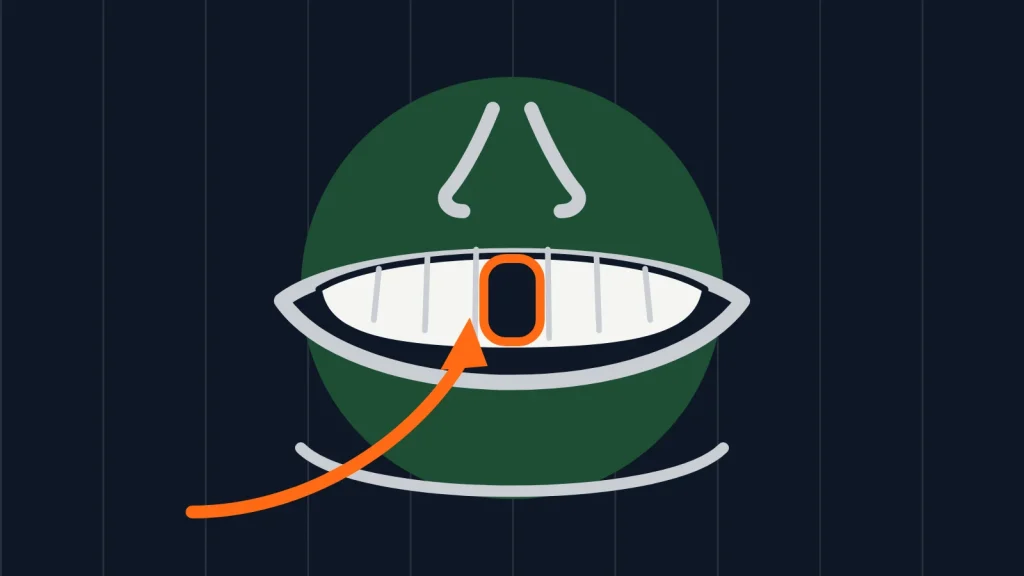
Every manufacturer talks about it, and none publishes a comparable measurement. Shock Doctor advertises integrated breathing channels on the Gel Max and, on the Max AirFlow, "10% more airflow capacity" plus a Jaw-Relax platform meant to stop the teeth blocking the passage. Makura calls its channel AIRTHRU. Battle claims the largest breathing channel on the market. Those sentences come from the brands, not from an independent laboratory: AFG has run no tests and does not rank them.
Two firmer reference points, though. First, no NOCSAE standard covers mouthguards at all, so a "NOCSAE certified" claim on a mouthguard has nothing behind it. Second, only one model in our catalogue carries a verifiable certification: the Tephra Max Convertible, with CE marking, SATRA and UKCA certification, and BS EN 1186:2002 and BS EN 71-3:2013 testing.
Thickness, fitting and braces
A thick mouthguard protects more and gets in the way more. The constructions quoted by manufacturers give a rough idea: triple layer on the Gel Max and the Tephra Max, double layer on the V1.5. Fitting is done in hot water on boil-and-bite models, while the Max AirFlow fits with no boiling at all. The full method is in our guide to moulding a boil-and-bite mouthguard.
With braces, hot-water moulding is the wrong route. The Shock Doctor Braces is made of 100% medical-grade silicone, fits without boiling and adapts as the teeth move between orthodontic adjustments. The American Dental Association notes that a dental professional may help with the final moulding, particularly for a wearer with orthodontic appliances.
For every other criterion, our two existing guides still apply to flag: how to choose a mouthguard and, more broadly, what you need to play flag football. The mouthguard remains the simplest item in your football protection, and the only one flag really keeps.
FAQ
Is a mouthguard compulsory in flag football?
It depends on the rulebook in force. The 2023 IFAF rules call it "strongly recommended". The 2026 AFVD rulebook and NFL FLAG require it of every player. Check the current text of your own federation and the specific regulations of your competition.
Can I keep the helmet tether in flag?
The rulebooks we read forbid any part of the mouthguard extending more than 1.25 cm out of the mouth, and helmets are banned anyway, so the tether has nothing to clip onto. Convertible models let you take it off.
Is a clear mouthguard allowed?
The 2023 IFAF rules ask for a visible, non-white colour. The 2021 FFFA edition also bans clear guards. The 2026 AFVD text requires a visible colour without naming either case. The three do not match, so follow your own federation.
Which mouthguard works with braces?
One designed for braces that does not need hot-water moulding. The Shock Doctor Braces is medical-grade silicone and follows the teeth as they move during treatment. Your orthodontist's advice outranks any buying guide.
Sources
- IFAF Flag Football Rules 2023 (PDF)
- FFFA, Règles Flag Football, 2021 edition (PDF)
- AFVD, Flag Football Regeln 2026 (PDF)
- NFL FLAG, Safety and Injury Prevention
- NCAFA, 2026 Flag Football Overview (PDF)
- NOCSAE, standards library
- American Dental Association, Athletic Mouth Protectors
- Shock Doctor, official European store
- Makura, Tephra Max