
A boil-and-bite mouthguard is decided in a handful of seconds: once you have bitten down, the impression is set, good or bad. Manufacturers publish precise instructions, and their timings look nothing alike from one model to the next. Here is what those instructions actually say, step by step, and how to check the impression took.
Contents · 11 parts
The 2-minute summary
- There is no universal soaking time: 12 seconds for the Shock Doctor Pro, 50 seconds for the Makura Tephra Max, 60 seconds for the Gel Max Power.
- Boiling water is not always the rule: Shock Doctor heats the water to 63–66 °C for the SuperFit Power and writes "Do NOT use boiling water".
- Two moves do the work: suck in while pressing the centre, then suck in while pressing the edges. Makura gives them 5 and 55 seconds and calls them the most important steps.
- Let it cool before it goes in: 90 seconds out of the water for Makura, 1 to 2 seconds under the tap for Shock Doctor.
- An objective check: Makura states that a properly fitted mouthguard should hold a hanging 100 g weight for at least 30 seconds without falling out.
- Braces: several boil-and-bite models are ruled out by their own makers, and dedicated pieces exist.
Start with the instructions for your model
This is the part generic tutorials skip: there is no shared protocol across shop-bought mouthguards. Shock Doctor says so plainly on its European store: boiling time and moulding steps vary by product, and you should always follow the instructions supplied with your model. The brand adds that the wrong timing can damage the material or spoil the fit. If you are still choosing the piece itself, our guide to picking a football mouthguard covers the rules, the product families and the certifications.
The kit list is short. Shock Doctor asks for a saucepan, a slotted spoon, a mirror, a bowl, water and a clock or watch with a second hand. Makura asks for the same, plus a cup of iced water. Both insist on the timer: at these durations, counting in your head is not good enough. The Makura leaflet also carries a "CAUTION! HOT WATER — ADULTS ONLY" warning: an adult handles the hot water, even when it is a child who bites.
Every model has its own soaking time
The gaps between instruction sheets, even from the same manufacturer, are striking, and they are not up for negotiation: they follow the thickness and the type of material.
| Model | State of the water | Soaking time |
|---|---|---|
| Shock Doctor Pro | Rolling boil, taken off the heat, left to stand 30 s | 12 s (10 s if you wear braces) |
| Makura Tephra Max Convertible | Brought to the boil, 3 cm of water in the pan | 50 s |
| Shock Doctor Gel Max Power | Rolling boil, taken off the heat, left to stand 30 s | 60 s, never longer |
| Shock Doctor SuperFit Power | Heated to 63–66 °C, never boiling | 35 to 45 s, facing up |
Take the principle rather than the numbers: a piece left in too long loses its shape. Makura puts it the same way on its product page, warning that water which is too hot can distort the mouthguard so that it no longer fits properly.
Bite, suck in, press
Lift the piece out with the slotted spoon, or by its tether when it has one. Shock Doctor suggests licking your lips before putting it in, then lining the mouthguard up with the centreline of the upper teeth in front of a mirror and placing it around all of the upper teeth. For the Gel Max Power, the brand adds the order of pressure: press firmly into the molars first, then the front teeth.
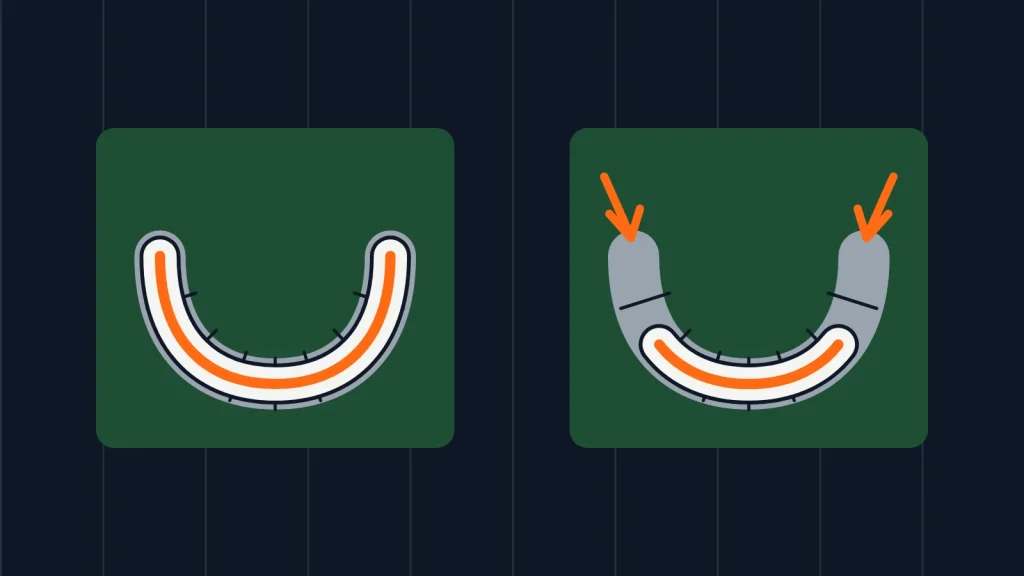
This is not only a comfort question. The IFAF rulebook requires the mouthpiece to cover all upper teeth and recommends that it be properly fitted. An impression that stops at the incisors leaves the rear teeth bare and the piece shifts about.
Then comes the decisive part:
- bite down firmly, tongue pushed against the roof of the mouth;
- suck in hard to draw the material onto the teeth;
- press with your fingers against the gums, first at the centre, then along the edges.
The durations again come from the instruction sheets. Shock Doctor asks you to hold the bite, the suction and the pressure on the edges for 20 seconds on the Gel Max Power. Makura splits the move in two: 5 seconds on the centre, then 55 seconds on the edges, and flags these as the most important steps of the whole procedure.
Mind the temperature of the piece as it goes in. Makura requires 90 seconds of cooling out of the water before it reaches the mouth, and repeats the point on the back of its leaflet. Shock Doctor runs the Gel Max Power under the tap for 1 to 2 seconds, purely to bring the surface down to a comfortable level.
Set the impression, then check it
The final cooling is not a formality: it is what locks the shape in. Shock Doctor asks for 30 seconds in cold water before the piece goes back in for a test fit. Makura goes much further with 10 minutes in iced water. Its own Ultra Braces model is dropped into a glass of cold water with ice cubes for at least two minutes.
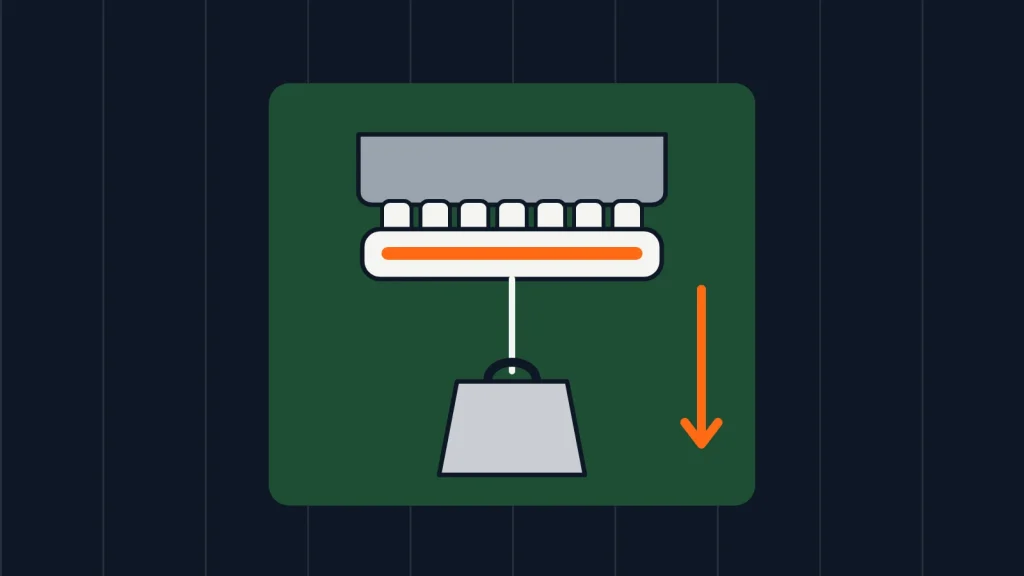
Makura gives the only objective criterion we found from a manufacturer: a suitably fitted piece should withstand a 100 g weight hanging from it for at least 30 seconds without falling out. Two other markers help you judge:
- the Shock Doctor Pro expands by up to 20% during a correct fitting, according to its instructions, so a piece that looks small out of the packet is not necessarily too small;
- Makura allows you, and only if necessary, to trim small pieces of excess material with a pair of scissors.
The mistakes that wreck the piece
- Going over the soaking time. The material turns too soft and the impression never bites deep.
- Putting it in too hot. Beyond the burn risk, you are pressing on material that has not settled.
- Chewing the mouthguard. Makura and Shock Doctor forbid it in the same terms: chewing or distorting the piece damages it, shortens its life and ruins its effectiveness.
- Rushing straight into another attempt. Makura asks for a few minutes of rest before you start again.
Re-moulding after a failed attempt
All three instruction sheets allow it, with shades of difference. Shock Doctor simply says to repeat the procedure from the start if the fit is not accurate; on the Ultra Braces model, the second attempt uses 15 seconds of soaking instead of 20. Makura asks you to let the piece rest for a few minutes, then run steps 1 to 7 again.
Shock Doctor's European store adds a caveat: re-moulding is generally not recommended unless the fit feels loose, uncomfortable or unstable. In other words, a second moulding happens because the first one failed, not as a routine at the start of each season.
Braces are a separate case
With braces, conventional boil-and-bite is usually off the table. Shock Doctor states that the Gel Max Power is not compatible with braces; Makura rules the Tephra Max out and points to its Lithos model, designed for braces, after advice from a dentist or orthodontist. Some pieces do plan for it: the Shock Doctor Pro soaks for 10 seconds instead of 12 with braces, and the brand's Ultra Braces model is fitted by pushing its inner brace channel over the brackets with your fingers.
The other route is to skip the step altogether. The Shock Doctor Max AirFlow fits instantly and takes braces, and the Battle Speed XL Mouthguard is sold ready to use, with no boiling, in one size. The Battle Oxygen follows the same logic and is likewise advertised by Battle as braces-compatible.
After the moulding
Makura asks you to wash the piece and its case in fresh water no hotter than 35 °C after every use, then dry both thoroughly before storage; on its product page the brand recommends a vented case. On replacement, the manufacturer's two official texts disagree: the leaflet says every two years, the product page at least once a year. We keep the shorter figure, together with the one genuinely useful criterion the brand gives, a visual check after each use: once the biting surface is worn, cracked or split, the piece is replaced immediately. For a jaw still growing, Makura asks a responsible adult to check the fit regularly and to replace the piece as soon as it feels loose or tight.
One last point from the field: a well-moulded mouthguard stays put on its own. If it is left hanging from the facemask during play, the official warns the player, and a third lapse costs the team a timeout or a delay-of-game penalty. The tether on a convertible model is there for the gaps between plays, not during them, and its clip is worth checking when you mount the facemask, like the rest of the head kit. See also our football helmets and the full range of football protection.
FAQ
How long should a boil-and-bite mouthguard soak?
It depends on the model. The instruction sheets we opened run from 12 seconds for the Shock Doctor Pro to 60 seconds for the Gel Max Power, with 50 seconds for the Makura Tephra Max in between. Follow the sheet that came with your piece.
Do you need boiling water?
Not always. Shock Doctor asks for a rolling boil taken off the heat for the Pro and the Gel Max Power, but heats the water to 63–66 °C for the SuperFit Power, with an explicit instruction not to use boiling water.
How do you know the moulding worked?
Makura gives a test: the piece should hold a 100 g weight hanging from it for at least 30 seconds without falling out. It must also cover all of the upper teeth, rear teeth included, as the IFAF rulebook requires.
Can a mouthguard be re-moulded?
Yes, the instruction sheets allow you to run the procedure again after a failure, with a few minutes of rest for Makura and a shorter soak on the Ultra Braces model. Shock Doctor does, however, advise against re-moulding a piece that already fits.
Sources
- Shock Doctor, Pro Mouthguard Fitting Instructions: https://www.shockdoctor.com/pages/pro-mouthguard-fitting-instructions
- Shock Doctor, Gel Max Power Mouthguard Fitting Instructions: https://www.shockdoctor.com/pages/gel-max-power-mouthguard-fitting-instructions
- Shock Doctor, Ultra Braces Mouthguard Fitting Instructions: https://www.shockdoctor.com/pages/ultra-braces-mouthguard-fitting-instructions
- Shock Doctor EU, How to Mold a Mouthguard: https://shockdoctorsports.eu/blogs/insights/how-to-mold-a-mouthguard-a-step-by-step-guide
- Shock Doctor EU, SuperFit Power Mouthguard: https://shockdoctorsports.eu/en-gr/collections/mouthguards/products/superfit-power-mouthguard
- Makura, Tephra Max Mouthguard Guide (official leaflet, PDF): https://makurasport.com/wp-content/uploads/2022/07/TephraMax_Mouthguard_Guide_EN.pdf
- Makura, Tephra Max: https://www.makurasport.com/products/tephra-max/
- IFAF Football Rules and Interpretations 2025, rules 1-4-4 and A.R. 1-4-8:I: https://amerikanskeidretter.no/wp-content/uploads/2025/02/IFAF-Rules-and-Interpretations-2025.2.1.pdf