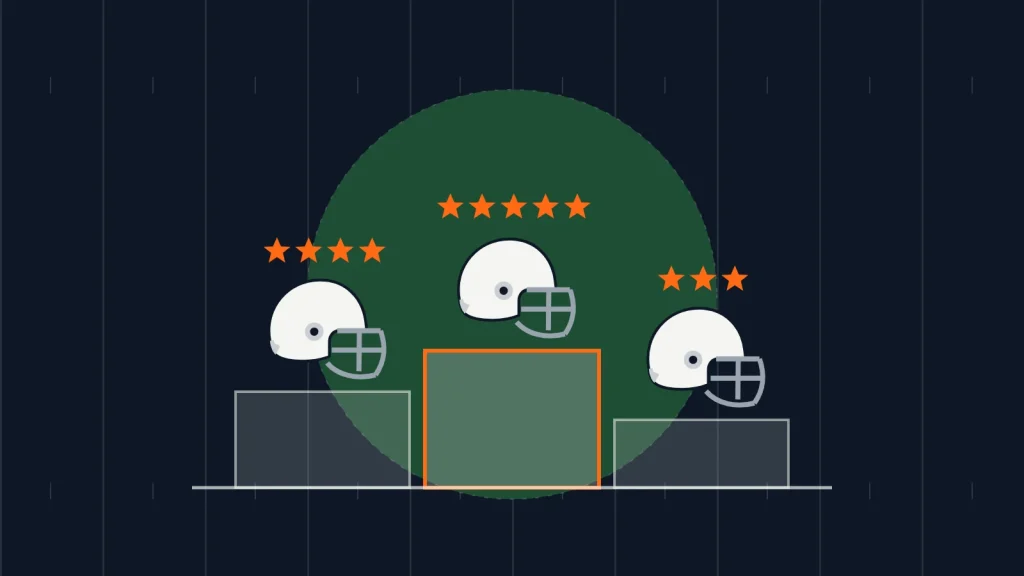
A helmet listed at 5 stars two years ago may show 4 today, without a gram of its shell changing. In July 2025 the Virginia Tech Helmet Lab raised the bar, and the thresholds published until then no longer apply. Here is how to read a line of the ratings before you buy.
Contents · 10 parts
The 2-minute summary
- 48 impacts per helmet: a pendulum reproduces a helmet-to-helmet collision at the front, front boss, side and back, at three energy levels.
- The score matters more than the stars: it estimates how many concussions an average player would see from those impacts, and lower is better.
- The thresholds changed on 14 July 2025: at varsity level, 5 stars now require a score below 1.8, against 10.0 before.
- Immediate effect: 33 of the 35 varsity helmets tested held 5 stars before the update, 11 after it.
- Varsity and youth do not compare: a headform the size of a 10 to 12 year old boy, its own thresholds, 5 stars below 1.7.
- In our catalogue: best varsity score 0.92 (Schutt F7 AiR), best youth score 0.81 (Schutt F7 AiR Youth Elite).
What the lab actually measures
The Virginia Tech Helmet Lab ranks football helmets against a single criterion, stated plainly on its home page: the ratings "identify which helmets best reduce concussion risk". The lab adds that the work is part of the university's service mission and is "100% independent of any funding or influence from helmet manufacturers".
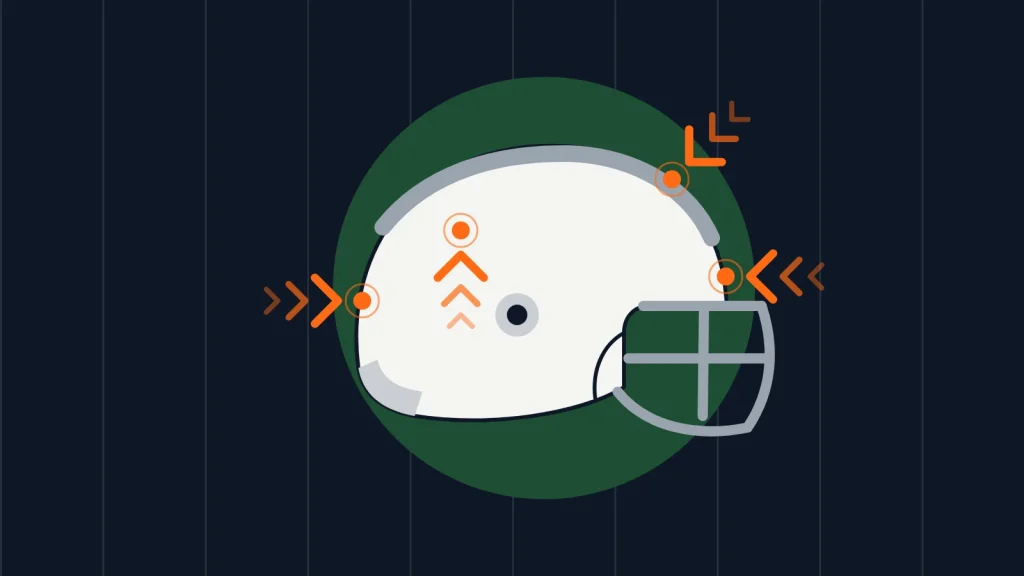
The varsity protocol fits in one sentence: 48 impact tests in the laboratory, using a pendulum designed to match helmet-to-helmet characteristics in football. Four locations are struck, the front, front boss, side and back, each at low, medium and high impact energy. Those 48 measurements collapse into a single number, the STAR score, short for Summation of Tests for the Analysis of Risk.
A score, not a mark out of ten
This is where most readers go wrong. The score is not a quality mark to maximise: it "estimates the number of concussions the average person would see if they experienced identical impacts at rates matching their weightings while playing football". In other words, a low score is a good score, and two helmets a tenth of a point apart are very close indeed.
The stars only exist to simplify that number. Virginia Tech recommends choosing a helmet rated 4 or 5 stars, and leaves it there. The lab also warns that scores from one set of ratings are not comparable with another sport's: 1.5 in football and 1.5 in cycling do not mean the same thing.
July 2025: the bar went up
On 14 July 2025, Steve Rowson, Mark Begonia, Barry Miller and Nicole Stark published a Helmet Lab memorandum. Their point is blunt: when nearly everyone scores 5 stars, the top category no longer distinguishes anything. In varsity football, 33 of 35 helmets tested had earned 5 stars; in youth football, 26 of 36. "The 5-star label has become diluted," they wrote.
The new rule is explicit. To take 4 or 5 stars, a helmet must sit in the top 50% of the ratings. To split 4 from 5, the lab computed the midpoint between the median helmet and the best helmet: closer to the best, 5 stars; closer to the median, 4. The width of those two bands was then used to cut the bottom half into 3, 2, 1 and 0 stars, with thresholds rounded to the nearest tenth and set on the distribution as of 7 July 2025.
Varsity ratings
| Stars | Previous threshold | Helmets | Updated threshold | Helmets |
|---|---|---|---|---|
| 5 | score < 10.0 | 33 | score < 1.8 | 11 |
| 4 | < 20.0 | 1 | < 3.2 | 6 |
| 3 | < 30.0 | 1 | < 4.6 | 4 |
| 2 | < 40.0 | 0 | < 6.0 | 4 |
| 1 | < 50.0 | 0 | < 7.4 | 6 |
| 0 | 50.0 and above | 0 | 7.4 and above | 4 |
Youth ratings
| Stars | Previous threshold | Helmets | Updated threshold | Helmets |
|---|---|---|---|---|
| 5 | score < 5.0 | 26 | score < 1.7 | 6 |
| 4 | < 10.0 | 7 | < 3.3 | 12 |
| 3 | < 15.0 | 3 | < 4.9 | 7 |
| 2 | < 20.0 | 0 | < 6.4 | 4 |
| 1 | < 25.0 | 0 | < 8.0 | 3 |
| 0 | 25.0 and above | 0 | 8.0 and above | 4 |
The lab is insistent on one point: a helmet that loses a star has not become less protective, the bar for top-tier performance has risen. It compares the move to the way the automotive New Car Assessment Programme periodically resets its own thresholds.
Varsity and youth: two separate ratings
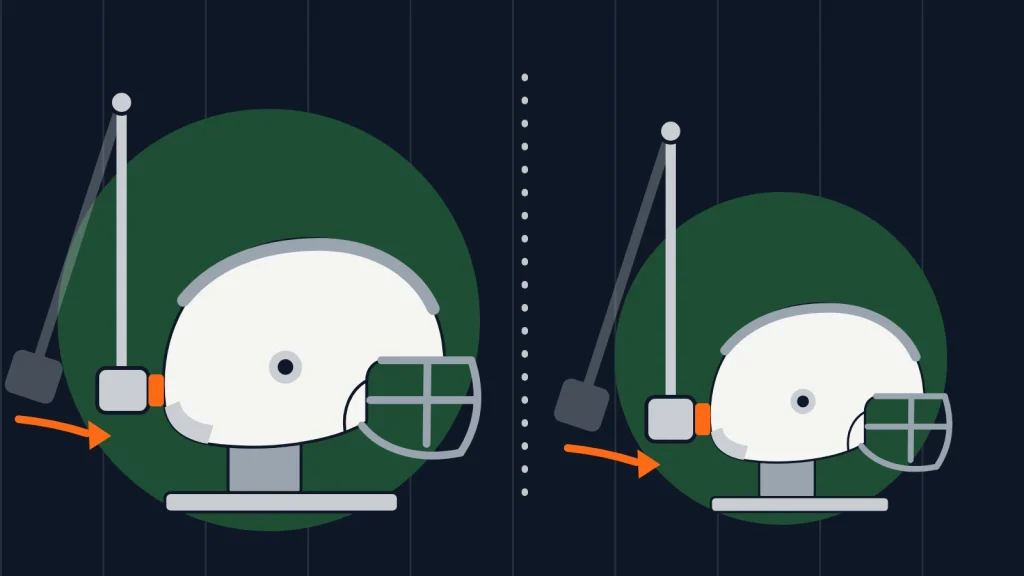
The youth ratings run the same number of tests, 48 impacts, but with a pendulum and a dummy built for the job: a headform sized to match a 10 to 12 year old boy. The weightings come from impact data collected directly from 10 to 14 year old players wearing sensor-equipped helmets. So compare youth helmets with each other, never against a varsity score.
The helmets in our catalogue
As of 2 October 2026, the varsity ratings list 40 models and the youth ratings 45. Here are ours, best score first. The weight is the one measured by Virginia Tech: helmet shell plus the lightest standard facemask for each model.
| Model | Score | Stars | Tested | Rank | Measured weight |
|---|---|---|---|---|---|
| Schutt F7 AiR | 0.92 | 5 | 2025 | 9th of 40 | 1,814 g |
| Schutt F7 2.0 | 1.35 | 5 | 2022 | 12th of 40 | 2,132 g |
| Riddell SF Echo | 1.48 | 5 | 2025 | 13th of 40 | 2,087 g |
| Riddell SpeedFlex Diamond | 1.69 | 5 | 2020 | 15th of 40 | 2,177 g |
| Riddell SpeedFlex II | 2.27 | 4 | 2026 | 18th of 40 | 1,814 g |
| Xenith Shadow | 3.35 | 3 | 2019 | 24th of 40 | 1,950 g |
| Riddell SpeedFlex | 4.49 | 3 | 2018 | 26th of 40 | 1,996 g |
| Schutt F7 Pro | no entry | — | — | — | — |
| Schutt F7 AiR Elite | no entry | — | — | — | — |
| VICIS ZERO2 Elite | 0.73 | 5 | — | — | — |
| Xenith Shadow XR | not published | 5 | — | — | — |
Youth helmets
| Model | Score | Stars | Tested | Rank | Measured weight |
|---|---|---|---|---|---|
| Schutt F7 AiR Youth Elite | 0.81 | 5 | 2025 | 6th of 45 | 1,361 g |
| Schutt F7 AiR Youth | 0.95 | 5 | 2025 | 8th of 45 | 1,406 g |
| Xenith Shadow Youth | 1.24 | 5 | 2022 | 10th of 45 | 1,678 g |
| Riddell SpeedFlex ND6 | 1.60 | 5 | 2025 | 11th of 45 | 1,542 g |
| Xenith X2E+ Youth | 2.11 | 4 | 2019 | 13th of 45 | 1,768 g |
| Riddell SpeedFlex Youth | 2.19 | 4 | 2025 | 14th of 45 | 1,860 g |
Four habits when you read a rating line
- Check the test year. The SpeedFlex was tested in 2018, the SpeedFlex II in 2026. Between the two, both the method and the field of comparison moved on.
- Check which version was tested. Virginia Tech lists two SpeedFlex Youth entries: the 2018 version (score 3.98, 3 stars, tested in 2019) and the 2020 version (2.19, 4 stars, tested in 2025). Same commercial name, different results.
- An absent helmet is not a bad helmet. The F7 Pro and the F7 AiR Elite have no entry of their own: they simply have not been tested separately.
- Mind the units. The lab publishes weights in pounds and prices in US dollars. The euro prices on our product pages come from European retailers instead.
What the ratings do not cover
The memorandum is clear that every helmet tested has already passed the relevant certification standards, which keep the risk of severe head injury low for the impacts those standards define. The ratings do not replace certification, they extend it onto different ground, concussion risk. For certification, sizing and budget, see our guide on how to choose a football helmet; for upkeep over time, our guide on helmet reconditioning and replacement covers NOCSAE reconditioning and recertification.
The lab also runs tests alongside the main ratings. Soft shell add-ons, the Guardian Cap XT, the Guardian Cap NXT and the SAFR Helmet Cover, were assessed separately on a Riddell SpeedFlex and a Schutt F7 VTD: 336 impacts, four locations, three speeds (3.1, 4.9 and 6.4 m/s). Fitted to the helmet alone, they cut linear accelerations by 3 to 8% on average, rotational accelerations by 5 to 14% and concussion risk by 15 to 34%. They get no stars of their own: the STAR score of the equipped helmet is recalculated instead. Flag football headgear has its own ratings, over 36 impacts.
One caveat from the lab applies to every figure above: "No helmet is concussion-proof. Any athlete can sustain a head injury, even with the very best head protection."
FAQ
Is a helmet that was 5 stars last year less safe now?
No. The thresholds were raised on 14 July 2025, the performances were not revised down. A helmet dropping from 5 to 4 stars carries exactly the score it had before.
What is the best varsity score in your catalogue?
The Schutt F7 AiR, at 0.92, tested in 2025, 9th of the 40 helmets in the varsity ratings.
Why are some helmets sold in Europe missing from the ratings?
Virginia Tech tests the models it selects and buys. The Schutt F7 Pro and the F7 AiR Elite, for instance, have no entry of their own, which says nothing about how protective they are.
Can I compare a youth score with a varsity score?
No. The two ratings use a different headform and different weightings: the youth dummy assembly is sized to match a 10 to 12 year old boy, and concussion risk is computed from youth-specific data.
Sources
- https://helmet.beam.vt.edu/
- https://helmet.beam.vt.edu/varsity-football-helmet-ratings.html
- https://helmet.beam.vt.edu/youth-football-helmet-ratings.html
- https://vtechworks.lib.vt.edu/server/api/core/bitstreams/bf7415b8-c8b3-47bb-ba9a-a54b1c9bcc53/content
- https://www.helmet.beam.vt.edu/js/varsityFootballData.js
- https://www.helmet.beam.vt.edu/js/youthFootballData.js
- https://helmet.beam.vt.edu/football-helmet-add-ons.html
- https://helmet.beam.vt.edu/flag-football-helmet-ratings.html