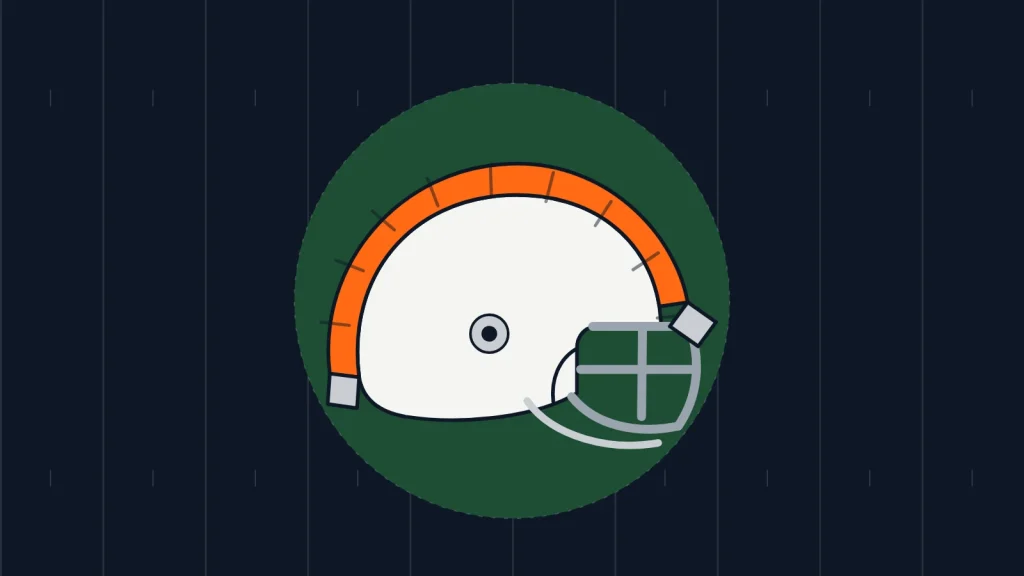
Padded covers have been sitting on NFL helmets at practice for several seasons, and the same object is now sold to amateur clubs. Here is what the manufacturer claims, what the laboratories measured, and what happens to a helmet's certification once you bolt something onto it.
Contents · 9 parts
The 2-minute summary
- What it is: a soft cover fastened over an already certified helmet with snaps and hook-and-loop strips, without altering the rigid shell.
- In the NFL: mandatory at contact practices since 2022 and widened season after season; in games it stays optional.
- What was measured: Virginia Tech records a concussion risk 15 to 34% lower when one helmet carries an add-on, and 22 to 64% lower when both do.
- Certification: for NOCSAE, attaching an item to a helmet creates a new model that has not been tested in that state.
- Order of priorities: a strong helmet without an add-on protects better than a weak helmet with one.
- Flag football: no general rulebook requires a helmet, though some competitions do require a soft cover.
A soft cover over a certified helmet
The Guardian Cap is external padding that sits on the crown of a football helmet. Guardian Sports describes it as a product that "attaches to itself with snaps and Velcro" and "does not alter the helmet": nothing is drilled, nothing is taken apart. The manufacturer states it fits all football helmets from youth to adult sizes and that every version weighs less than a pound, under 454 g; the NXT 2.0 picked by the NFL is given as a 12-ounce soft shell, roughly 340 g. It is an addition to kit you already own, which means the helmet underneath is still the decision that matters. Our football helmets are split between adult helmets and youth helmets, two families assessed under separate protocols.

Four versions are sold: the XT and XT 2.0, presented for youth up to college play, and the NXT and NXT 2.0 for college, professionals and larger players, the 2.0 models reusing the technology of the originals in a sleeker shape.
What the NFL has done with it, season after season
The American league gave the product its shop window. In 2022 the cap was required at preseason practices, up to the second preseason game, for offensive and defensive linemen, tight ends and linebackers. The league then extended it to the whole preseason, then to contact practices in the regular season and the playoffs, adding running backs and fullbacks; kickers, punters, quarterbacks, receivers and defensive backs were exempt at that stage.
For 2026, according to Guardian Sports, the requirement covers every contact practice and every position except quarterbacks, kickers and punters, with teams choosing between the NXT and the NXT 2.0. In games it has never been compulsory: it is merely permitted, and the manufacturer counted thirty players wearing one in 2026 regular-season games.
What the laboratories measured
The Virginia Tech Helmet Lab tested three such add-ons, the Guardian Cap XT and NXT plus the SAFR Helmet Cover, and publishes two sets of results. When only one of the two helmets involved carries an add-on, it records a drop of 3 to 8% in linear acceleration, 5 to 14% in rotational acceleration and 15 to 34% in concussion risk. When both carry one, those figures become 6 to 17%, 5 to 25% and 22 to 64%. The spread between the bounds comes from the base helmet and the add-on model.
The lab publishes no star rating of its own for add-ons: it measures how a fitted helmet's STAR score shifts. Its warning is explicit, that the helmet model is decisive because it sets the baseline level of protection, and that a weak helmet with an add-on may still fall short of a strong helmet without one. Our guide to the Virginia Tech ratings explains how to read those scores. In our catalogue the Schutt F7 AiR, the Xenith Shadow XR and the VICIS ZERO2 Elite hold five stars, the Riddell SpeedFlex three.
Guardian Sports points to third-party work of its own: a 25% average reduction in HARM values at 3.5 m/s credited to Stanford, 9% for the NXT credited to BioCore, and 52% fewer concussions from NFL field data. On its own page the league describes a drop of "more than 50%" among the position groups covered by the 2022 preseason mandate, against the average of the 2018, 2019 and 2021 seasons, with 2020 set aside as anomalous.
Adding a cover means changing model
This is the point clubs tend to discover last. For NOCSAE a helmet model is an assembly "intended to be identical in every way, except for size", and its statement of 22 May 2024 leaves no room: "the addition of an item(s) to a helmet previously certified without those item(s) creates a new untested model." The helmet maker and the certifying body may then treat the earlier certification as void.
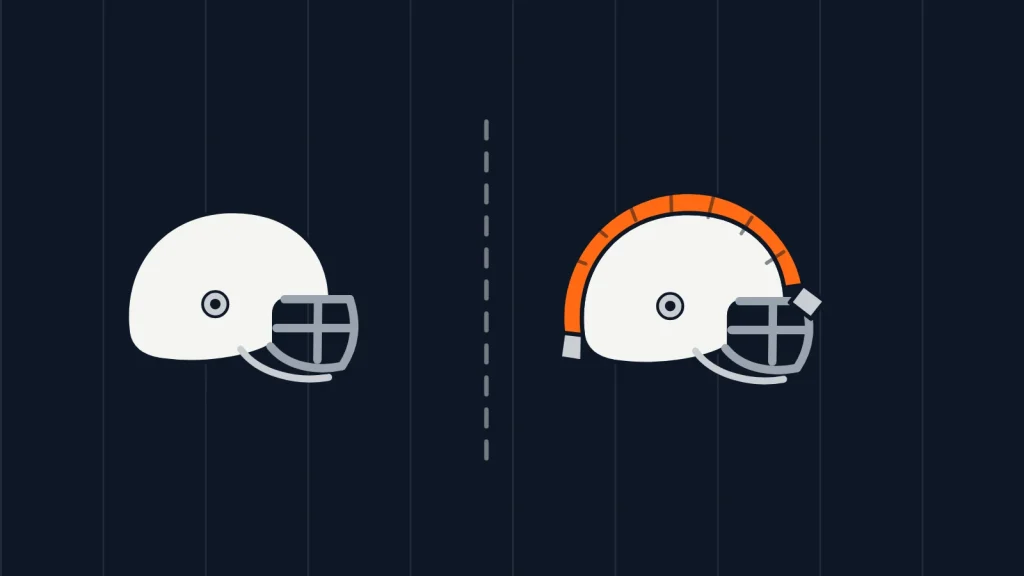
NOCSAE does leave a door open: the add-on maker may have the combination certified, but the certification and the responsibility for it then become theirs rather than the helmet manufacturer's. Conversely an item that is not attached to the helmet, a headband or a mouthguard for instance, creates no new model. At its winter meeting of 13 and 14 February 2026 the standards committee said it was working to lighten that certification route without lowering quality control on the base helmet. Until then, the question to put to your helmet maker is simple: do you accept this add-on on this exact model?
And in flag football, where there is no helmet
Soft covers are sold as flag football helmets, which muddies the water. Under NFL FLAG rules the required kit is the official belt and flags, a jersey, shorts without pockets and a mouthguard, described as "the only protective gear that players wear". Helmets and shoulder pads are not required; metal cleats are banned and gloves stay optional. Our guides to the flag football rules and to flag football kit set out that framework, and the flag football collection gathers the gear.
NFL FLAG does note that some school programmes or 7-on-7 sides may require a soft shell helmet: that is a competition requirement, not a general rule of flag. If yours asks for one, the Virginia Tech Helmet Lab publishes a separate STAR table for flag football headgear, in cap style and headband style, and recommends a 4 or 5-star model.
What a cover does not replace
The Virginia Tech lab puts it in one sentence worth reading before any purchase: whatever helmet or add-on is used, a player can still sustain a concussion. A cover goes on top of a well-chosen, well-fitted helmet, never in place of that work. Our guide on how to choose a football helmet takes certification, sizing and the facemask in order, and the Riddell SpeedFlex Youth shows what changes on a youth listing. AFG lists no soft cover in its catalogue.
FAQ
Does a Guardian Cap void my helmet's certification?
For NOCSAE, attaching an item creates a new untested model, and both the helmet maker and the certifying body may declare the earlier certification void. Only your manufacturer can say whether it accepts the add-on on that model.
How much does a soft cover cut concussion risk?
Virginia Tech measures a 15 to 34% drop when one helmet is fitted, and 22 to 64% when both are.
Does the NFL make players wear one in games?
No: the mandate covers contact practices. In games it is permitted but voluntary, with thirty players wearing one in the 2026 regular season.
Do you need a soft cover to play flag football?
NFL FLAG rules do not ask for one, and require neither helmets nor shoulder pads. Some school programmes and 7-on-7 tournaments do impose one, so check your own rulebook.
Sources
- Guardian Sports — Guardian Caps
- Guardian Sports — NFL Allows Guardian Cap 2.0 for 2026 Season
- Guardian Sports — Guardian Caps Worn in NFL Games: 2026 Season
- NOCSAE — Certification to NOCSAE Standards and Add-on Helmet Products
- NOCSAE — 2026 Winter Meeting Recap
- Virginia Tech Helmet Lab — Football Helmet Add-Ons
- Virginia Tech Helmet Lab — Flag Football Headgear Ratings
- NFL — Guardian Cap Results: "Exceeded Our Expectations"
- NFL — Guardian Caps required in regular season, postseason
- NFL FLAG — Flag Football Equipment