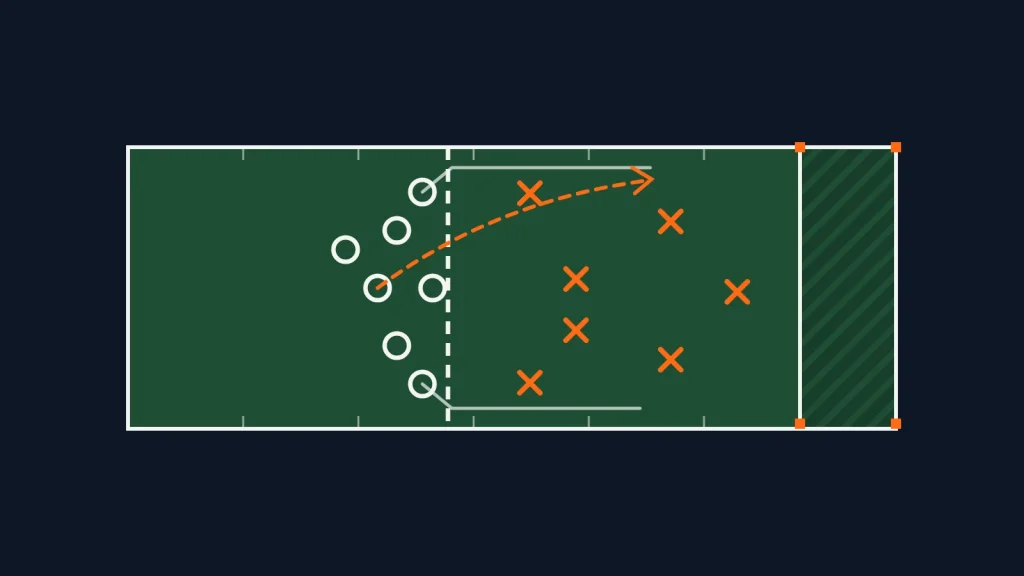
7v7 football is American football without the tackle, played entirely through the air. It is the most common summer training format in the United States and, for a lot of European players, the first way into the sport. This guide sticks to the text of the rulebooks organisers publish, and to the equipment they do or do not demand.
Contents · 9 parts
The 2-minute summary
- A passing game: USA Football bans running plays, double passes and shuffle passes, and the ball carrier is stopped by a one-hand touch anywhere on the field.
- Three downs per segment: every possession starts on the 40-yard line, with the 25 and then the 10 to cross.
- Four seconds to release the pass: at 4.01 seconds or more, USA Football records a loss of down and treats the play as a sack.
- Headgear is not settled: USA Football requires a helmet for every player, other organisers require a soft-shell helmet, one only encourages it.
- A mouthpiece is required by several rulebooks, sometimes with an exemption for the quarterback.
- This is not flag football: the IFAF rulebook is played 5-on-5, pulls a flag instead of touching, and bans helmets outright.
A passing game with half a team
The name does the work: seven players a side instead of eleven, and half the sport disappearing with them. The official USA Football rulebook sets out the split in exact terms: seven defenders, who may not line up eight and drop one before the snap, against six offensive players, the offence having to use a centre or an extra player to snap. With no offensive line and no defensive line, the starting point of every play looks closer to third and long than to a conventional first down. Plenty of these tournaments share their pitches, and their atmosphere, with flag football without sharing a single rule with it.
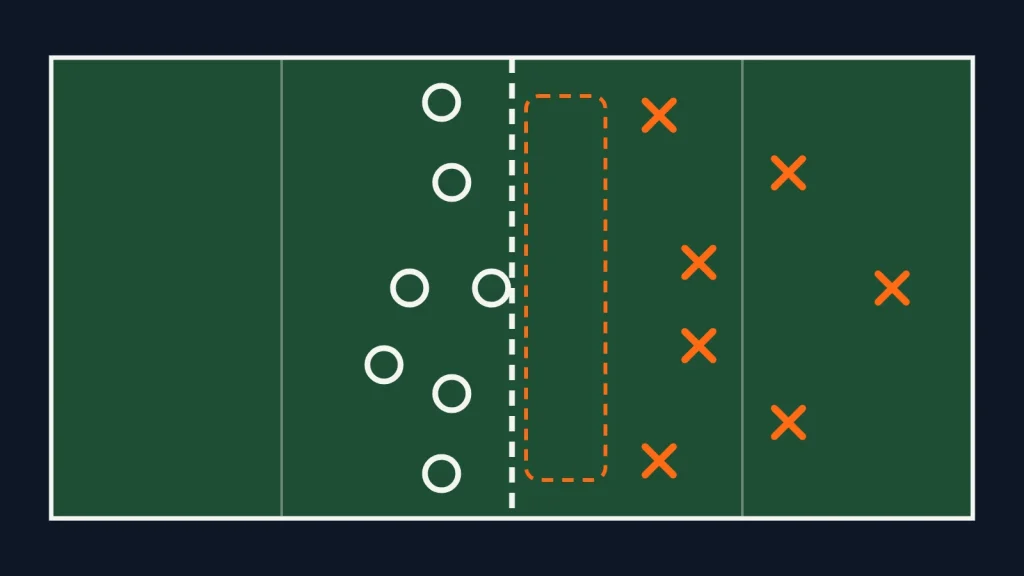
Both rulebooks we read outlaw the run. USA Football states that no running plays are allowed, nor double or shuffle passes, and that a one-hand touch anywhere ends the play. A pass behind the line of scrimmage is still legal, but the receiver must carry it past that line, or the play is treated as a sack. The 7on7 Association goes further and bans blocking outright, which it presents as a safety measure, alongside any run.
That mechanic explains everything downstream. With no block and no contact at the line, football shoulder pads have nothing left to protect against, and none of the rulebooks we consulted lists them under equipment.
Three downs and two marker lines
The chain goes too. Under USA Football, each possession starts on the 40-yard line going in, and a first down is earned by crossing the 25 and then the 10. Three downs are granted to get there, including inside the 10.
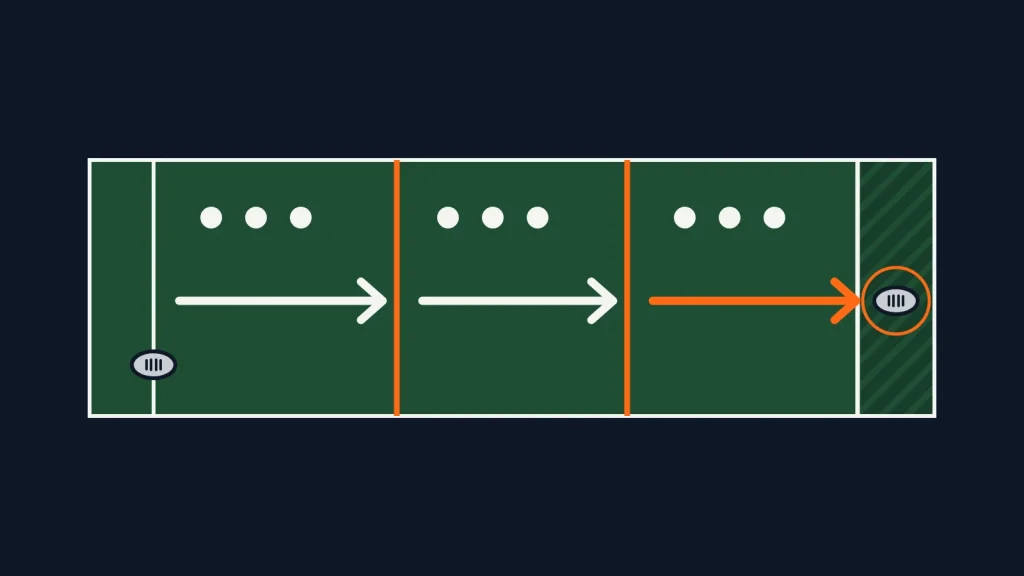
The 7on7 Association splits the field the same way: three plays to reach the 25, three more for the 10, three last ones to score. Scoring, on the other hand, resembles nothing else in the sport. In the USA Football rulebook a touchdown is worth 6 points, an interception earns the defence 3, with no points for an interception on the PAT, and a turnover on downs is worth 2. The PAT is worth 1 point and is snapped from the 5: two-point conversions are barred in pool play and are taken from the 10 in tournament play.
The clock decides the game
A 7v7 game is short and barely ever stops. The two rulebooks part company on the detail, which is worth checking before you travel.
| Rule | USA Football 7on7 | 7on7 Association |
|---|---|---|
| Length | 21 minutes | 20 minutes |
| Clock | continuous for the first 20 minutes, stopping as per the rules in the final minute | continuous |
| Time to snap | 25 seconds | 30 seconds from the end of the previous play |
| Time to pass | 4.0 seconds from the snap | not stated |
| Overtime | none in pool play | not stated |
USA Football adds a mercy rule: once the margin reaches 21 points at the end of the first 20 minutes, the clock runs out the game even if the gap closes again. Four seconds also come off the clock on every snap.
What 7v7 is not
The mix-up with flag football never goes away, because neither format tackles. The rules have almost nothing in common: the IFAF international rulebook organises a 5-on-5 game in which the defender pulls a flag from the carrier's belt, and its illegal-equipment article names shoulder pads, helmets and head wear. In 7v7 the opposite applies, and the USA Football rulebook opens on the line "All players must wear helmets." Our guide to the flag football rules goes through the IFAF text, and what you need to play flag football covers the kit that goes with it.
In Europe the format stayed marginal. The German federation files "7er Flag" among the flag variants: seven players a side, contact allowed to a limited extent, blocking permitted only inside a defined zone. It adds that the variant used to be played more often and is now rarely seen outside indoor tournaments. The same name covers two different games depending on the side of the Atlantic, so read the organiser's rules before buying anything.
Equipment: where the rulebooks disagree
No international federation publishes a single rulebook for this format. Every organiser writes its own, and the widest gap is on the head.
| Organiser | Headgear | Mouthpiece |
|---|---|---|
| USA Football (7on7) | helmet required for all players | not mentioned in the rules |
| 7on7 Association | soft-shell helmet required, strapped and fastened during play, quarterback exempt | required and worn during play, quarterback exempt |
| My7on7 | soft-shell helmet required, no exceptions | required |
| Prep Redzone | strongly encouraged, not required | strongly encouraged, not required |
We are not picking a winner between those texts, because they do not describe the same object. USA Football means a helmet, in a rulebook that elsewhere allows preparation sessions "in helmets only" where state association rules permit, and with no scrimmaging. The other three mean a padded shell worn directly on the head. Our guide to flag football headgear sets out what these products are and what they are not.
Two models in our catalogue are sold for this use. The Xenith Loop is listed as "Non-Tackle" by its maker, who says it was designed from sensor data collected in games for incidental head impacts in 7v7 and non-contact football; it is therefore not a certified tackle helmet, and no standard is quoted on its official page. The Guardian x Schutt Loop 2.0 is described by Schutt as built to be worn without a helmet or a chinstrap. Both run from S to XL.
The rest of the bag
The mouthpiece is the item most often required, and the cheapest to keep in a bag. A strapped model such as the Battle Oxygen, ready to wear without boiling and compatible with braces according to the brand, saves you turning up at a tournament with nothing to show. The Battle Speedtab F7, with a pull-tab strap rather than a fixed one, is marketed by Battle as built specifically for 7v7 and flag football, where players often reach for the mouthguard between plays; the rest of the range sits in our mouthguards.
Gloves are required by none of the four rulebooks, but a format that lives on passes makes them useful. Receiver gloves such as the Cutters Rev Pro 6.0, stated to meet the SFIA specification for NFHS and NCAA play, run from S to 3XL. On footwear, My7on7 writes that cleats are encouraged without being mandatory, so the surface decides; our football cleats cover both families. A pair of long socks like the spandex Battle Long Football Socks finishes a kit that otherwise belongs to football apparel.
FAQ
Is 7v7 football played in a helmet?
It depends on the organiser. The USA Football rulebook requires a helmet for every player; the 7on7 Association and My7on7 require a soft-shell helmet; Prep Redzone encourages one without requiring it.
Can you run with the ball?
No. USA Football bans running plays, and the 7on7 Association likewise writes that no runs are allowed. The ball only moves forward through the air.
How long does the quarterback have to throw?
Four seconds from the snap under the USA Football rules. From 4.01 seconds the play counts as a sack, with a loss of down.
How is it different from flag football?
IFAF flag football is played 5-on-5, the defender pulls a flag from the belt, and the rulebook bans helmets and shoulder pads. 7v7 is played seven a side, the carrier is stopped by a touch, and most rulebooks require some head protection.
Sources
- USA Football, Official USA Football 7on7 Rules: https://assets.usafootball.com/7on7/RulesandScoring.pdf
- The 7on7 Association, 7on7 Rules: https://www.the7on7association.com/rules-7on7
- My7on7, Info (equipment): https://www.my7on7.com/info
- Prep Redzone, 7on7 (equipment FAQ): https://prepredzone.com/7on7/
- AFVD, About Flag (flag variants in Germany): https://afvd.de/about-flag/
- IFAF, International Flag Football Rules 2023: https://www.americanfootball.sport/wp-content/uploads/2023/05/FlagRules2023.pdf