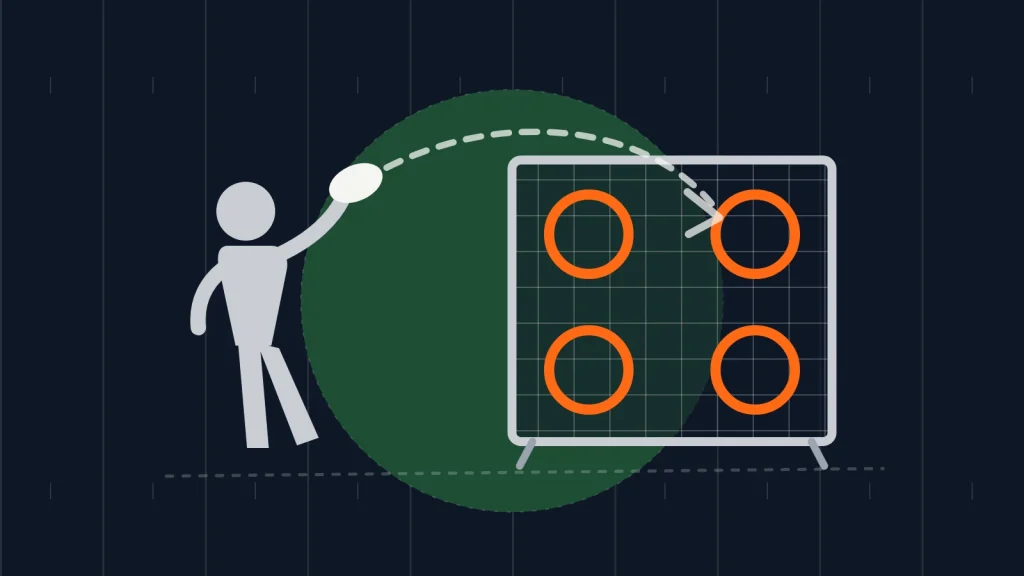
Between club sessions, throwing and catching can be worked on in a garden with very little kit. This guide gathers what the governing bodies publish about drills you can run alone or with one partner, and what manufacturers state about the target nets sold in Europe. AFG has tested no net: you will find no field verdict here, only figures that can be checked.
Contents · 7 parts
The 2-minute summary
- A target net is for aiming, not for collecting: both nets in our football training equipment listing carry numbered rings, four on the FN-01 and three on the FN-02.
- Space to allow for: Barnett states 213 cm high, 213 cm wide and 106 cm deep for both nets, with tool-free assembly.
- Price on record: €79 at Barnett on 16/10/2026 for the FN-01 and the FN-02 alike, carry bag and four pegs included.
- The reference drills come from USA Football: throws from a standing start 10 yards apart, a six-inch punch step, and a ceiling of 180 throws per session.
- Ball size follows age: Wilson gives 6 to 9 years for Pee Wee, 9 to 12 for Junior and 12 to 14 for Youth.
What really can be trained alone or in a pair
USA Football, the American governing body, publishes a set of accuracy drills for quarterbacks that need nothing more than a partner and a line on the ground. The first, "toes on the line", puts two throwers 10 yards apart with their toes on a line: the ball is delivered without a step or a stride, everything comes from the hips. The second, the punch step, starts with the shoulders perpendicular to the line and a six-inch step with the front foot before the release. The last two, "the easy way" and "the hard way", have the thrower start facing away from the target and flip the hips one way, then the other.
The same page sets a limit that is easy to forget without a coach watching: no more than 180 throws in a session, and lighten the load as soon as the arm tires rather than pushing through.
On the receiving side, the governing body describes a "bad ball" drill with the receiver 10 yards from the thrower, who deliberately delivers high, low, inside and outside passes, plus a goal post drill where the player stands behind the post with hands out, two-handed first and one-handed once experienced. None of these drills needs anything bought: what is missing at home is the partner, not the equipment.
Target nets: what the manufacturers state
When nobody is available to throw with, a target net stands in for the partner on passing work alone. Two models are listed, both from Barnett.

The Barnett FN-01 carries four numbered ring targets, the Barnett FN-02 three: that is the only difference between the manufacturer's two data sheets, which quote the same dimensions, 213 cm high, 213 cm wide and 106 cm deep. Both were listed at €79 on Barnett's own site on 16/10/2026, the only European retailer found for these references.
| Barnett FN-01 | Barnett FN-02 | |
|---|---|---|
| Numbered targets | 4 | 3 |
| Stated dimensions | 213 × 213 × 106 cm | 213 × 213 × 106 cm |
| Supplied with | Carry bag, 4 pegs | Carry bag, 4 pegs |
| Price on 16/10/2026 | €79 | €79 |
Barnett publishes neither the weight of the net nor the exact mesh material, so both fields stay empty on our product pages until an official source gives them.
Where to put it and how to anchor it
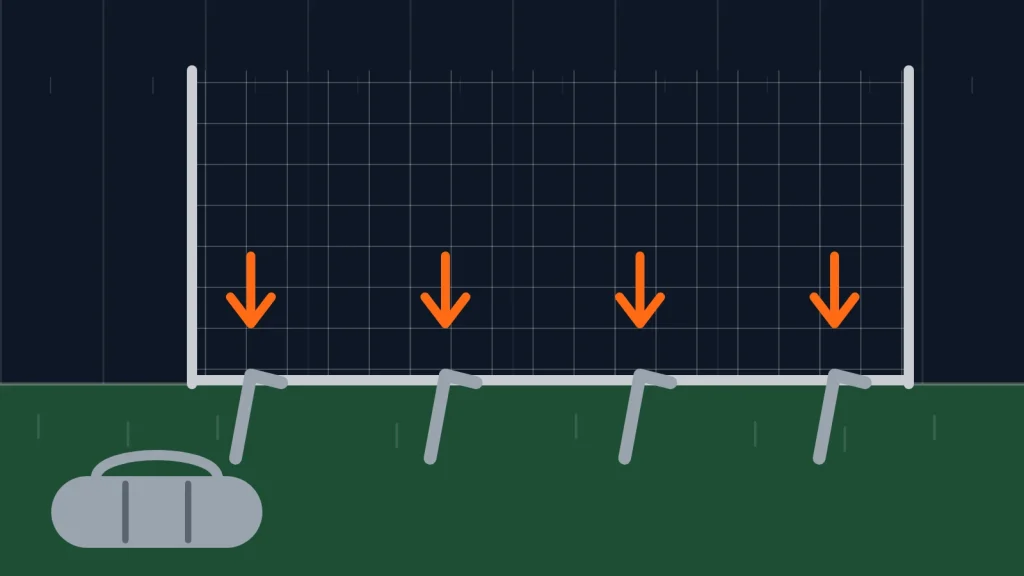
Both nets go up without tools and come with four metal ground pegs, so they need soft ground, a lawn or a pitch, and the manufacturer presents them for outdoor use. Plan for the depth as much as the width: 106 cm behind a 213 cm face, roughly the footprint of a small tent, before you add the distance you throw from. The supplied carry bag means the whole thing folds away between sessions, which matters when the garden has another job.
Start with the right ball
A net is no use with a ball that is too big for the hand. Among the American footballs in the catalogue, the Wilson GST Youth comes in three sizes for which Wilson gives indicative ages: Pee Wee from 6 to 9, Junior from 9 to 12 and Youth from 12 to 14. Above that comes the official size, as on the Wilson The Duke or the Nike Championship, listed in official size 9. Our guide to ball size by age sets out the full range.
For accuracy work, a second ball saves a walk to the net after every throw, especially when the high rings are in play.
Before a session, a quick pressure check avoids a bad surprise: our guide on ball pressure and care covers the benchmarks and cleaning between sessions.
What a net does not replace
A net measures accuracy, not reading the game. The USA Football drills that build reaction and movement all call for a partner or a marker: four cones for the linebackers' multi-directional work, a speed ladder with a ball tossed at the end of the run for running backs, a resistance band for defensive backs.
Above all, none of this is contact. As soon as play resumes at the club, the full kit is required again, football helmets and football shoulder pads included; our guide to mandatory equipment sets out what the rules demand. Work at home prepares the team session, it does not replace it.
FAQ
Do you need a big garden for a target net?
The two Barnett nets in the catalogue take up 213 cm in width and 106 cm in depth according to the manufacturer. To that, add the throwing distance you choose: USA Football's accuracy drills are run 10 yards apart, a little over nine metres.
Is a four-target net more useful than a three-target one?
The FN-01 offers one more ring than the FN-02 to vary the angles, and that is their only stated difference: dimensions, accessories and recorded price are identical. AFG has tested neither.
Can this kind of net be set up indoors?
Barnett presents these nets for outdoor use and supplies four ground pegs, which assume soft ground. The manufacturer states no indoor fixing method.
How many throws per session when training alone?
USA Football advises staying under 180 throws in a session and easing off at the first signs of arm fatigue rather than finishing the drill.
Sources
- USA Football, 4 drills to help QBs sharpen accuracy (accessed 18/10/2026)
- USA Football, 3 drills to reinforce wide receiver catching technique (accessed 18/10/2026)
- USA Football, 7 drills to improve your football skills midseason (accessed 18/10/2026)
- Barnett, FN-01 football training net (recorded 16/10/2026)
- Barnett, FN-02 football training net (recorded 16/10/2026)