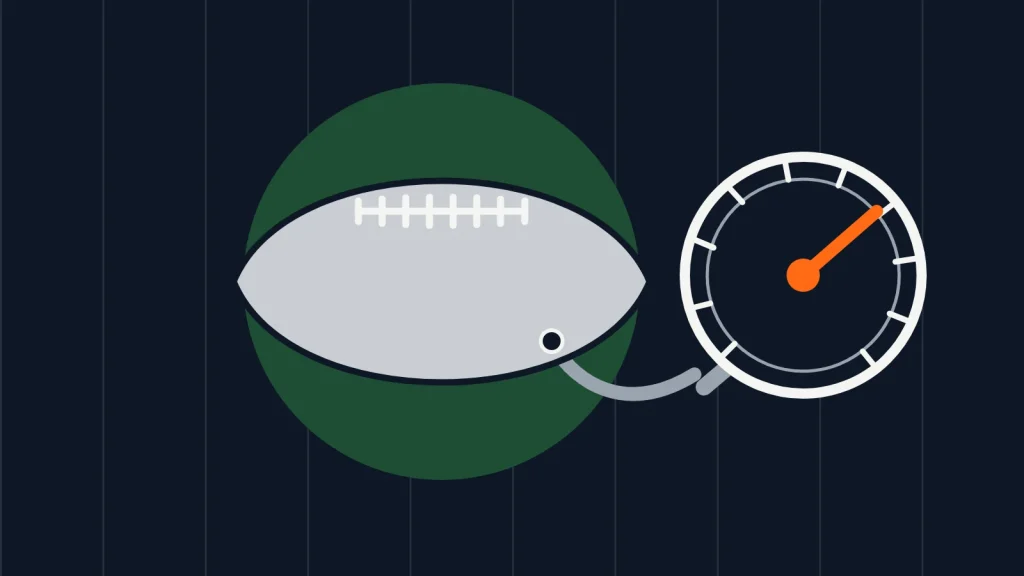
A football is played at a set pressure, and a leather one has to be prepared before it plays properly. The IFAF rulebook sets the range and the way the ball is checked; Wilson publishes its own break-in method and its list of things never to put on leather. This guide sticks to those two sources and to the balls in our own catalogue.
Contents · 10 parts
The 2-minute summary
- The range: 12.5 to 13.5 psi, published by the IFAF as 0.85 to 0.95 bar in its metric version.
- The check: game management supplies the pump and the gauge, and every ball goes to the referee at least 60 minutes before kick-off.
- Leather or composite: the Horween leather of the Duke and the GST is brushed and conditioned, a composite cover is played as it comes.
- Wilson's quick method: brush each panel for 30 to 45 seconds, conditioner, tack bar, brush, tack spray.
- Never: milk, shoe polish, olive oil, soap, shaving cream, anything heavy in lanolin, or a wet cloth.
- The limit: a game ball must stay new or nearly new and unaltered, and the officials are the sole judge.
What the rulebook asks: 12.5 to 13.5 psi
IFAF rule 1-3-1 describes the ball before it gets to pressure: new or nearly new, a cover of four panels of pebble-grained leather, one set of eight equally spaced lacings, natural tan colour. Then come the two figures that matter: inflated to 12½ to 13½ pounds per square inch (psi), and a weight of 14 to 15 ounces, for a long circumference of 27¾ to 28½ inches. The six references in our American footballs collection come in official size or in youth sizes.
In flag football, the IFAF international rules repeat the same range and add the metric equivalent: 12.5 to 13.5 psi, or 0.85 to 0.95 bar. They set youth size balls for under-16 games and junior size for under-13 games, with the note that those balls "need not be leather", and they allow each team to use its own legal ball. Sizes by age are covered in our ball size guide.
Measuring the pressure, and who checks what
The rulebook does not leave the check to the players. Game management provides a pressure pump and a measuring device, every ball is presented to the referee at least 60 minutes before the start of the game, and from that moment the balls stay under the supervision of the officials. They test and are the sole judge of not fewer than three and not more than six balls offered for play before and during the game; the home team supplies at least three legal balls.
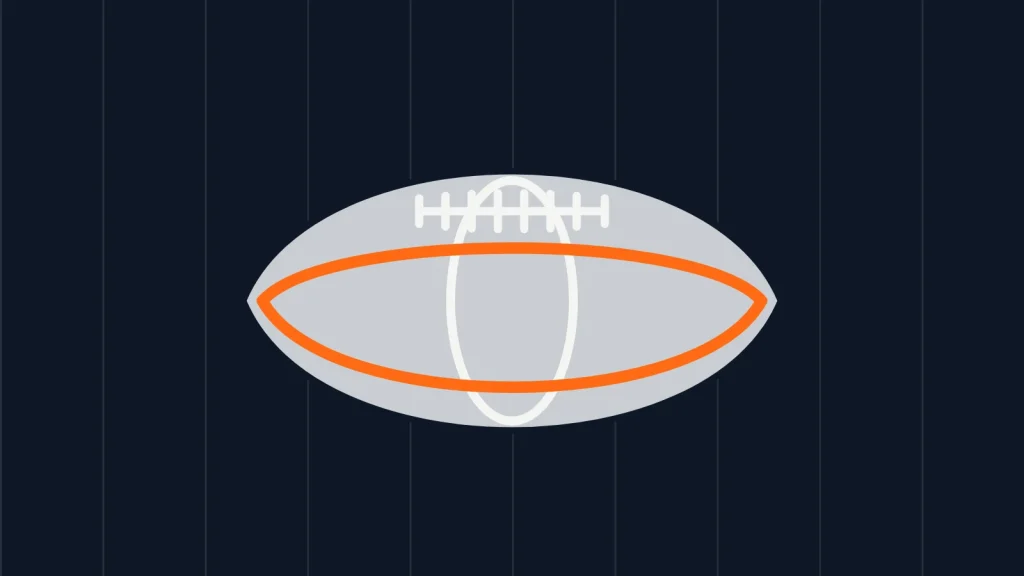
The measurements follow their own protocol: all of them are made after the ball has been legally inflated. The long circumference is measured around the ends of the ball but not over the laces; the short one goes over the valve and over the lace, but not over the cross lace. For your own ball a gauge is enough: Wilson ends its prep procedure by inflating to 13 psi, the middle of the legal range.
Leather or composite: two different routines
The two leather game balls in our catalogue, the Wilson The Duke and the Wilson GST, are handmade in Ada, Ohio, from Horween leather. Wilson compares a leather ball to a baseball glove: it has to be broken in and conditioned to perform, because the leather "is skin, and it behaves like skin when worked, conditioned, and moisturized".
Composite covers do not ask for that work. For its NCAA composite ball Wilson claims all-weather performance and a butyl rubber bladder for long-term air retention. That is the build of the Wilson The Duke Replica (Pressure Lock bladder) and of the Wilson NFL Flag Football. The Nike Championship mixes 45% cowhide, 47% rubber and 8% polyester. The method below is for leather balls.
Breaking in a leather ball: Wilson's quick method
Wilson publishes two procedures. The short one is five moves, and it doubles as the in-season routine.

- Brush each panel for 30 to 45 seconds with light to medium strokes, without pressing hard: too much pressure costs you pebble, and the pebble is the grip.
- Work a small amount of conditioner into each panel with your hands and let it dry for 20 minutes.
- Run the tack bar across each panel two or three times.
- Brush each panel for 10 seconds, still with light to medium strokes.
- Spray tack spray once per panel and let it dry for 5 minutes.
Brushing is done in four directions, clockwise, counter-clockwise, up and then down: the panels are cut from one large sheet of leather, so the grain runs different ways, and those strokes spread the tack, the conditioner and the mud evenly. The Wilson kit holds the wax bar and the brush; conditioner and tack spray are sold separately.
The long procedure, the one Wilson uses on balls for NCAA and NFL teams, goes further: deflate the ball to around 8 psi so the leather takes the conditioner, spread two parts conditioner to one part tack spray with a glove, pass a hairdryer over the panels in a continuous motion on medium heat, add a thin layer of Lena Blackburne rubbing mud thinned to the consistency of a milkshake, dry for at least an hour, brush the mud into the ball, and finally inflate to 13 psi. Wilson warns that climate changes everything: one or two hours of drying in dry air, one or two days in humid air.
How often to do it
| Task | Frequency published by Wilson |
|---|---|
| Brushing | Once a week, or before every game |
| Conditioner | Once a month during the season |
| Tack bar | Every one to two weeks during the season |
| Tack spray | "Once a week" in the list of dos, "once every 1-2 weeks during season" in the quick method |
Both tack spray figures sit on the same Wilson page, which does not settle between them: set the frequency on how much the ball actually gets used.
What ruins a ball
Wilson puts the principle in one sentence: a ball should never soak in water, never dry out, and should stay protected from abrasions and harsh chemicals. The rest follows from it.
- Keep water away from the leather, and above all from the lace holes: in cold weather that moisture ices under the skin and destroys the bladder.
- Do not wipe a new ball with a hot or wet cloth to remove a supposed preservative: there is none, and you only dry the ball out faster.
- No milk, shoe polish, olive oil, soap or shaving cream, which dry the leather out, and nothing heavy in lanolin, which makes the leather expand until the ball loses its shape.
- Use a brush made for footballs: household brushes scratch the leather, shoe-polish brushes are too soft to work the tack in.
- Do not brush a ball that is still damp, and do not cake it in mud.
The rulebook draws a hard line of its own: the ball may not be altered, including by any ball-drying or ball-warming substance, and mechanical ball-drying or ball-warming devices are not allowed near the sidelines or in the team area. A game ball has to stay new or nearly new, meaning unaltered. Whether a prepped ball passes is therefore down to the officials, who are the sole judge; the full rulebook is covered in our guide to the rules.
When the ball stops holding air
Wilson replaces the bladder and the laces on its own leather balls, in all sizes from pee wee to professional, at the Ada, Ohio factory, three to four weeks from receipt, but the prepaid shipping label it provides is a US one: from Europe the question goes to your retailer first. Balls from other brands and composite balls are not covered.
FAQ
How much psi should a football have?
12.5 to 13.5 psi under IFAF rule 1-3-1, or 0.85 to 0.95 bar in the IFAF's own metric version.
Does a composite ball need breaking in?
Wilson only publishes a prep procedure for leather balls. Composite covers are presented as all-weather, with a butyl rubber bladder that keeps the pressure over time.
Can I condition a ball with oil or soap?
No. Wilson rules out milk, shoe polish, olive oil, soap, shaving cream and anything heavy in lanolin.
Is a prepped ball legal in a game?
The rule asks for a ball that is new or nearly new and unaltered, bans any drying or warming substance, and puts three to six balls in the officials' hands before and during the game. They decide.
Sources
- IFAF, Football Rules and Interpretations 2026, rule 1-3: https://amerikanskeidretter.no/wp-content/uploads/2026/02/IFAF-Rules-and-Interpretations-2026.2.4.pdf
- IFAF, International Flag Football Rules 2023, rule 1 section 2: https://americanfootball.sport/wp-content/uploads/2023/05/FlagRules2023.pdf
- Wilson, "How to Prep a Football Like The Pros": https://www.wilson.com/en-gb/blogs/blog/how-to-prep-a-football-like-the-pros
- Wilson, Football Prep Kit: https://www.wilson.com/en-us/product/game-ball-prep-kit-wf60022
- Wilson, Leather Football Bladder Repair: https://www.wilson.com/en-us/product/football-repair-wtfrepairv
- Wilson, NCAA Composite Football: https://www.wilson.com/en-us/products/ncaa-composite-football-wf30023