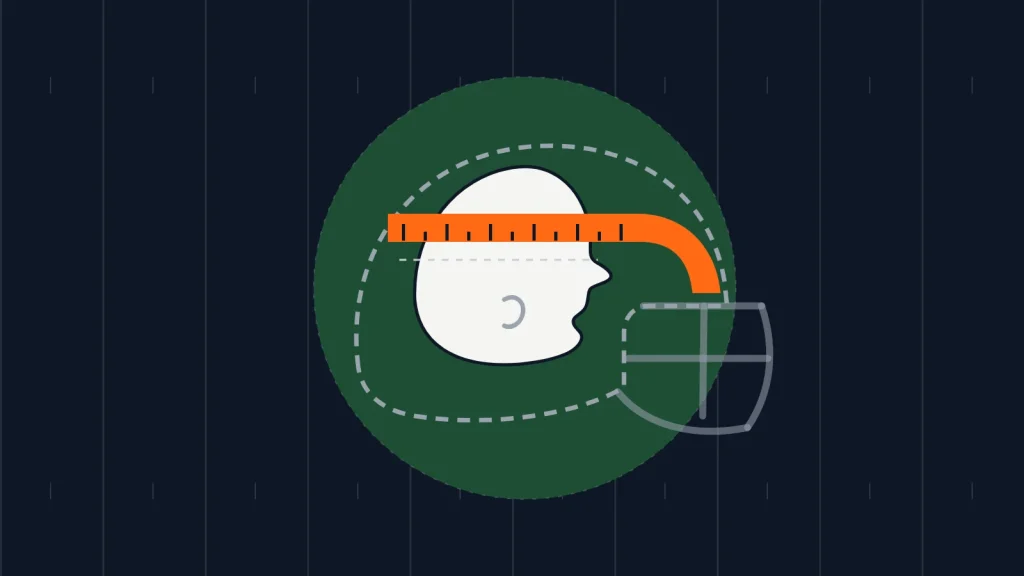
A football helmet is not picked off a clothing size. Everything starts from head circumference, and the fit is then built up pad by pad. Riddell and Schutt publish their own charts, and two opposite rules for a measurement that falls between sizes. This guide sticks to their official fitting guides and to the charts on the football helmets in our catalogue. The measurement is the same for youth helmets and adult helmets, but their charts and their rules of use do not overlap, and we come back to that further down.
Contents · 9 parts
The 2-minute summary
- One measurement: head circumference, about 1 in above the eyebrows, around the widest part of the skull. Riddell and Schutt give the same instruction.
- Between two sizes: Riddell says take the smaller size, Schutt the size up. The rules are opposites.
- Charts do not line up: an L covers 56 to 60 cm on the SpeedFlex but 54.5 to 58.5 cm on the F7 AiR.
- Size is only a starting point: both guides begin with every air pad deflated, then set height, cheeks and chin strap.
- The final check is the same: the skin of the forehead must move with the helmet when you rotate it. If it does not, the helmet is too loose.
- Youth is not a small adult: the SpeedFlex Youth has no inflatable crown pad, and Schutt bars its youth helmets from high school level.
 Play the video: Football Helmet Sizing: Riddell vs Schutt Size Charts Explained
Measuring head circumference
Both manufacturers ask for the same thing. Riddell says to run a soft tape measure about 1 in (2.5 cm) above the eyebrows. Schutt uses the same landmark and adds the part that matters: "approximately 1" above the brow line around the widest part of the head". It is that widest path, above the ears and around the bulge at the back of the skull, that gives the right number.

Write the result down in centimetres and in inches: helmet charts are published in inches. Riddell gives the centimetres itself for the SpeedFlex; elsewhere they are converted from inches and rounded to the nearest 0.5 cm. A measurement that lands exactly on a boundary is therefore a borderline case, not a settled answer.
The charts, model by model
| Model | Published head circumference |
|---|---|
| Riddell SpeedFlex and SpeedFlex Youth | S up to 52 cm · M 52–56 · L 56–60 · XL 60 and over |
| Riddell SpeedFlex ND6 | S up to 52 cm · M 52–56 · L 56–59.5 · XL 59.5 and over |
| Riddell SF Echo | 6 3/4 up to 54.5 cm · 7: 54.5–57 · 7 1/4: 57–58.5 · 7 1/2: 58.5–60.5 · 7 3/4: 60.5–63 · 8: over 63 |
| Schutt F7 AiR | S 47–51 cm · M 51–54.5 · L 54.5–58.5 · XL 58.5–62 · 2XL 62–66 |
| Schutt F7 AiR Youth | 2XS 48.5–50 cm · XS 50–52 · S 52–54 · M 54–56 · L 56–58 · XL 58–59.5 |
| Schutt F7 Pro | M 51–57 cm · L 56–62 · XL 61–67.5 |
| Xenith Shadow XR | M 53–57 cm · L 56–61 · XL 60–64 |
| Riddell Victor-i | XXS/XS up to 51.8 cm · S/M 52.7–55.9 · L/XL 56.8–59.7 |
Take a 57 cm head. It is an L on the SpeedFlex, an L on the F7 AiR, a 7 1/4 shell on the SF Echo, and exactly the boundary between M and L on the F7 Pro. The letter on the label means nothing from one brand to the next: go back to the chart for the exact model every time.
The SF Echo is a special case: Riddell sells it in US hat sizes, across only three shell sizes. The F7 Pro starts at M.
Between two sizes: two opposite rules
- Riddell: "if measurement falls between helmet sizes, start with the smaller size".
- Schutt: take the size up. Its help desk uses the example of a 23 in head, which gives an XL on the F7 AiR.
Each brand has its reasons, and they come from what is inside the shell: Riddell makes up the volume by inflating its liners, Schutt by changing the thickness of its pods. Applying one brand's rule to the other's helmet means starting from the wrong shell.
Every row in the table comes from the model's own product page. On the Schutt F7 Pro, the PDF fitting guide and the product page disagree by half an inch on the M: the figure shown at the point of sale is the one used.
Checking the fit with the helmet on
The Riddell procedure
The SpeedFlex guide starts with every inflatable liner deflated. The helmet is then judged on height: the front should sit roughly 1 in above the player's eyebrows. Too high, and Riddell asks you to try a larger size and start again. Too low, and you inflate the crown pad with the Riddell pump and a glycerin-lubricated Riddell needle: other needles can damage the liner.
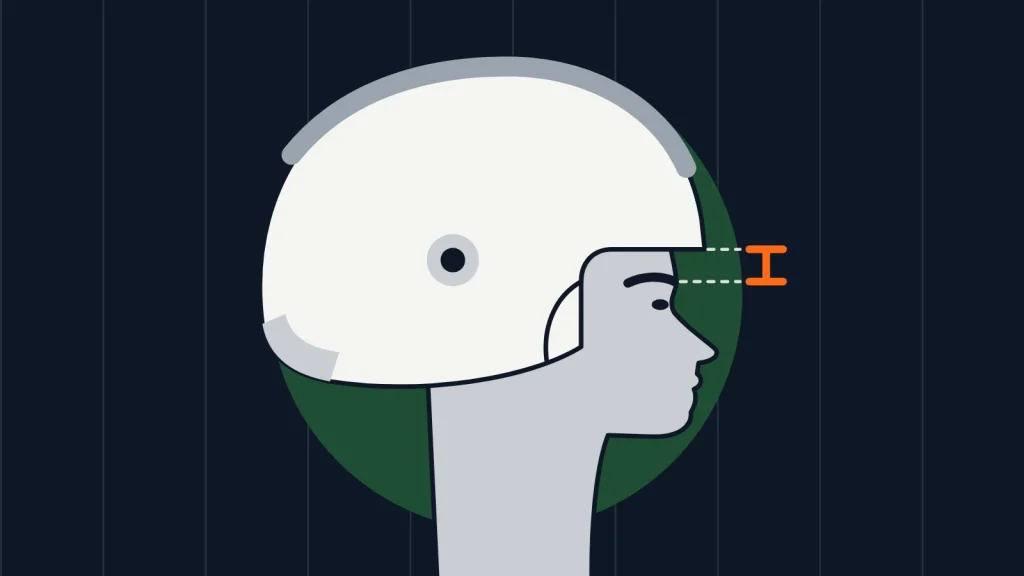
Next come the back and side liner, the face frame pads, then the occipital lock, which should sit snug against the lower back of the head to keep forward and backward rotation to a minimum. Riddell then lists four confirmations: the skin of the forehead moves with the front pad, the front of the helmet stays about 1 in above the eyebrows, the helmet is never worn too high or too low, and every liner is in contact with the head. For that last one, interlock your hands on top of the helmet and press down: the player should feel pressure on the crown, not on the brow.
The chin strap is set last: the chin cup held centred and firmly on the chin, the upper straps glided through the Strap·Loc and screwed down, the lower straps pulled towards the rear of the head until the cup is secure.
The Schutt procedure
Schutt also starts with the air bladder deflated. The helmet goes on from back to front, and you then check whether the brim of the shell sits 1 in, "about two fingers", above the brow line. Too low or too high, and you swap the pods in locations 7 and 8 for one thickness up or down, then repeat. The remaining pods set the grip: thicker to tighten, thinner to loosen, front-to-back first and side-to-side after.
Jaw pads come next. They should be snug against the face, flush with the jaw, "creating a slight puffiness in the cheeks", without pressing too hard. Schutt offers five thicknesses, from 3/8 to 1 1/4 in, as sold in pairs in the Universal HSS Jaw Pads. The upper chin strap routes between the shell and the facemask without interfering with the jaw pad; the lower strap routes under the shell, not outside it.
The final check is spelled out: pull firmly sideways on the mask with the player stiffening their neck to resist, and the helmet should not slip while the facial skin moves with it. Repeat the same test pulling up and down on the mask. If the helmet slips in any direction, go back and redo the pads and the chin strap. Only then is the air system used, until the bladder pushes firmly against the occipital region, with a dedicated pump such as Schutt's Air Inflator Pump, which ships with a 20mm needle.
Youth and adult: what actually changes
The SpeedFlex Youth chart is identical to the adult one, but the shell and the liner are not. Youth helmets in the SpeedFlex range have no inflatable crown pad: when the helmet sits too low, Riddell does not offer to pump it up, it tells you to try a smaller size. The shell material changes too, ABS for youth against polycarbonate for adults, with a three-year warranty instead of five.
Schutt splits the range differently. Its F7 AiR Youth offers six narrow sizes between 48.5 and 59.5 cm, where the adult range runs from 47 to 66 cm. The brand adds a rule of use rather than of size: its youth helmets cannot be worn at high school level. A tall teenager who still fits a youth XL therefore belongs in the adult helmets.
When to measure again
Nothing requires a measurement on a fixed date, but two figures from Riddell frame the rhythm: reconditioning is recommended every year and required at least every two years by a NOCSAE-licensed reconditioner, and the shell is warranted for three or five years depending on the material. Reconditioning is therefore the natural moment to take the tape out again, especially for a growing player.
FAQ
Should the measurement be taken with the hair tied back?
Neither Riddell nor Schutt gives any instruction about hair in their sizing guides. Both only ask for the widest path around the skull, about 2.5 cm above the eyebrows.
My head measures 57 cm, what size is that?
An L on both the Riddell SpeedFlex and the Schutt F7 AiR, and a 7 1/4 shell on the SF Echo. On the F7 Pro, 57 cm is the top of the M range, so Schutt's rule points to the L.
Can pads make up for a helmet that is too big?
Both manufacturers say no, at least for height. Riddell asks you to change size if the helmet sits too high; Schutt asks you to redo the pads and, if it still slips, to run the whole procedure again.
How do I know the helmet is tight enough?
Both brands use the same test: the skin of the forehead, or of the face, must move with the helmet when you rotate it. If it stays put, the helmet is too loose.
Sources
- Riddell, SpeedFlex Platform Helmet Fitting Guide: https://content.riddell.com/wp-content/uploads/2021/01/SpeedFlex-Platform-Helmet-Fitting-Guide-min.pdf
- Riddell, Helmet Fitting Guide: SF Echo: https://online.flippingbook.com/view/419797435/
- Riddell, Helmet Fitting Guide: SpeedFlex ND6: https://online.flippingbook.com/view/573048174/
- Schutt, F7 Pro Official Fitting Guide: https://cdn.shopify.com/s/files/1/0611/2526/3597/files/F7_Pro_Fit_Guide_1.04.pdf
- Schutt, F7 Pro product page: https://schuttsports.com/products/f7-pro-helmet
- Schutt, F7 AiR product page: https://schuttsports.com/products/f7-air-helmet
- Schutt, F7 AiR Youth product page: https://schuttsports.com/products/f7-air-youth-helmet
- Schutt, help centre, "How do I know what size of football helmet to buy": https://schutt.gorgias.help/en-US/how-do-i-know-what-size-of-football-helmet-to-buy-4947868