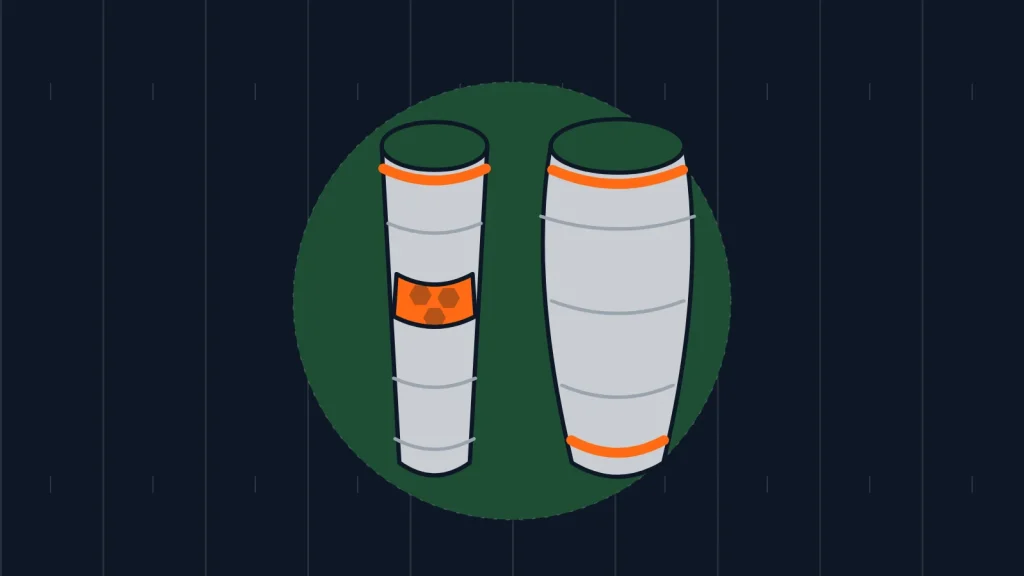
Three different garments go by the name "sleeve" on a football field: a plain tube of compression fabric, a padded sleeve that shields the elbow, and a leg sleeve worn over the calf. They do not do the same job, and only one of the three carries a protection standard. This guide sticks to what manufacturers publish on their own pages and to the wording of the uniform rules.
Contents · 8 parts
The 2-minute summary
- Three items, one word: the plain compression sleeve, the padded sleeve and the leg sleeve differ in function and in the rules that cover them.
- What the brands claim: Nike lists recovery, running economy and a lower injury risk; Under Armour talks about the "potential" to help recovery; McDavid writes that research supports compression sleeves without giving a reference.
- One standard only: the padded Barnett sleeves carry CE marking (NF EN 13277-1 and 13277-2); the McDavid HEX Shooter page cites no standard at all.
- The rulebook: the NCAA, IFAF, AFVD and FFFA texts set no colour rule for the arm, but require leg coverings that are identical in colour and design across the whole squad.
- Sizing: McDavid measures arm circumference above the bent elbow, Under Armour asks for bicep, forearm and wrist. No size chart carries over between brands.
Three garments that all get called a sleeve
The word covers three distinct products, and that is the first thing to sort out when shopping for football apparel. The first is a plain tube of stretch fabric. Nike describes it as a close-fitting, elastic band of fabric worn on the arms or legs to improve blood flow, made from nylon, elastane and polyester. It carries no foam and stops no impact. Battle's Speed Ventilated Full Arm Sleeve is this plain type for the arm, with ventilated mesh zones and moisture-wicking fabric but no foam.
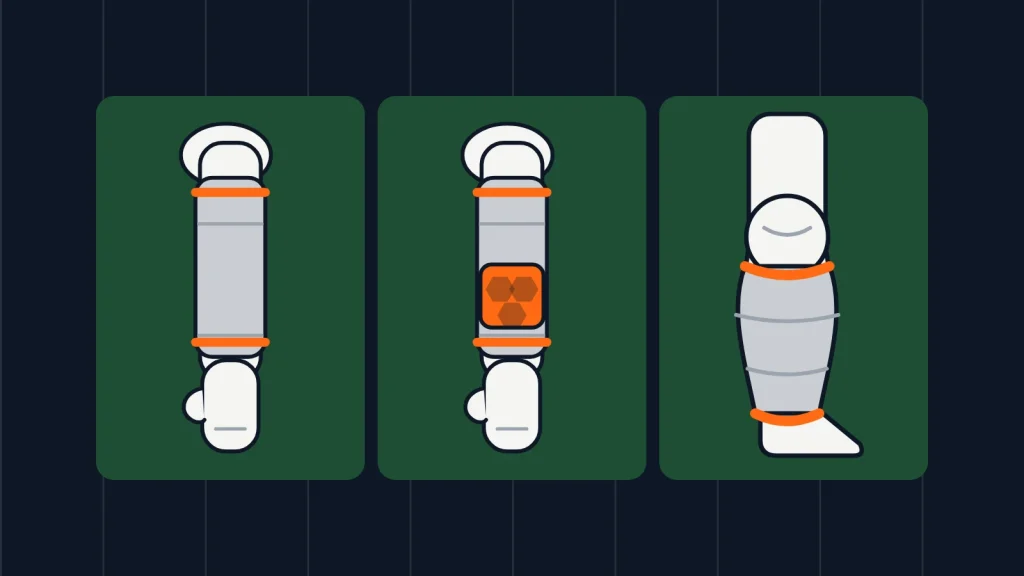
The second is a padded sleeve. It keeps the compression base and adds foam at the elbow or along the forearm, the two areas that meet the ground on every tackle. The McDavid HEX Shooter Arm Sleeve sets 9 mm of HEX foam at the elbow in a fabric of 80% nylon and 20% elastane. The Barnett FOREARM 2 goes further with two foam sections, one at the elbow and one on the forearm, while the Barnett ELBOW covers the elbow only. Battle draws the same line: the Elbow Padded Arm Sleeve pads the elbow only, while the Elbow & Forearm Padded Arm Sleeve extends the padding to the forearm. These models belong to football protection as much as to apparel.
The third is the leg sleeve, worn on the lower leg. McDavid explains that graduated models apply more pressure near the ankle to help blood travel back up. A padded equivalent exists too: knee and elbow pads such as the McDavid HEX Viz are sold as a single sleeve to be worn on the knee, the elbow or the shin. The plain leg version is sold too: Battle's Performance Leg Sleeve comes as a pair with built-in compression bands and no padding.
What manufacturers claim, and what they back up
The official pages do not say the same thing, and the gap is telling.
| Brand | What the page claims | Research cited on the page |
|---|---|---|
| Nike | Recovery, running economy, lower injury risk, prevention of swelling | Yes, links to published studies |
| Under Armour | The "potential" to help the body recover by increasing blood flow and stabilising the arm muscles | None |
| McDavid | Stimulated circulation, reduced vibration, less muscle fatigue | No reference given, plus a notice that the text does not replace medical advice |
In short, the promise shifts from brand to brand, and two of the three pages simply assert it. AFG has run no field testing and takes no position on effectiveness. What can be checked is narrower: a plain sleeve contains no foam, and it covers the skin, which is what Under Armour points to when it mentions protection against turf abrasion.
The padded sleeve is the only one with a standard
This is the clearest difference between the three. Both Barnett models come with a CE declaration of conformity: directive 89/686/EEC with NF EN 13277-1 and NF EN 13277-2 for the FOREARM 2, NF EN 13277-1 alone for the ELBOW. The McDavid HEX Shooter page cites no standard, on either the European or the American site.
| Model | Foam | Standard cited | Sizes | Price recorded |
|---|---|---|---|---|
| Barnett FOREARM 2 | Elbow and forearm, two sections | CE, NF EN 13277-1 and 13277-2 | S to 2XL | €19 |
| Barnett ELBOW | Elbow | CE, NF EN 13277-1 | S to 2XL | €19 |
| McDavid HEX Shooter | 9 mm HEX at the elbow | None | XS to L | €23.96 |
No standard does not mean the foam does nothing; it means nothing guarantees a level of absorption measured by an independent laboratory. For a lineman who hits the ground on every snap, that belongs on the shortlist alongside the stated thickness.
What the rulebook allows
This usually comes as a surprise: the uniform rules say nothing about arm sleeves. NCAA rule 1-4-4, mirrored by the IFAF, AFVD and FFFA texts, lists the helmet, knee pads, mouthpiece, pants and socks, but never mentions a covering for the arm. There is therefore no colour restriction on the arm, contrary to what is often repeated.
The leg is the opposite case. The same rule 1-4-4-h requires that "players of a team must wear socks or leg coverings that are identical in color and design", with only three exceptions: unaltered knee braces, tape or a bandage to protect an injury, and barefoot kickers. The official interpretation adds that tights are legal provided every player who wears them uses the same design and colour. One orange leg sleeve in a squad wearing black is not legal.
Three further rules shape the choice indirectly:
- 1-4-7-c: hard, abrasive or unyielding equipment that is not completely covered is illegal. The soft foams used in the models above are fine; a rigid shell strapped over the top is not.
- 1-4-7-h: no uniform attachments other than towels.
- 1-4-5-a-1: jersey sleeves must completely cover the shoulder pads. A sleeve does not replace a jersey sleeve; it goes underneath.
For padded lower-body gear, rule 1-4-4-d stays the strictest: knee pads must be covered by the pants, and no pads may be worn outside them. Our guides to knee and elbow pads and to the uniform rules go through the detail.
Getting the size right
A sleeve that is too large slides down; one that is too small rolls on itself. Each manufacturer publishes its own method, and none of them transfers to another brand.

McDavid asks for the arm circumference above the elbow with the arm bent at roughly 45°, and gives four sizes: XS from 23 to 25.5 cm, S from 25.5 to 28 cm, M from 28 to 30.5 cm, L from 30.5 to 33 cm. Under Armour asks for three measurements, the circumference of the bicep, the forearm and the upper wrist. For the FOREARM 2, Barnett publishes four dimensions per size: forearm opening, arm length, bicep opening and elbow pad height, from 10 cm and 44 cm in S to 12 cm and 48 cm in 2XL.
The logic holds for the leg: the McDavid HEX Viz is chosen on knee circumference, from 25.5 to 33 cm in XS up to 42 to 47 cm in XL, with a one-size youth version for which McDavid publishes no measurement.
One last point, from Nike: if a sleeve feels tight, the brand advises against going up a size. These garments are meant to sit directly on the skin, under the compression layer described in our guide to what to wear under your pads.
FAQ
Does a compression sleeve protect against impact?
No. Only padded models add foam, at the elbow or along the forearm. A plain sleeve is a compression garment that covers the skin, nothing more.
Do sleeves have to match across the squad?
On the arm, the NCAA, IFAF, AFVD and FFFA texts set no requirement. On the leg, rule 1-4-4-h requires socks and leg coverings identical in colour and design for the whole team.
Does a sleeve replace the jersey sleeve?
No. Rule 1-4-5-a-1 requires jersey sleeves to cover the shoulder pads completely; the sleeve is worn under the jersey.
Can you write plays on a sleeve?
The rules allow written play information carried on the wrist, the arm or the belt. That is the job of a play wristband, not of the sleeve itself.
Sources
- Nike, "Comment utiliser un manchon de compression": https://www.nike.com/fr/a/comment-utiliser-un-manchon-de-compression
- Under Armour, "What Is a Football Arm Sleeve and Why Wear One?": https://www.underarmour.com/en-us/t/playbooks/football/what-is-a-football-arm-sleeve-and-why-wear-one/
- McDavid Europe, "Do Calf Compression Sleeves Work?": https://mcdavid.eu/blogs/insights/do-calf-compression-sleeves-work
- McDavid, HEX Shooter Arm Sleeve: https://mcdavid.eu/products/hex-shooter-arm-protection-sleeve-single-6500
- Barnett, elbow and forearm protection FOREARM 2: https://www.barnett.fr/fr-fr/products/protection-for-elbows-and-forearms-aspx
- Barnett, CE declaration of conformity FOREARM 2: https://cdn.shopify.com/s/files/1/0104/0629/7636/files/EPI_FOREARM2.pdf?v=1729609190
- NCAA rule 1-4-4, mandatory equipment and leg coverings: https://www.sdcfoa.org/ncaa/rule-1-the-game-field-players-and-equipment-1/college-1-4-4
- NCAA rule 1-4-7, illegal equipment: https://www.sdcfoa.org/ncaa/rule-1-the-game-field-players-and-equipment-1/college-1-4-7
- NCAA rule 1-4-5, jersey sleeve requirements: https://www.sdcfoa.org/ncaa/rule-1-the-game-field-players-and-equipment-1/college-1-4-5
- IFAF, Football Rules and Interpretations 2025: https://amerikanskeidretter.no/wp-content/uploads/2025/02/IFAF-Football-Rules-and-Interpretations-med-norske-tilpasninger-2025.pdf
- FFFA, Règles du football américain 2022/2023: https://l2fa.fr/wp-content/uploads/2022/11/Regles-FA-2022-2023-20220725-correction2221109.pdf
- AFVD, American Football Regeln & Interpretationen 2025: https://afvd.de/wp-content/uploads/2025/08/AFVD_AMERICAN-FOOTBALL-REGELN_2025.pdf