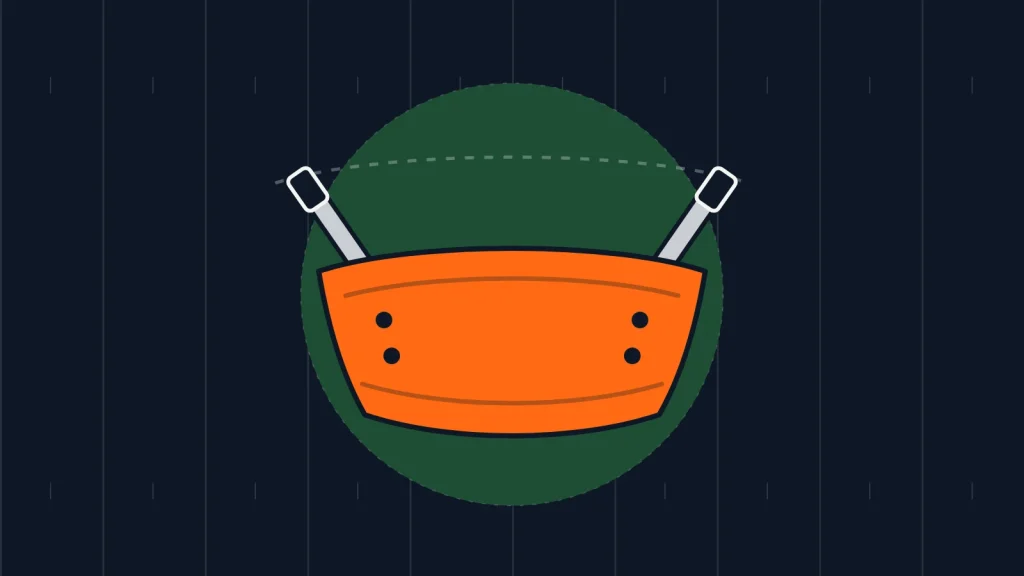
A backplate is the curved plate that hangs off the back of a set of shoulder pads. It appears on no list of compulsory equipment, yet nearly every brand sells one and some pads ship with it. Here is what the manufacturers say it covers, how it attaches, which size they recommend and what the rulebook demands.
Contents · 9 parts
The 2-minute summary
- What brands claim: Xenith advertises lower back protection "for athletes of all ages", Douglas extra lower back protection, Schutt increased back protection.
- Attachment: two adjustable straps or a coated belt running to the rear of the pads, with hardware supplied by Schutt and Battle.
- Adjustment: extra grommet holes let a player raise or lower the plate on his or her back.
- Size: Douglas recommends its 6-inch plate for players 6'2" (1.88 m) and taller; Battle quotes 29 × 17 cm for its adult plate and 24 × 15 cm for the youth one.
- Rules: the NFHS sets no maximum size, but the jersey must completely cover the shoulder pads and any hard attachment.
- Included or not: VICIS ships a plate with its ARC_V1 Varsity pads, while Xenith, Schutt, Douglas and Battle sell theirs separately.
What a backplate covers
Every manufacturer points to the same area. Xenith states that its plate "provides lower back protection for athletes of all ages". Douglas promises "extra lower back protection". Schutt, on both of its plates, describes "increased back protection". Battle sells a curved shell that spreads the energy of an impact and calls it more comfortable than a flat plate. None of the four names an organ, cites a safety standard or claims a reduction in injury risk: these are comfort and coverage accessories, not certified protective equipment.
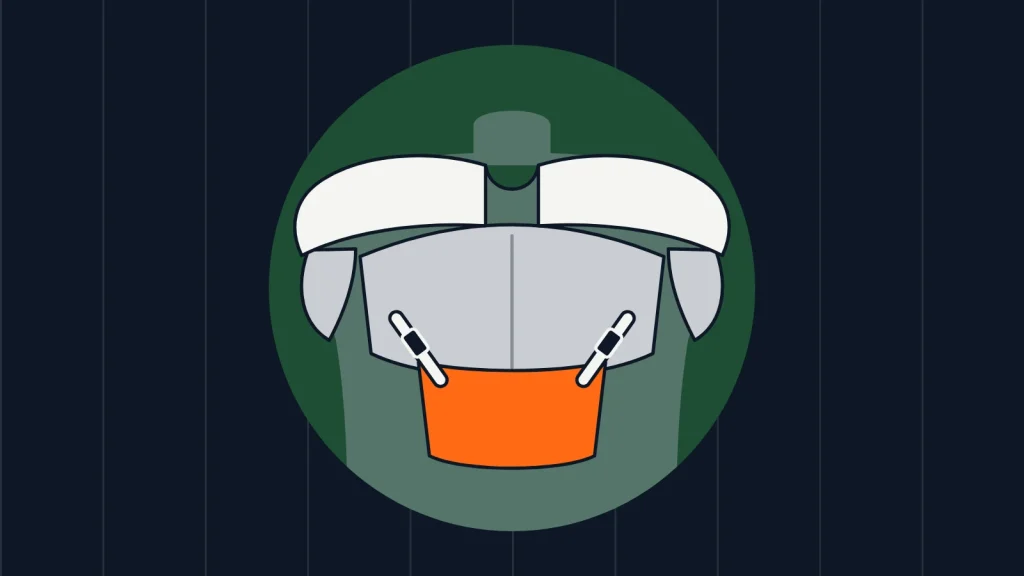
The plate therefore sits below the rear panel of the pads, where the shell stops. Our back plates collection lists the models sold in Europe. It replaces nothing else: the flank and the ribs are the job of a rib protector such as the Schutt XV Varsity Rib Protector, covered in our guide to rib protectors.
Supplied with the pads, or bought separately
The answer depends on the brand, and it changes the budget.
- VICIS lists a "VICIS backplate included" on both of its varsity cuts: the VICIS ARC_V1 Trench, built for linemen, and the Skill cut, built for QB, WR, DB and kickers. Its higher-tier range follows the same pattern: the VICIS ARC_V1 Elite All-Purpose and the VICIS ARC_V1 Elite Skill both include a removable Elite back plate.
- Schutt sells the plate on its own. Its XV Flux All-Purpose and XV Flux Skill pads do not include one; the brand lists an XV Varsity Back Plate and a Flex Youth Back Plate instead.
- Xenith does the same: the Velocity 2 on one side, the Xenith Velocity Back Plate on the other. In Europe, Bridge Sports showed it at €60.00 including VAT on 14 October 2026.
- Douglas also sells its plate on its own.
- Battle also sells its plate separately, the I'm Back Back Plate, in adult and youth cuts, plus a Defender Pro Football Back Plate advertised as fitting any shoulder pad brand, also in adult and youth sizes.
Barnett sell a plate of their own, the Barnett B-01: EVA foam and breathable mesh, 31 cm wide by 18 cm tall, 140.5 g, screwed to the back of the shoulder pads with the screws supplied, and described by the maker as compatible with all their own pads and with many models from other brands. Barnett also sell a related piece mounted at the front: the Barnett F-01 is a removable sternum pad in EV foam and breathable mesh that clips onto the shoulder caps to reinforce chest protection rather than the back. Barnett also sells a neck roll, the N-01, in EV50 foam and mesh, which straps onto the shoulder pads to protect the neck rather than the back or the chest.
If the pads themselves are still undecided, start with football shoulder pads and our shoulder pad sizing guide: the plate is chosen afterwards, around whatever is already on your back.
How it attaches, and at what height
Every plate mounts the same way: it hangs off the back of the pads on straps that run through the rear belts.

- Xenith: "durable and adjustable coated nylon straps".
- Schutt: a coated belt connection with multi-height adjustment, hardware included, designed to integrate with its own XV Varsity or Flex Youth pads.
- Douglas: "the extra grommet holes allow players to raise or lower the back plate".
- Battle: strong attachment straps, a universal fit and hardware in the box.
Height is not a detail. Set too high, the plate fouls the shell of the pads; set too low, it flaps over the lower back and escapes from under the jersey, which the rulebook does not allow (see below).
Cross-brand fitment is worth checking before you pay. Xenith says its plate "attaches to all Xenith shoulder pads and most other brands". Douglas is stricter: its plates are made "for use on Adult CP and SP series pads" and "modifications may be needed if attached to a different series shoulder pad". Schutt sells its plate as the companion to its own models.
Which size: 4 inch, 6 inch, adult or youth
Sizing follows no common standard; each brand has its own.
| Plate | What the manufacturer states | Who for |
|---|---|---|
| Douglas Removable Back Plate 4 inch | For Adult CP and SP series pads | No player size given |
| Douglas Removable Back Plate 6 inch | For CP and SP series pads | "Recommended for player 6'2" and taller" |
| Battle I'm Back, adult | 11.5 in wide by 6.5 in tall (29 × 17 cm) | From 5'4" (1.63 m) and roughly 100 lb (45 kg) |
| Battle I'm Back, youth | 9.5 in wide by 5.75 in tall (24 × 15 cm) | Younger players |
| Xenith Velocity Back Plate | Small (Youth) and Large (Varsity) | Athletes of all ages |
Two rules of thumb come out of those pages. First, plate height tracks player height: Douglas only recommends its 6-inch version for frames of 6'2" and above, and Battle sets a 5'4" floor for its adult plate. Second, an adult plate on a young player hangs too low, which is exactly why Xenith and Battle split their ranges into youth and varsity. Xenith does not publish the dimensions of its plate; the retailer Bridge Sports quotes 28 × 15 cm in Small and 33 × 17 cm in Large, figures the manufacturer does not confirm.
The rule that matters: the jersey must cover it
The NFHS rulebook, which governs American high-school football, sets no maximum size for a back plate. It demands something else, and that is the real constraint: rule 1-5-1 requires a jersey that "must completely cover the shoulder pads and all pads worn above the waist on the torso", and lists "shoulder pads and hard surface auxiliary attachments, which shall be fully covered by a jersey". Rule 1-5-3 adds that "equipment not worn as intended by the manufacturer" is illegal.
In practice, a plate too large or set too low to stay under the jersey is an officiating problem rather than a kit problem. Buy football jerseys long enough for the job and set the height of the plate accordingly. That text applies to American high schools; in Europe, your own federation's rulebook is the one to read.
Does your position need one?
No manufacturer restricts the part to a position. Xenith and Battle talk about athletes "of all ages", Battle advertises a universal fit, and VICIS ships the same plate with its Trench cut, built for the offensive and defensive lines, and with its Skill cut, built for quarterbacks, receivers, defensive backs and kickers. The call is yours. For the rest of the kit, our guide to mandatory football equipment sets out what you actually have to wear.
FAQ
Is a backplate compulsory?
No. The NFHS list of required protective equipment covers hip pads and a tailbone protector, knee pads, shoulder pads and thigh guards. A back plate is not on it.
Can one brand's plate go on another brand's pads?
It depends on the model. Xenith claims fitment with "all Xenith shoulder pads and most other brands" and Battle advertises a universal fit. Douglas, by contrast, builds its plates for its CP and SP series and warns that modifications may be needed elsewhere.
Which size for a young player?
Youth versions exist at Xenith (Small) and Battle (24 × 15 cm), and Schutt offers a Flex Youth Back Plate matched to its youth pads. The Douglas adult plates are listed for adult pads.
What does a backplate cost in Europe?
On 14 October 2026, Bridge Sports listed the Xenith Velocity Back Plate at €60.00 including VAT, in Small and Large. Prices published by the American manufacturers do not apply to the European market.
Sources
- Xenith, Velocity Back Plate
- Schutt, XV Varsity Back Plate
- Schutt, Flex Youth Back Plate
- Douglas, Removable Back Plate 4 inch
- Douglas, Removable Back Plate 6 inch
- Battle, I'm Back Back Plate
- VICIS, ARC_V1 Varsity Shoulder Pads Trench
- VICIS, ARC_V1 Varsity Shoulder Pads Skill
- NFHS, 2025 Football Jersey and Pant Rules
- Bridge Sports, Xenith Back Plate