A visor changes two things: what you see, and what the official sees. The first is comfort, the second is the rulebook, and the two pull in opposite directions. Here is what the texts allow, federation by federation, and how a visor actually attaches to a helmet.
Contents · 8 parts
The 2-minute summary
- Clear, always: under the IFAF and BAFA rulebooks a visor must be clear, not tinted, and made from moulded or rigid material.
- Mirrored eyewear is named and banned, and "clear" is defined by the result, not by a tint percentage.
- No medical exceptions under IFAF or BAFA; France allows one, but only with a federal derogation.
- Germany is the outlier: since 24 June 2022 the AFVD has allowed tinted, coloured and mirrored visors in all of its leagues.
- Two fitting families: universal clip-on visors that clip on and off without tools, and helmet-specific shields fitted by temporarily removing part of the facemask.
 Play the video: Are Tinted Football Visors Legal? Why Germany Says Yes
What the rulebook actually says
A visor is not mandatory equipment. It sits in the "Optional equipment" article of Rule 1, next to gloves and towels. The IFAF 2026 text, reproduced word for word in the BAFA rulebook used in British competition, reads:
Eye shields must be clear, not tinted, and made from moulded or rigid material. Eyeglasses and goggles also must be clear and not tinted. No medical exceptions are allowed. Eyewear is not clear if it obscures a player's eyes at any time from any angle or in any light condition. "Mirrored" eyewear is expressly prohibited.
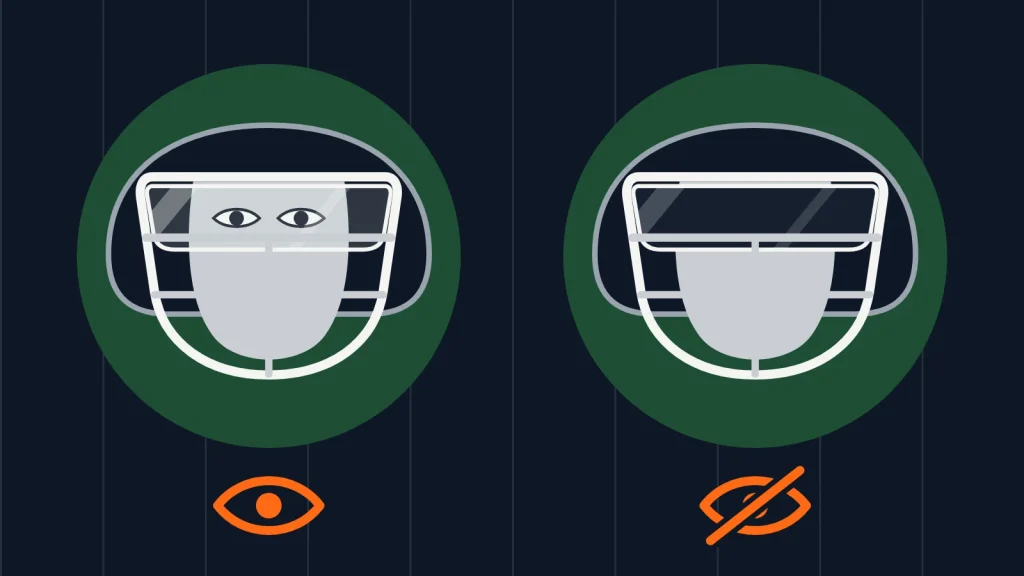
Two details in that paragraph matter more than the headline ban. The first is the definition: eyewear is not clear if it obscures the eyes at any time, from any angle, in any light condition. There is no "lightly tinted" category in the rulebook, because the test is the result, not the percentage printed on the box. A shield sold as a light smoke can still be turned down when the sun is low behind the player.
The second is the flat refusal of exceptions. Both IFAF and BAFA state plainly that no medical exceptions are allowed, which is stricter than what many players assume from watching American television.
The sanction is spelled out in the IFAF approved rulings: equipment violation, off the field for at least one down, and no return while the shield is still on.
France, the UK and Germany give three different answers
This is the part retailers never mention: a visor that is perfectly legal in Berlin is not legal in London or Paris.
| Federation | Tinted or mirrored visor | Medical exception |
|---|---|---|
| IFAF (international play) | Banned | None |
| BAFA (United Kingdom) | Banned | None |
| FFFA (France) | Banned | Possible, with a federal derogation |
| AFVD (Germany) | Allowed | Not applicable |
The German case is worth the detail. On 24 June 2022 the AFVD rules commission, after consulting its own medical department, replaced the old wording with this: visors must be made of a continuous, stable material, and may be clear, tinted, mirrored or coloured. The sentence banning tints and refusing medical exceptions was deleted outright. In exchange, wearing a visor is explicitly at the player's own risk, and it is the club officer who certifies that the players are properly equipped by signing the game report. The rule covers every AFVD league, licence leagues included.
The NFL, by contrast, holds the strict line. A player who suffers from migraines or is sensitive to sunlight needs a medical exemption before a tinted shield can replace the permitted clear one. The stated reason is medical rather than cosmetic: medical staff sometimes need to see an injured player's eyes without removing the helmet, and a tint prevents that.
So the only useful question before you buy is: which competition will you actually play in?
The helmet has to be legal first
Before the tint, the helmet itself has to comply: the rule asks for an authorised facemask and a four or six point chin strap, with every attachment point fastened while the ball is in play.
That has two practical consequences. First, a visor clips to the bars of the facemask, so the facemask decides whether the fitting is possible at all; our guide to choosing a facemask explains how to read a reference. Second, adding a shield does not excuse a loose chin strap: see our method for fitting a chin strap. The rulebook also requires every player on a team to wear helmets and facemasks of the same type and colour, a uniformity constraint that does not extend to visors.
Universal clips or a helmet-specific shield
The visors in our catalogue split into two families.

Universal clip-on visors fit a wide range of helmets. The Barnett premium A visor, in its flat clear version, is listed as fitting most youth and adult helmets thanks to a two-clip system that goes on and comes off without tools. The trade-off is fixed dimensions, 245.5 x 122 x 2.6 mm, so the manufacturer does not guarantee every model. Measure the opening of your facemask before ordering.
Helmet-specific shields are drawn around one shell. The Battle Eclipse is engineered specifically for the Riddell SpeedFlex platform, and its pronounced wrap-around curvature is why Battle Sports will not guarantee the fit elsewhere. Schutt follows the same logic with two parts of very different scope: the F7 Switch Shield fits only the F7 Pro and the F7 AiR Varsity, where it locks straight onto the helmet without extra clips, while the F7 Exclusive Shield is listed as fitting every Schutt helmet and ships fitted on the F7 AiR Youth Elite. VICIS follows the same logic with the Oakley Edge Visor, built exclusively for all four VICIS ZERO2 variants (standard, TRENCH, Youth and QB) and supplied with its own mounting clips.
| Model | Stated compatibility | Finishes | Price seen in Europe |
|---|---|---|---|
| Barnett premium A 522046 | Most youth and adult helmets | Flat clear | 29 € at Barnett (06/10/2026) |
| Battle Eclipse | Riddell SpeedFlex | 6, including Smoke and three Prism | No European offer found (06/10/2026) |
| Schutt F7 Exclusive Shield | Every Schutt helmet | 6, including 3 PRIZM, plus 3 clip colours | 82.99 € clear, 98.99 € PRIZM (02/10/2026) |
| Schutt F7 Switch Shield | Schutt F7 Pro and F7 AiR Varsity | 6, including 3 PRIZM | 98.99 € clear, 139.99 € PRIZM (02/10/2026) |
| Oakley Edge Visor | VICIS ZERO2 (4 variants) | Clear, Prizm Clear, Prizm Gridiron, Gray | €115.99 at EP Sports Europe (03/11/2026) |
The ranges explain the confusion. Of the six finishes Schutt lists, one is clear and a second carries the PRIZM Clear optic; the other four, 45% grey, 60% grey, Sapphire and Gold 24K, will not pass under IFAF or BAFA rules. Battle is the same story, with Smoke, Silver and three Prism finishes alongside a single Clear. Ordering the clear version is not settling for less: in European play outside Germany it is the only version you can wear.
Fogging, UV and scratches
With the tint fixed, the differences move elsewhere. Both universal visors claim the same three treatments: anti-fog, anti-scratch and a UV filter. Barnett states that the polycarbonate of its premium A blocks 100% of UVA, UVB and UVC rays; Battle lists HD Vision optics, an anti-fog treatment, UV protection and a scratch-resistant coating on the Eclipse. Schutt publishes neither the material nor the weight of its two shields; European retailer EP Sports describes the F7 Exclusive as using a Plutonite lens, Oakley's proprietary material.
None of the five carries a NOCSAE certification, because that standard covers the helmet and the facemask, not the eye shield. The point worth remembering is that a scratched visor scatters light into a haze when the sun is low, which is precisely what the definition of "clear" rules out. The protective microbag supplied with the Eclipse is not decoration.
For everything else in the build, start from the football helmets themselves: the shell you wear decides which visor you can fit, never the other way round.
FAQ
Are tinted visors legal in the UK?
No. The BAFA rulebook reproduces the IFAF wording: eye shields must be clear and not tinted, and no medical exceptions are allowed.
Where in Europe are they allowed?
In Germany. Since 24 June 2022 the AFVD has permitted clear, tinted, coloured and mirrored visors across all of its leagues, with the player carrying the risk and the club officer signing for the equipment.
What happens if an official spots a tinted visor during a game?
It is an equipment violation. The player must leave the game for at least one down and may not return while still wearing that shield.
Will a universal visor fit any helmet?
No. The Barnett premium A is listed as fitting most youth and adult helmets, but its dimensions are fixed and the manufacturer does not guarantee every model. The Battle and Schutt shields are tied to one helmet or one brand.
Sources
- IFAF, Football Rules and Interpretations 2026, Rule 1 Article 6 c and A.R. 1-4-8:II: http://myiafoa.org/rules/ifaf2026/1.html
- BAFA rulebook 2026, Rule 1 Article 6 c: https://rules.bafra.info/rulebook/bafa2026/1.html
- FFFA, Règles du jeu à 11, Rule 1 Articles 3, 4 and 6: https://www.fffa.org/publications-officielles/
- AFSVD (AFVD officiating body), Bulletin 2022/1 on visors: https://afsvd.de/news/visiere/
- NFL Football Operations, Uniform Inspections: https://operations.nfl.com/game-operations-logistics/preparation-safety/uniform-inspections/
- Barnett, premium A 522046 visor: https://www.barnett.fr/products/visiere-premium-a-522046-plate-transparente
- Battle Sports, Eclipse Helmet Visor: https://battlesports.com/products/eclipse-helmet-visor
- Schutt, F7 Exclusive Visor by Oakley: https://schuttsports.com/products/f7-exclusive-visor-by-oakley
- EP Sports, helmet visors: https://www.epsports.eu/helmets/helmet-accessories/helmet-visors.html