Eleven players a side, three units, and a couple of dozen job titles that television commentary throws around without ever defining them. This article works through the lot, using the IFAF rule book that governs international competition and the glossary published by NFL Football Operations.
Contents · 9 parts
The 2-minute summary
- The frame: under the rule book, a game is played between two teams of no more than eleven players.
- Position at the snap: where a player stands, not the label on the depth chart, decides what they may legally do.
- At the snap: the offence has at least five players wearing numbers 50 to 79 on its scrimmage line and no more than four in the backfield.
- Forward pass: only the players at either end of the line, plus the backs, may catch one, and only if they are not wearing 50 to 79.
- Position families: the offensive line blocks, the quarterback distributes, receivers and running backs carry the ball; opposite them, the defensive line, the linebackers and the secondary answer position by position.
- Equipment: IFAF imposes the same kit list on everyone but sets no specification at all for shoulder pads, the gap manufacturers use to split their ranges by position.
 Play the video: American Football Positions Explained: Every Role on the Field
Eleven players, three units
IFAF rule 1-1-1 is blunt: "the game shall be played between two teams of not more than 11 players each". Because substitution between plays is free, squads are organised into three units: the offence, which has the ball and is trying to score; the defence, which is trying to stop it; and special teams, which come on for the kicking plays.
Mandatory kit does not depend on position: IFAF rule 1-4-3 requires every player to wear a helmet, hip pads, a jersey, knee pads, a mouthpiece, pants, shoulder pads, socks and thigh guards, with the helmet carrying a NOCSAE certification (rule 1-4-4-a). By contrast, the rule book states that "there are no specifications for shoulder pads", and that is the space brands fill with position-specific cuts. See the football shoulder pads, football helmets, football protection and football apparel.
Linemen and backs: the rule that shapes the offence
Before positions, the rule book recognises only two kinds of offensive player, defined in rule 2-27-4:
- a lineman is a player legally on their scrimmage line, facing the opponents' goal line with the line of their shoulders roughly parallel to it, whose head breaks the plane drawn through the snapper's waistline;
- a back is any player who is not a lineman, plus whoever is in position to take a hand-to-hand snap.
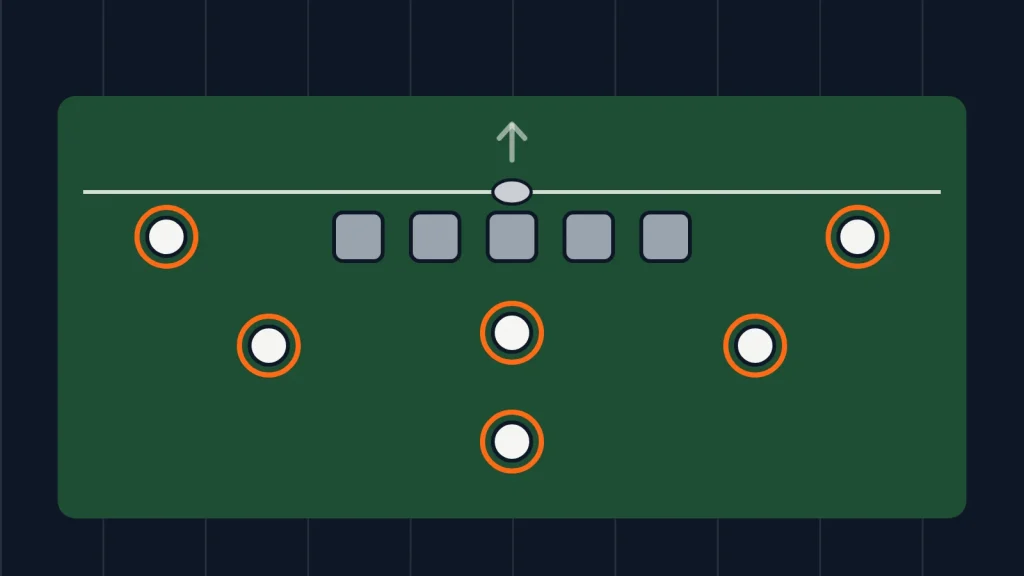
Rule 7-1-4 adds the formation requirements at the snap: everyone inbounds, at least five linemen wearing numbers 50 to 79, and no more than four backs. Rule 7-3-3 then names who may touch a legal forward pass: each lineman on the end of the line wearing a number other than 50 to 79, and each back wearing a number other than 50 to 79. Every defender is eligible.
The five big bodies in the middle therefore cannot catch; the players on the ends and in the backfield can.
Offensive positions
Quarterback
The NFL describes the quarterback as the leader of an offence: they huddle their team-mates, call the play, take the snap from the centre, then run with the ball, hand it to a running back or throw a forward pass.
Running back and fullback
The running back, also called a halfback or a tailback, is typically the primary ball carrier. The fullback is usually the heavier of the two players lined up behind the quarterback and often works as an extra blocker.
Wide receiver
The wide receiver is defined by speed and catching ability. They line up close to the sidelines on either side of the offensive line, run downfield and take passes from the quarterback.
Tight end
The tight end lines up at the end of the offensive line, outside the tackle: an extra blocker on running plays, a receiver on passing plays. The H-back, or slot back, does a similar job.
Offensive line
The offensive line is five players. The centre sits in the middle and snaps the ball between their legs to the quarterback to start every play. The two guards line up either side of the centre and block oncoming pass rushers. The two tackles close the formation, outside the guards. The area between those two tackles has its own name in the rule book: the tackle box.
Defensive positions
Defensive line
Defensive ends line up at each outside end of the line and try to force their way into the offensive backfield. Defensive tackles usually line up opposite the guards and push into the offensive line to disrupt or stop the play; the one who lines up opposite the centre is the nose tackle, or nose guard. See the defensive line page.
Linebackers
Linebackers line up three to five yards behind the defensive linemen. They support the line against the run and share pass coverage.
The secondary
Cornerbacks line up in the defensive backfield across from the wide receivers, and a standard defensive formation has two of them. Safeties line up about 10 to 15 yards from the line of scrimmage and defend against the pass. Together they are the secondary, or the defensive backs.
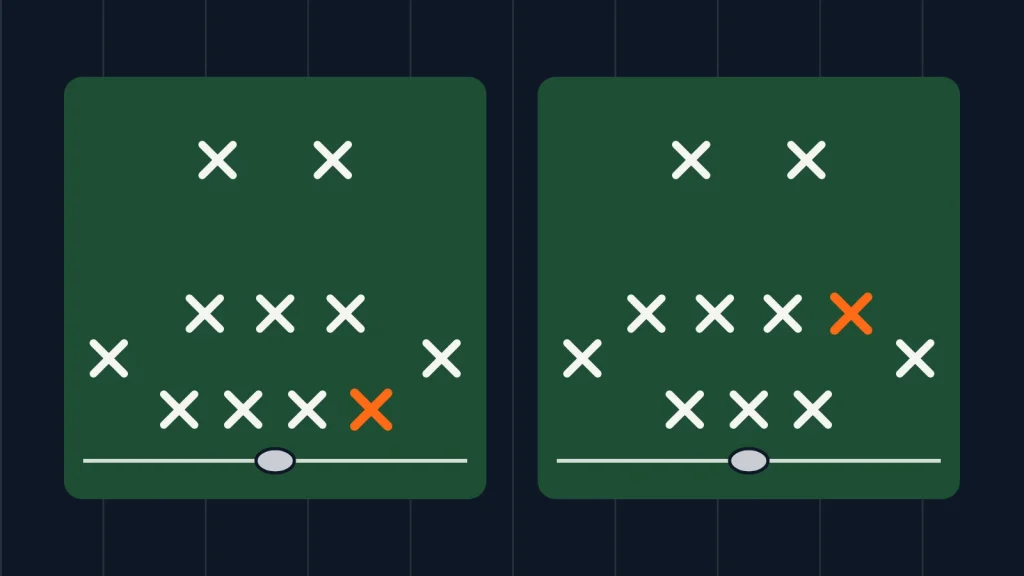
How many players sit in each layer changes with the situation. The NFL describes the 4-3 defence (four linemen, three linebackers), the 3-4 defence (three linemen, four linebackers) and the nickel package, where a fifth defensive back replaces a linebacker or a defensive lineman when a pass is expected.
Special teams
The kicker, or placekicker, comes on for field goals, extra points and kickoffs. The punter comes on at fourth down to kick the ball away to the other team. Around them, the long snapper is the special teams version of a centre, the holder catches and sets the ball for placekicks, and the returner, fast and elusive, fields punts and kickoffs.
What manufacturers build for each position
With no specification to work to, brands split their ranges by cut instead. Taken from the manufacturers' own product pages on 29/09/2026:
| Positions named by the brand | Shoulder pad cut | Gloves |
|---|---|---|
| Quarterback, wide receiver, defensive back | Skill cut, "designed for skill positions (QB, WR, DB)" per Schutt: Schutt XV Flux Skill | Receiver gloves with a tacky palm: Cutters Rev Pro 7.0 |
| Offensive line, defensive line, tight end | Trench cut, "designed for OL, DL, DE, TE, and those on the line" per VICIS: VICIS ARC V1 Trench | Lineman gloves padded across the back of the hand: Cutters Force 6.0 |
| No position named | All-Purpose cut, "designed for a wide range of positions" per Schutt: Schutt XV Flux All-Purpose | All-purpose gloves |
The matching collections: football gloves, receiver gloves and lineman gloves, or the wide receiver gloves selection filtered by position; our glove buying guide breaks down the criteria by position.
Football cleats follow the same logic. In its cleat guide, Nike points linemen towards a high-cut shoe that holds the ankle with a hook-and-loop strap, and names the Nike Force Savage Pro 2; for receivers it recommends a low cut that lets the foot flex naturally. Browse the molded cleats and our cleat buying guide.
FAQ
How many positions are there in American football?
The rule book sets no number. In offence it recognises only linemen and backs (IFAF rule 2-27-4). The familiar labels, quarterback, running back, wide receiver, tight end, linemen, linebackers, defensive backs, kicker, punter, come from custom and from league glossaries.
Why do linemen wear numbers 50 to 79?
Because IFAF rule 7-1-4 requires at least five players numbered 50 to 79 on the offensive line at the snap, and rule 7-3-3 makes those numbers ineligible to catch a forward pass. The number is an instant cue for the officials.
Can a player change position during a game?
Yes. Substitution between plays is free, and nothing stops a player lining up somewhere else, as long as the formation is legal at the snap: at least five linemen numbered 50 to 79 and no more than four backs.
Does equipment really differ by position?
The mandatory list is identical for everyone (IFAF rule 1-4-3). The differentiation comes from manufacturers, helped by the absence of any shoulder pad specification: Skill cuts for the quick positions, Trench cuts for the line, tacky gloves for receivers, padded gloves for linemen.
Sources
- IFAF, Football Rules and Interpretations 2023: https://americanfootball.sport/wp-content/uploads/2023/05/ifafrules.pdf
- NFL Football Operations, Football Terms: https://operations.nfl.com/rules-officiating/nfl-football-basics/football-terms
- NFL Football Operations, Formations: https://operations.nfl.com/rules-officiating/nfl-football-basics/formations
- Schutt, XV Skill Shoulder Pads: https://schuttsports.com/products/xv-skill-shoulder-pads-flux
- Schutt, XV All-Purpose Shoulder Pads: https://schuttsports.com/products/xv-all-purpose-shoulder-pads-flux
- VICIS, ARC_V1 Varsity Shoulder Pads Trench: https://vicis.com/products/arc_v1-varsity-shoulder-pads-trench
- Cutters, Force 6.0 Lineman Gloves: https://cutterssports.com/products/force-6-lineman-gloves-black
- Nike, cleat guide (in French): https://www.nike.com/fr/a/meilleures-chaussures-de-football-americain-a-crampons